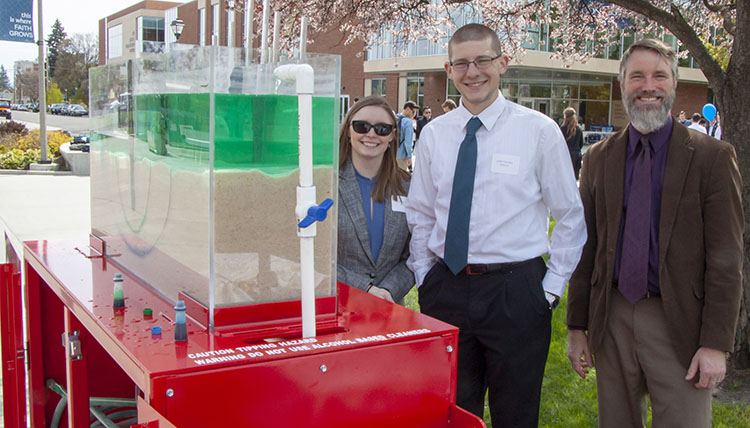
Gonzaga geotechnical engineering students and their faculty advisor, Dr. Mark Muszynski, display their model of water seepage under a dam at a Senior Design Expo.
Geotechnical Engineering often begins near the “starting point” of many types of civil engineering projects. Everything that is constructed on the Earth (and beyond) must somehow be connected to the ground securely. Different types of ground exist. Some types are competent, dense, and strong. Others are soft, compressible, and unstable. The challenge of the civil/geotechnical engineer is to determine how the ground will react to the new loadings of a given structure, how much soil/rock movement can be anticipated, and how to construct the facility; all while considering the safety, health, and welfare of the public not only after construction, but also during the critical times during construction for the contractors and other involved.
Geotechnical engineering relates to nearly all other types of civil engineering (where the ground is involved). With that, we may find ourselves working on pipelines, culverts, water and transmission towers, buildings, tunnels, factories, power plants, roads, bridges, dams, wastewater treatment plants, and other facilities.
Some of the typical duties of a civil/geotechnical engineer include:
planning/coordinating site exploration and drilling activities
classifying soils and rock, estimating Earth material properties and behavior
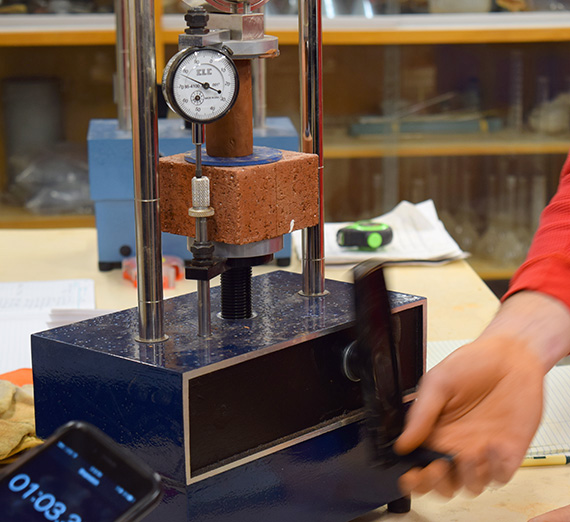
overseeing laboratory testing of the soil and rock
performing design/analysis related to the behavior of the anticipated ground conditions
value engineering
communicating the results of the analysis effectively with your client
performing testing and observation services during construction of the facilities, and
investigating issues related to the performance of existing facilities.
Civil/geotechnical engineers also have a skillset that is well-suited to entrance in the construction industry. It is here where the civil/geotechnical engineering may become involved in tasks such as coordinating field crews, planning approaches concerning the construction equipment to be used, scheduling, cost estimating, and project management.
In a non-construction sector, civil/geotechnical engineers may generally work in either the public and private sectors. In the public sector, civil/geotechnical engineers find themselves working with city municipalities, county road commissions, state department of transportation (DOTs), and federal agencies (DNR, Army Corps of Engineers, etc.). In the private sector, civil/geotechnical engineers may choose to work with a number of variable sized firms, including both “specialty” geotech firms or multi-disciplinary civil engineering companies.
What You'll Study in Geotechnical Engineering
The subdiscipline requires knowledge of geology, foundations, and infrastructure design. Some of these subjects are in the standard civil engineering coursework. Others are specific technical electives for your senior year. The Civil Engineering major section of the Catalog marks these technical electives with a "G."
Mark Muszynski has eight years of full-time experience in civil and geotechnical engineering, and has been involved in engineering consulting for an additional decade since. He has worked on projects and sites for all types of clients including industrial,...
Soil Mechanics Lab
Students study the properties and behavior of soils (sand, gravel, silt and clay) under various environmental conditions. The study includes weight-volume relations, soil classifications, soil compaction, seepage through porous media, consolidation, shear strength, lateral pressures and slope stability. Laboratory and field methods for evaluation of pertinent properties that are used in analysis and design of structures and foundations are discussed.