
About
Gonzaga’s Jesuit, Catholic, Humanistic education will challenge and inspire you.
Your college years are a powerful chapter in your story, a time to rise above challenges, embrace change, and build resilience that lasts a lifetime. Whether it's overcoming obstacles, setting new goals, or identifying areas for self-improvement, we all have opportunities to grow.
Resilience is defined by the American Psychological Association as the process and outcome of successfully adapting to difficult or challenging life experiences. In other words, being resilient means that you are able to bounce back when something goes wrong. Resilience, despite what many think, is a learned skill.
A person’s perspective and mindset can be one of their greatest supporters or biggest obstacles when it comes to overcoming challenges. Stanford psychologist Carol Dweck's research and work posits that there are two different mindsets: fixed and growth.
A fixed mindset is the belief that your abilities, knowledge, and skills are static and cannot be changed. This perception can often lead us to standing in the way of our own success. Those with a fixed mindset may avoid challenges, give up quickly when faced with obstacles, and dismiss constructive criticism. Believing that we are born with a set level of ability, those with a fixed mindset may not see the point in practicing a skill as it will not help them improve.
Common thoughts with a fixed mindset can include:
A growth mindset, on the other hand, is the belief that abilities, knowledge, and skills can be developed. People with growth mindsets embrace challenges and view setbacks not as failures, but as an opportunity to learn and improve. This perspective supports the idea that our abilities and skills are like muscles that will strengthen with hard work and practice. Studies by Dweck have shown that having a growth mindset improves motivation, learning, and academic performance.
Someone with a growth mindset might have thoughts such as:
(Source: Mindset Health, 2025; The Decision Lab, 2021; Growth Method)
Everyone's path and journey to developing a growth mindset will be a little different. However, there are a few practices you can implement into your daily routine to help support a growth mindset.
(Source: Purdue Global, 2025; & University of St. Andrews, 2024)
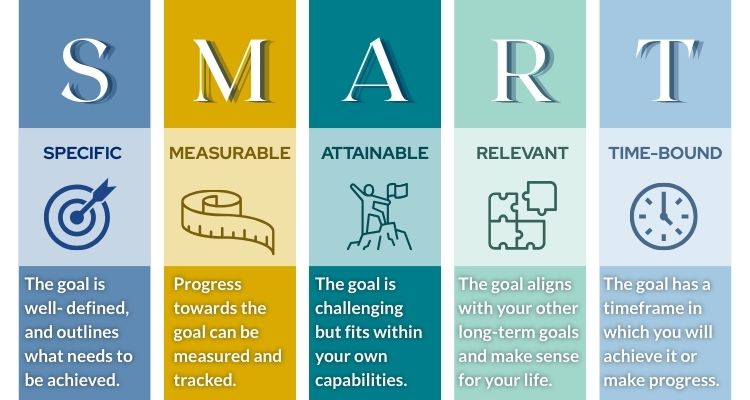
Goal setting is an important aspect of personal growth and is a skill that can be utilized in personal, professional, and academic settings. Goals that relate to academics may include meeting assignment deadlines or changing study habits, while goals related to health and wellbeing may include creating a health behavior change. No matter what your goal is, you are more likely to achieve your goal if it is a SMART goal.
SMART goals are:
Center for Cura Personalis: Non-clinical case managers at the Center for Cura Personalis promote holistic wellbeing for students, connecting them to resources that they may not know of. This is a great place to start for anyone who needs some support with their mental health, classes, relationships, or most any concern that you might have.
To set up an appointment with a case manager email ccp@gonzaga.edu or call 509-313-2227. Walk-ins are also welcome.
Learning Strategies: With a dedicated team that offers one-on-one academic coaching, peer mentoring, and interactive workshops, Learning Strategies can support your personal growth by helping with time management, organization, study habits, and test preparation.
Learning Strategies is located in Foley Library 203. You can make an Academic Coaching appointment, or walk-ins are welcome.
Rudolph Fitness Center: The Rudolph Fitness Center (RFC) offers a variety of programs that are fun, social, and contribute to the development of the whole person. All undergraduate students receive a membership and have access to the secure facility throughout the academic year using their student ID.
Center for Community Engagement: The Center for Community Engagement coordinates community and public service programs, including community-engagement learning courses, community-based volunteer and outreach programs, and external volunteer projects. They offer a variety of opportunities to support causes that matter to you, develop valuable leadership skills, and carry out Gonzaga’s Jesuit mission of working in and with communities.
7 Tips for Building Resilience When You’re Not a Kid Anymore: Often articles around resilience are for parents helping their children build resilience. However, resilience can be built at any age by reframing your mindset, finding ways to cope with change, and managing stress.
Carol Dweck-The power of believing that you can improve:Carol Dweck researches “growth mindset” — the idea that we can grow our brain's capacity to learn and to solve problems. In this talk, she describes two ways to think about a problem that’s slightly too hard for you to solve. Are you not smart enough to solve it … or have you just not solved it yet?
The Benefits of Failure: Not many people would consider failure a positive outcome. However, it can actually be an important step in our personal growth and improvement. Author Nigel Barber shares that everyone can learn from failure, improving their resilience to the setbacks they will inevitably encounter in life.
Getting Stuck in the Negatives: This talk is all about understanding how people think, and how they can think better. Learn how certain ways of thinking about an issue tend to stick in people's heads.
Reflection Toolkit: Reflection is a key skill for success. Developing it helps you get the most from your experiences – whether for coursework, personal growth, or professional development. Here you will find resources, models, and questions to help you get started, build confidence in reflecting effectively, and turn insights into meaningful action.