In 1912, Gonzaga University decided to establish a law school. But the University’s plans for its new law school included two audacious goals: To produce excellent attorneys and to contribute to the development of the region’s legal institutions.
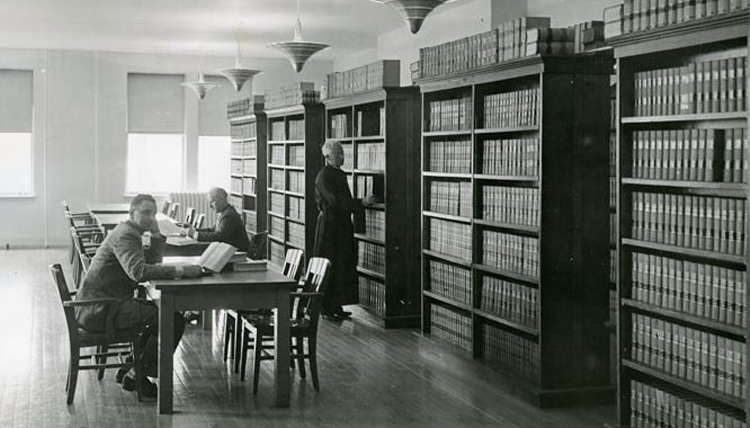
The law library grew steadily through its infancy, making good on the promises in the Law School’s 1913-14 catalog which stated that students would “have the use of a well-equipped working library separate from the other libraries of the University.” In January 1913 the library acquired Washington Statutes and Reports and the American Encyclopedia of Law. The 300-volume library, serving the first law class of 19 students, was then given its own room.
As the Law School grew, so did the law library, through the shrewd collection development and acquisition policies that still govern today. In 1937, University President Father Leo Robinson, S.J., raised $500 and bought duplicate volumes from the county law library for 10 cents apiece. But the library’s growth hiccupped on December 10, 1941. Just three days after the attack on Pearl Harbor, a fire, apparently started by smoldering cigarette butts in a garbage can burned the library’s annex. It took $6,119.06 and nearly a full year to repair the damage.
In the fall of 1948, Miss Emily Ehlinger was appointed the law library’s first full-time law librarian. The library continued to grow and it received many significant donations, such as the 6,000-volume legal library of State Supreme Court Justice W.H. Abel Montesano in 1953. This addition increased the library’s collection to 56,270 volumes. By 1962, the library claimed to be the “only law library in the country that never closes its doors.” Although the library was open 24 hours, the stacks were not open to students, making both students and the American Bar Association unhappy. Both the Law School and its library had outgrown its rooms on the third floor of the Administration Building.