
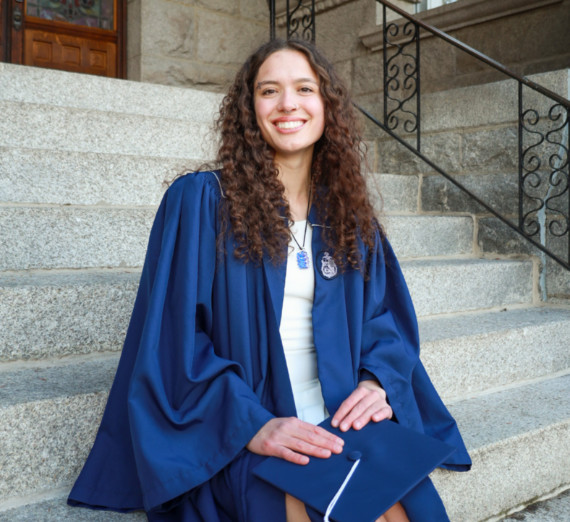
Before graduation, Dr. Joe Johnston sat down with Juliana Maucione, Sociology Major, and Outstanding Sociology Senior Award Recipient, to look back at her Gonzaga journey, and look forward to what is next as she moves into the world.
Dr. Joe Johnston: What led you to become a sociology major in the 1st place?
Juliana Maucione: When I was in high school, I was in a time when I was getting increasingly more online and also more exposed to a lot of the political world around me. COVID was a big part of that and also just these mass social movements that were really growing like Black Lives Matter and climate justice, and I was starting to tune in more to what was going on in the social world around me. During this time, I was also in environments and watching some media that was that had more of a like reactionary or surface level kind of framing of these issues and I felt myself like struggling to really make sense of them. I wanted to engage with these social issues more deeply and critically and so I looked to look to other sources of information. I started watching all these video essays online and I came across this one YouTube channel of someone who was a formerly a sociology major. They did these lecture style videos on current events and pop culture and even theory. And their channel talked about sociological concepts, and it started to introduce things like systemic racism and how to engage with like white supremacist talking points. And I just my world opening up as I started to look at things in my world as constructed and shaped by systems rather than just being “things that happened” or the result of individual action. When I learned that this is something I could actually study, I was pretty excited to go to Gonzaga and take a Sociology class. And I always knew I wanted to follow really what I was interested in and what I really cared about, rather than chasing a very specific career or money. I didn't really know what I wanted to do with it, but I knew this was speaking to something that was really important in my heart and in my mind. And I just wanted to follow that lead. So, I did. And it introduced me to a world of social justice, research, and community engagement that have been instrumental to shaping my path moving forward.
Joe: Why’d you stick with it? Were there times where you doubted it or considered changing majors?
Juliana: when I was first starting to take classes, learning about sociology and having conversations with my classmates and with my professors, I really just had this sort of passion sparked in me. I loved it all and my mind was like a sponge just soaking in the wide world of knowledge sociology has to offer. Even though the topics were heavy, I felt very hopeful and curious when I was able to more critically engage in these issues and how inequality is produced. It all felt very important and relevant to just my everyday life, and the type of work I view as important for building a better and more just world in the future. And so, I just felt very energized and curious when I was in a sociology class and I honestly just never had felt that same type of spark in other disciplines. And so, I kind of knew it was a place where I could fit in and create my pathway through. And I think there were times I considered adding other parts to my major, but I was able to do add some minors like SOSJ and HEAL that were related. I'm glad I kept my major just as sociology because I ended up taking more SOC electives than I needed because I just loved being able to learn and dive into like different sociology topics. I think I also didn’t have many doubts about sociology because I always loved all the faculty in the program. They supported me and genuinely cared about my growth throughout it all. Sociology just felt like the right place for me. And I honestly never wanted to leave it, I still don’t!
Joe: What specific course or courses, experiences, people? Maybe assignments or projects or other kinds of things. Do you want to remember from sociology and why?
Juliana: Oh, there's so many. I think one of my favorite elective classes was sociology of education. Being able to start the walking school bus, and dive into education as a topic was very important in reflecting on my own life journey, my interactions with the education system, and the social of problems associated with that. And that started my experience with walking school bus, which has been something I've done for two semesters after that. And that has been very transformational, one of my favorite memories in the program. It gave me the opportunity to more authentically connect with other GU students and critically reflect on our experiences with the Logan Elementary School youth and community. There is just so much to love and learn from the Logan neighborhood that I would never know without spending my early mornings with the WSB. That's been great. Another one of my favorite courses in sociology was the sociology of health and medicine. this class really sparked a lot of what I'm now especially interested in with sociology and what I would later start to do some research related to. Since I began learning about the social determinants of health, I have been really interested in how these factors shape the overdose crisis in Spokane. In the past year I have started to do some research on how harm reduction infrastructure in Spokane serves people who are experiencing homelessness through the provision of naloxone. Being able to engage with people and a topic that's very pressing in our community was very impactful and just a great experience for me. It was never an easy project, but it was made possible through the constant support of people from GU—especially the Morris family and my faculty mentor Dr. Mike Deland.
Joe: What are you hoping to do in your post-gonzaga life, and how do you think sociology might connect to those hopes?
Juliana: Right now, I'm thinking I'm wanting to work in communities and get involved in responding to some of the social issues I'm most passionate about, which are homelessness and substance use disorder and harm reduction work. And so right now, I'm not sure exactly what that job title will look like, but I am hoping to find some sort of social service job that is connected to some of those areas. I am looking forward to being able to work with people more and take a break from school. In the long run, I'm also thinking about continuing to study sociology in graduate school. I really love learning and growing as a sociologist and I would like to eventually be able to continue contributing to the knowledge in this world.
Joe: Yeah. What else would you like to share?
Juliana: I'm very grateful to the SOC/CRIM program and all my professors. Especially, Joe Johnston, Mike Deland, and Andrea Brower. These people were incredibly impactful in my life and my time here at Gonzaga. And so, yeah, thank you guys so much!