
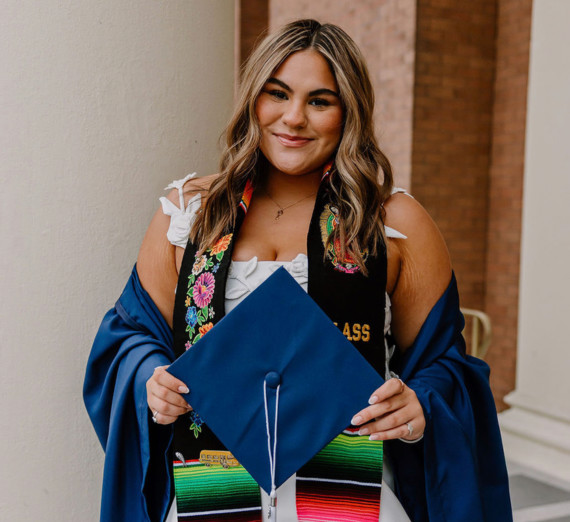
Before graduation, Dr. Joe Johnston sat down with Isabella Gonzalez, Criminology Major, and Outstanding Criminology Senior Award Recipient, to look back at her Gonzaga journey, and look forward to what is next as she moves into the world.
Dr. Joe Johnston: Isabella, what led you to become a sociology and criminology major in the 1st place?
Isabella Gonzalez: I came in as poli sci, which I didn't really know much about college or jobs that you could get with certain degrees because my parents didn't go to college. My brother did business and I knew I didn't want to do math and stuff. I kind of just was like, maybe I'll be a lawyer. I only really knew of very surface level jobs, but I just didn't know there were other options, I guess. Everyone said, if you're going to be a lawyer, you have to do poli sci. And I sat in like 2 classes and I really liked my teachers. But the content I already knew and yet I still don't like it. And I just don't think it was for me.
I can't exactly remember the transition. It was so long ago. But I remember I was adding a dance major and then I somehow decided, I think in the back of my mind, I was always interested in criminology and very interested in that kind of field. I didn't know it was different from criminal justice here because all the other schools I had applied to were criminal justice. I wanted to learn about all of it and not just the justice and law part of it. I think I met with you, and I was like, I'm going to add crim. And then you were like, “and we have soc.” And I was like, okay. I don't know, it seemed pretty easy. And then there were three majors there all of a sudden. And I was like, I'm going to take my first class first semester of sophomore year. I have a whole semester to decide if it's for me or not for me. I took my first social 101 class and I did a walking school bus. And I thought this is for me. I really like how I'm being asked questions and not being lectured at. And not to say that some people don't learn better like that, but that's just not the way I learned. So it just stuck.
Joe: Why’d you stick with the majors? Were there times when you doubted or considered changing majors beyond what you described already?
Isabella: No matter what your major is, there's always space to go back and change it or learn how to do other things. I knew it wouldn't be the end of the world. Obviously, you want to do what you're paying for, but it wouldn't be the end of the world if I later changed my mind. And that's why I got a job with Spike Nites doing marketing because I was like maybe I want to do that. I'm good at it because I don't have to do it all the time. I go in for two hours, make a flyer and then I'm done. I think I found through sociology and criminology there's a passion for helping people and I think that's where I'm needed and I want to be and not only helping people but learning from people. I considered maybe switching to a dance minor, switching to a soc or crim minor, kind of lightening the load a little bit. But then I was like, I'm already, at that point, it was already like second semester, sophomore year. And I was like; I can do it. I never really considered changing.
Sometimes I was like, this is a lot. But I never, I don't think I ever pondered changing because there's so much you can do with both of them. And if I still wanted to go to law school, I could. And if I want to be a teacher, I can. And if I want to, I don't know, be a forensic scientist, I can. I can literally do whatever I want. And if I want to do marketing, then I can get a job. It didn't really ever occur to me, this isn't for me. I don't know, it just did stick.
Joe: What specific class or classes, experiences, people, and or maybe assignments or projects do you want to remember from your time and why?
Isabella: Well, I have two, but I'll start with this one because she's not here. Christiane Schwarz. I will never forget her corrections class. And her taking us to tour the juvenile detention center, that changed my life. I will never forget walking through and meeting the staff and the staff wanting these kids in school. First, they came into our class to speak to us. Then we went to the juvie a couple weeks later and I'd never seen so much hope for these kids, and they will be in school. They have advocates to get them in school. I just was surprised how they paint the walls outside so the kids have something to look at. Because I mean, they're in these tiny shoeboxes of cells and they have a small window. So, they're trying to still make, I mean, a lot of those kids, it's not their fault that they're there and to take away their human rights, to not have a view and to not have a basketball court and a place to go play outside. They give them all of that. And so, I had never seen that before because we had been learning about in corrections so much of adult incarceration and how they really are restricted of everything. So, I thought it was beautiful that they were still strict because they don't want the kids to come back, but like still giving them their human rights. A lot of them are in unfortunate situations. And same with adult incarceration, but I think it was like, we got to watch them come out of a cooking class and things that they were learning how to make $1 burritos and how you can make them in a motel, things like that are valuable. And I think that as a criminologist is so important to see the rehabilitation side of incarceration. Being able to actually see, not many juvies do that, but being able to see one in my community that I live 5 minutes away from, actually implying those things was so awesome. And I don't even think I've ever told her how much that has changed my life. And because it was not supposed to be that we were really just going there to develop projects for them. And I really wanted an internship there, but I had to be 21. And I wasn't 21 until this November, so it was too late. But I loved them so much and loved that facility and all the staff. They were just so amazing.
I would say my second one was walking school bus. I think I was talking to Vik one day because he was like, what would you implement at school? And I said, greater information about our Logan community. And I'll never forget when you had people come in to talk to us about how us as college students and throwing parties and leaving trash and being disrespectful affects the families we live around. I'm so conscious of that now. I tell my friends all the time, like, hey, there's kids next to us. There’re people next to us. We need to reel it in a little bit. Hearing these kids while walking with them and them saying, that's the party house. And who lives there because we all know each other and go to such a small school and it's such a small neighborhood. Just hearing them say those things is insane. I think seeing how cognizant they are of what goes on in their community and how much we don't know about their community is something more people need to know if you're going to live in the Logan.
And I know we have Instagram pages and the school sends out emails about quiet hours and to be respectful. But I don't think people truly realize like this is so different than any other culture. We are neighbors, our kids who are going to a soccer game in the morning and school on Monday. I just wish more people, knew how much goes on in the Logan and even with the Karla stuff and seeing, not even like being in Logan, but seeing the donation page of like, Logan loves you, the Logan community loves you, even people from Garfield and all the schools around, how tightly knit that community is as families in a school center. I wish Gonzaga was more open to understanding that. And it makes me appreciate where I live now and that I get to live in the Logan. I guess they unwillingly share it with us, but it's shared and they share it with us. And I think that's so special. And I wish more people got to know that.
Joe: What are you hoping to do in your post-Gonzaga life? And how do you think sociology and criminology will connect to those hopes?
Isabella: I'm hoping to teach juvenile detention or be some kind of counselor or something. I'm not sure yet. I know I want to work in rehabilitation. It's so interesting right now with the government and seeing how that will go. I know I'm not in it for the money, but not even the money. Seeing how our administration will continue to deal with juvenile detention and adult incarceration, I am worried to see whether there's money in it or not, that doesn't matter. If it will exist is the question. And that's really scary because I think it was on such an uprise. I'm just hopeful that they have funding and all of that stuff. But I mean, it is hard to have, because a lot of people think, if they're going to jail, they don't need school. And the goal is to keep them in school every day. And they said at the Spokane Juvenile Detention, you want to make them come to school the next morning because you're not going to that's not a free, out of school situation. You're going to school the next morning. You're waking up and you're going to class. And then when you get out, you're waking up and you're going to class. That's their goal, which I think is really important. So right now, I'm going to go to Notre Dame and I'm doing their ACE program. It's pretty hard. There's going to be a lot going on, but I'm just going to give it my best shot. I'm nervous. But I know no matter how this program works out or whether or not it's through this program, that is my end goal. And that is it is to do service. And so, I'm hopeful. And I feel my greater purpose in life is to serve like within/for others. No matter what, it's going to happen. But yeah, that's my goal right now.
Joe: What else would you like to share, if anything?
Isabella: Really reading all the electives, when you're picking out classes and going with your gut to pick them out because I feel the electives are the most fun part. I know they're offering so many next semester, which I'm so jealous about. I heard Alana's teaching juvenile justice. I would say really try not to just pick one because you think it'll be easier, it'll fit into your schedule better. Really read all the descriptions and pick ones that you think will benefit you and they'll teach you so much. All the classes I've taken taught me something different. And so I'm glad I didn't just stick with what I thought would be easier or what fits better in my schedule. Even if it makes you have to come back after your long break, if you think it'll benefit you, there's so many awesome classes. I would say to do walking school bus. It was so fun and the kids are so awesome and it's so interesting now. I didn't do it this semester, but knowing my route and it being so close to my house and those kids don't know that, but I know that. And driving by and seeing them playing with their basketball outside after school and I see them and they don't see me but getting to watch them in that element which like driving by quickly so they don't see me. But getting to see them in that element is so fun. And just knowing that the humans that are in that school is just so fascinating. But I would say I think a lot of people get intimidated by the CEL classes, walking school bus or not.
Walking school bus is my second CEL class. I also did Zag dance, which is just another placement connected to the class. And just the way that it all evolves, I was taking my grad photos and my ZAG dancers walked by me and I wasn't expecting that, but knowing that, and they all were so excited and I didn't think I made that big of an impact, but they remembered me and were so excited to see me and I was excited to see them, but knowing that you share this memory of something that's so awesome for them and so awesome for you in different ways, you learn from them, they learn from you. It was just, it's just so cool to see how that evolves and realizing you did do something, but also you remember them so dearly and they did something to you. So, I think not to be scared of the CEL placements, whether you shop around for one, that's the reason we have those classes and like that's Gonzaga's whole goal is to get us to explore a greater community. I think it should be required to take one CEL class, but that's just my opinion.