Nursing student in a lab environment.

Formed in Mission. Inspired to Heal.

Professional nurses strive to promote, maintain, and restore the physical, intellectual, and spiritual health of others. The Nursing Department at Gonzaga University develops reflective, innovative nurses prepared to lead change in complex healthcare environments. Students approach patient care with knowledge, skill, ethical integrity, and a commitment to evidence-based practice and lifelong learning. Nursing coursework and clinical experiences build on the University Core Curriculum and Jesuit traditions, emphasizing care of the whole person, social justice, and preparation as servant leaders and change agents in their communities.

The Undergraduate Program

Nursing is built on a solid foundation in health and behavioral sciences and is informed by ethical principles. The ability to think critically and communicate effectively is essential to the profession, alongside competence in the science of nursing. Gonzaga’s nursing program integrates a liberal arts foundation with professional study to prepare adaptive, evidence-based, and practice-ready caregivers. The BSN program incorporates an updated curriculum aligned with the AACN Essentials (2021), emphasizing innovation, clinical judgment, population health, and professional identity formation.

Students learn to promote health, care for individuals with acute and chronic illnesses, and support patients and families across the lifespan. The Bachelors of Science in Nursing (BSN) program builds on themes of servant leadership, social justice, community, and reflective practice, while emphasizing evidence-based practice, equity, and innovation in healthcare delivery. Students begin by caring for individuals with more predictable needs and progress to providing care for individuals, families, and populations with increasingly complex needs across diverse healthcare systems.

Upon completion of the program, graduates will be able to independently use their learning to:

  • Collaborate with interprofessional teams through effective communication and servant leadership (Collaboration)
  • Embody intellectual curiosity and professionalism to deliver safe, ethical, and evidence-based care (Commitment)
  • Demonstrate compassion, empathy, and advocacy in the care of self, colleagues and clients (Compassion)
  • Apply nursing knowledge, skills, and attitudes, to inform clinical judgment and deliver quality care (Competence)
  • Engage in culturally sensitive care practices to promote holistic, equitable health outcomes for all (Culture)

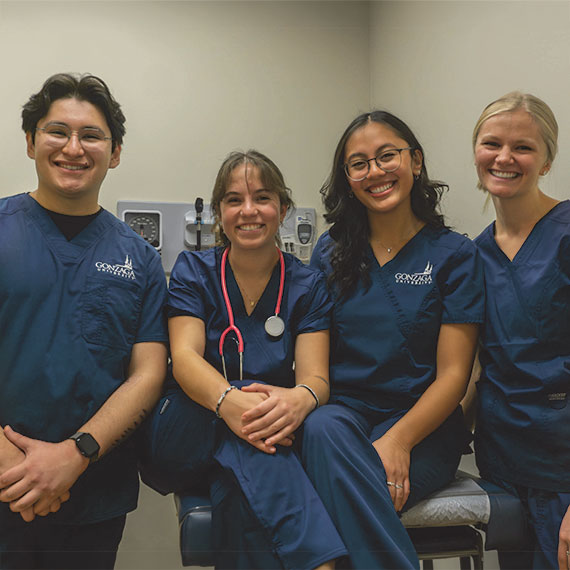
Four smiling student nurses side by side.

Undergraduate Nursing Career Outcomes

As the demand for nursing professionals continues to rise, Gonzaga BSN graduates are highly sought after. Graduates are prepared to work in hospitals, public health settings, community clinics, and beyond. The program prepares students not only for entry-level practice, but also for lifelong learning, leadership, and advancement into graduate education (MSN, DNP, DNAP). Graduates are equipped to adapt to evolving healthcare systems, integrate evidence-based practice, and lead improvements in patient and population health outcomes.

Student Success

decorative dotted line image
12:1

Student-to-faculty ratio

97%

Success Rate (May 2025 Graduates)

99%

Success Rate (December 2025 Graduates)

$81K

Average Salary (BSN Salary in Spokane, WA)

Nursing Stories

Recent Stories

2026 New Advisory Council Members

The primary role of the advisory councils is to provide strategic advice and external insights to th...

Gonzaga Launches Accelerated Nursing Degree Program for Seco...

Applications are now being accepted for Gonzaga University's School of Health Sciences’ new Accelera...

16 New Faculty Join Gonzaga University for 2026-2027 Academi...

Gonzaga begins the 2026-2027 academic year with an incredible 16-person new faculty cohort, as well...