
Gonzaga School of Health Sciences Earns Endorsement for Simulation
Students pursuing nursing and other health care careers complete much of their training in environments that simulate real medical exam experiences. The hands-on practice gained is critical for applying knowledge and skills before graduates enter the workplace, hence the necessity of state-of-the-art simulation labs like those at Gonzaga University’s School of Health Sciences. This spring, the school received endorsement from the International Nursing Association for Clinical Simulation and Learning (INACSL) of the Healthcare Simulation Standards, which recognizes excellence in applying the four cornerstone simulation standards of prebriefing, debriefing, facilitation, and professional integrity.
"This endorsement reflects the expertise, dedication, and mission-driven work of the faculty and staff who create meaningful simulation experiences for Gonzaga students," said Julie Wolter, dean of Gonzaga’s Health Sciences. "It is a powerful affirmation of GU's commitment to excellence, integrity, and innovation in preparing future healthcare professionals.”
INACSL describes its simulation standards endorsement as a public recognition for institutions that excel in creating simulation experiences that enhance learning, promote professional development, and advance the science of simulation. Programs that receive the endorsement have achieved the expectations of the Cornerstone Healthcare Simulation Standards.
Simulation-based education is increasingly important for preparing health professionals for real-world clinical settings in both urban and rural environments by strengthening decision-making, communication, teamwork, and reflective practice.
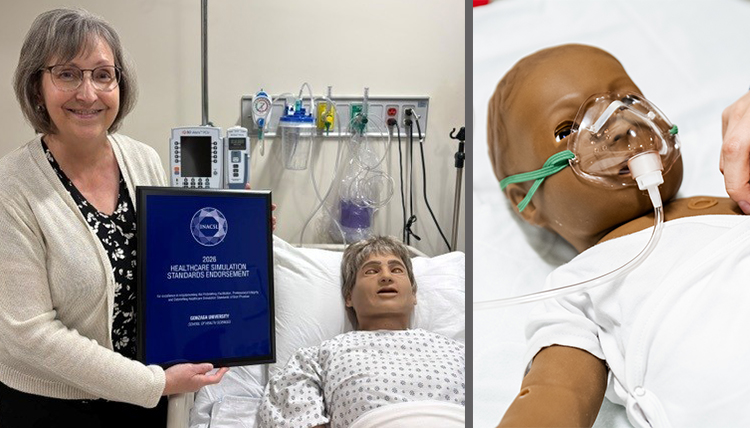
Susan Edwards, director of the Simulation and Resource Center at GU, shown above, attended the INACSL’s annual conference in Oklahoma City, Oklahoma. “Earning this endorsement shows that Gonzaga’s simulation program meets rigorous national standards and gives our students realistic, hands-on experience in caring for a variety of patients, from infant to geriatric,” she said. “As the only program in Eastern Washington with the endorsement, it’s an important validation of our team’s work and a win for the communities our graduates will serve.”
“This endorsement highlights our ongoing commitment to bolster student achievement and ultimately improve patient care outcomes," said Wolter. "It allows us to continue providing high-quality clinical experiences that complement the limited clinical rotation capacity available in our local hospital settings. As a result, we can expand our programming in ways not previously possible.”
Examples include launching a post-baccalaureate accelerated nursing degree program set to begin in June 2027, as well as accommodating more well-qualified students in high-demand health programs. In 2026, Gonzaga's Bachelor of Science in Nursing (BSN) program received nearly 1,000 applications for 100 new students.
Health care training began at Gonzaga in the 1940s with nursing. Nursing and Human Physiology became its own school in 2013, and in 2023, morphed into the current School of Health Sciences (SHS), boasting additional majors like public health and plans for a center for health equity. SHS is also a critical component of the University School of Washington – Gonzaga University Health Partnership, where undergraduates and medical students learn and research together.