Woldson

The M. Woldson Gallery

Welcome to the
M. Woldson Gallery

Presented by the Gonzaga University Art Department

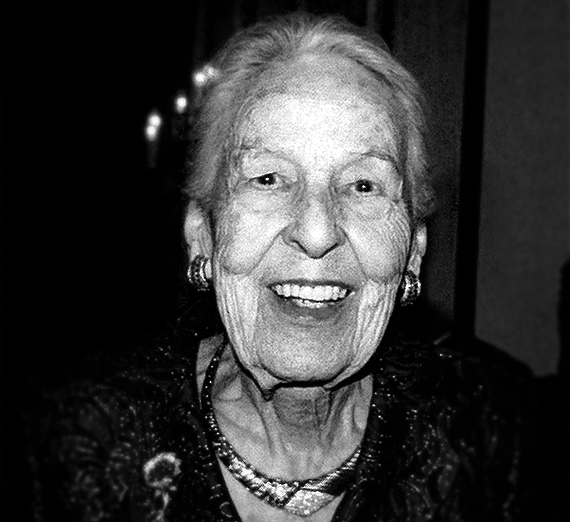
Rooted in the generous spirit of Miss Myrtle Woldson and her lifelong devotion to creative expression, the M. Woldson Gallery expands the Myrtle Woldson Performing Arts Center’s mission to inspire, educate, and uplift.

The gallery space is designed as a dynamic space for reflection and discovery, the gallery connects students, artists, and the Spokane community through compelling visual stories that complement the vibrant music, theater, and dance taking place across our stages.

Current Exhibition

Exhibition Dates and Hours

September 1, 2026 - December 18, 2026
Monday - Friday, 9 am to 5 pm
Open during all public performances

Opening Reception

September 11, 2026, 4:00-7:00pm

Contact Information

Myrtle Woldson Center
Phone (509) 313-2787
211 E Desmet Ave
Spokane, WA 99202


Find us on social media.

InstagramInstagram
FacebookFacebook
YouTubeYouTube

Spiritual Elegance -  The Next Generation of Native Artists:
Honoring Our Ancestors, Celebrating New Voices

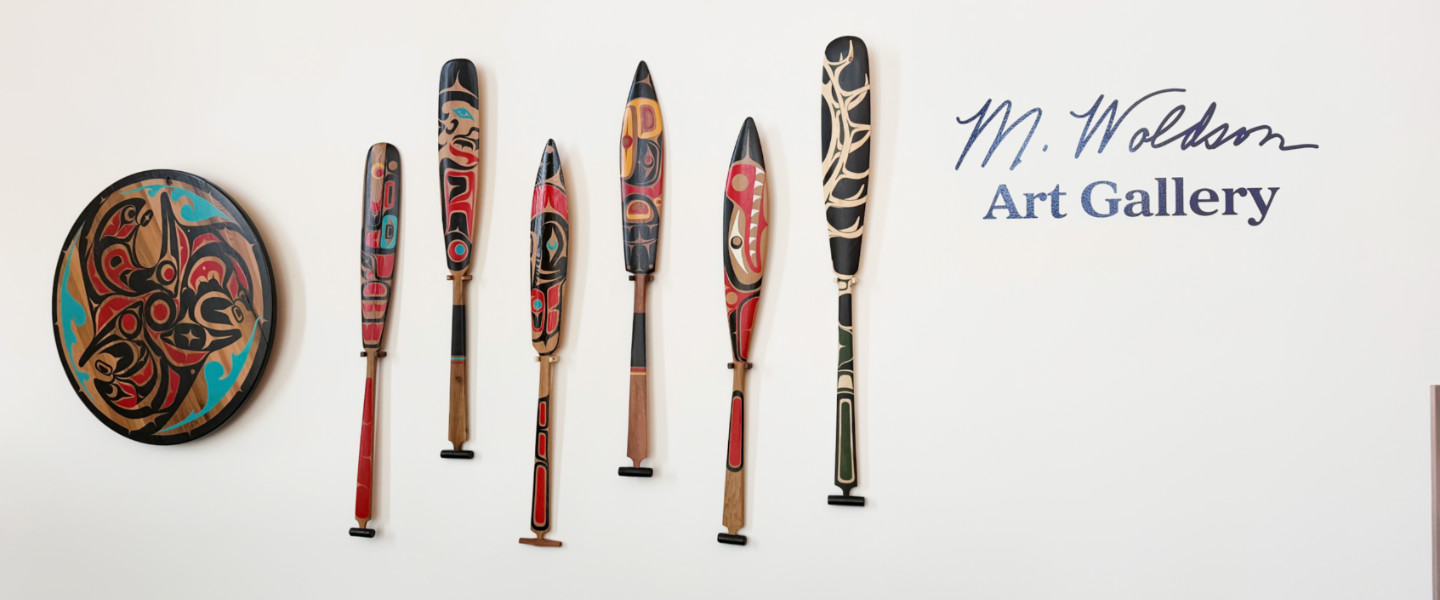
The M. Woldson Gallery logo and a row of Native American canoe paddles.

The title Spiritual Elegance was chosen in honor of my late father, Randy Capoeman (1956–2008), whose artwork forever changed the landscape of Coastal Salish art in the Pacific Northwest. Randy paved the way for Quinault like myself and many others, setting a standard of excellence that continues to inspire generations of Indigenous artists. Because of his vision, dedication, and commitment to our culture, many Quinault artists have been able to pursue art as a profession while sharing our stories with the world.

This exhibition is our way of honoring not only Randy Capoeman, but all of our ancestors who carried our traditions, protected our cultures, and passed their knowledge from one generation to the next. Their teachings live on through every carving, painting, weaving, and work of art created by today's Indigenous artists.

Spiritual Elegance celebrates the next generation of Native artists—new voices who carry the responsibility of preserving our cultural identities while creating new paths for the future. Our hope is that this exhibition inspires Indigenous artists to embrace their culture, honor those who came before them, and continue telling our stories for generations to come.

Titus Capoeman
Artist and Exhibition Curator

Decorative Image

Special Guest Artist


Joe Feddersen

Tribal Affiliation: Arrow Lakes / Okanagan (Colville Confederated Tribes)

Artist Biography

Joe Feddersen is a celebrated Indigenous artist and educator from the Confederated Tribes of the Colville Reservation in Washington State. Working across printmaking, sculpture, photography, and mixed media, Feddersen draws on Indigenous visual traditions, contemporary life, and the landscapes of the Pacific Northwest.

Explore Joe Feddersen's Work


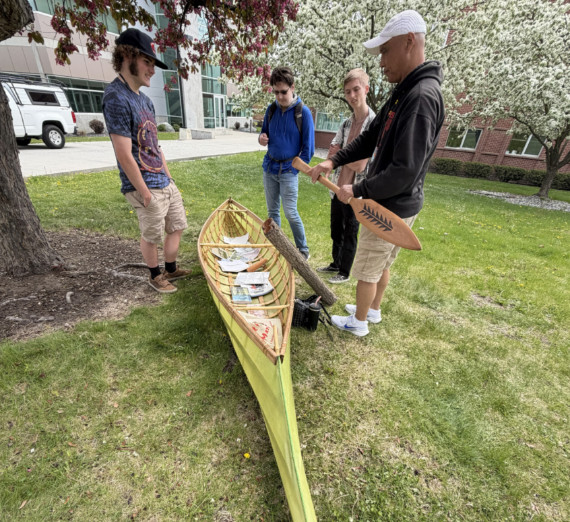
    Artist Shawn Brigman, Ph.D., holding a carved wooden paddle while showcasing a handcrafted skin-on-frame canoe to a small group of students on a lawn.

    Artist Profiles

    Shawn Brigman, Ph.D.

    Tribal Affiliation: Spokane Tribal Member; descendant of the Sinixt, Kalispel, and Shuswap peoples

    Artist Biography

    Dr. Shawn Brigman is a canoe artist and cultural preservationist whose work centers on ancestral bark sturgeon-nose canoes. Founder of SALISHAN STURGEON NOSE CANOES, he is dedicated to protecting and teaching Plateau canoe traditions while creating contemporary works inspired by those teachings.

    Exhibition Works

    • sp’ə́ƛ’m (Bitter Root) Birch Bark Basket (2022)
    • Salishan Sturgeon Nose Canoe Glass Bowl (2019)
    Decorative Image

    Guy Capoeman

    Artist Biography

    Guy Capoeman is a Quinault artist, canoe carver, storyteller, and cultural leader whose work has played an important role in the revitalization of Quinault art, canoe culture, and identity.

    In 1988, Capoeman graduated from the Pacific Northwest College of Art in Portland with a Bachelor of Fine Arts in Illustration. His artwork earned exhibitions at Quintana Galleries in Portland and Stonington Gallery in Seattle. After returning home to Taholah, Capoeman also dedicated himself to tribal leadership, serving six years on the Quinault Tribal Council and an additional six years as Vice Chair.

    In 1994, Guy carved the first ocean-going canoe on the Quinault Reservation in nearly a century. The 34-foot cedar dugout was named May-EE, meaning “the beginning.” The canoe became a powerful symbol of the renewed connection to Quinault cultural traditions and helped inspire a new generation of artists, canoe families, storytellers, and cultural practitioners.

    Capoeman later played an important role in the Tribal Journeys movement, including the historic return of ocean-going canoes to Quinault during Paddle to Quinault. His canoes have traveled through challenging ocean waters, demonstrating the strength of traditional Quinault canoe design and the knowledge passed down through generations.

    Alongside his brother Jeff and son Cecil, Capoeman continues the family tradition through Capoeman Arts, creating cedar canoes, paddles, masks, house posts, paintings, and other works rooted in Quinault history and Coast Salish artistic traditions. He also involves his children in the carving process, emphasizing that art is not only something created, but knowledge that must be taught and carried forward.

    Capoeman’s work draws deeply from Quinault oral history, the natural world, ancestral teachings, and spiritual relationships. His artwork includes traditional forms as well as contemporary paintings and abstract designs. His 2016 mural Kape Jiluupak, created with his son Cecil in Aberdeen, brings together Thunderbird, the whale, the ocean canoe, and the legendary figure Iskwalusis, or “Bright Sun.”

    For Guy Capoeman, art is a way of preserving identity and ensuring that future generations recognize their own history. His work reflects a lifelong commitment to keeping Quinault traditions alive while allowing them to continue evolving through contemporary Native artists.

    “My art reflects my people’s history. I want future generations to look at my work and know that it represents Quinault art of our time.”

    Artist Randy Capoeman

    Randy Capoeman

    Artist Biography

    Randy Capoeman was a respected Quinault artist whose work reflected the culture, stories, and traditions of the Pacific Northwest “Canoe People.” Raised on the Quinault Indian Nation, Randy grew up surrounded by master canoe carvers, basket weavers, fishermen, and tribal leaders, influences that deeply shaped his artistic vision and connection to culture.

    Inspired by Northwest Coast art from a young age, Randy developed a passion for formline design, carving, and storytelling that would become his life’s work. He became widely known for his murals, carvings, and graphic designs throughout Indian Country, including artwork featured throughout the Quinault Nation and the iconic Quinault Pride Seafood labels.

    More than an artist, Randy was a teacher and visionary whose work preserved Indigenous identity and inspired future generations. His legacy continues today through the artwork and cultural teachings carried on by his son, Titus Capoeman.

    Decorative Image

    Theron Capoeman

    Traditional Name: KloGwak

    Tribal Affiliation: Quinault Indian Nation

    Artist Biography

    Onugʷitu hinč Klo-Gwak ču ta kʷinaiɫth. Theron Capoeman is a 14-year-old Quinault artist raised by master artists Guy and Samantha Capoeman. He has worked with paint, carving tools, basket materials, and cedar bark from a young age. His greatest passions are wood carving and creating original Coastal Salish formline designs. He hopes to one day carve another traditional dugout canoe alongside his father while carrying Quinault artistic traditions into the next generation.

    Primary Medium

    • Wood carving
    • Coastal Salish formline design
    • Cedar bark arts
    • Painting
    Artist Titus Capoeman

    Titus Capoeman

    Traditional Name: Toth-La-laition

    Tribal Affiliation: Quinault Indian Nation & The Nez Perce Tribe

    Artist Biography

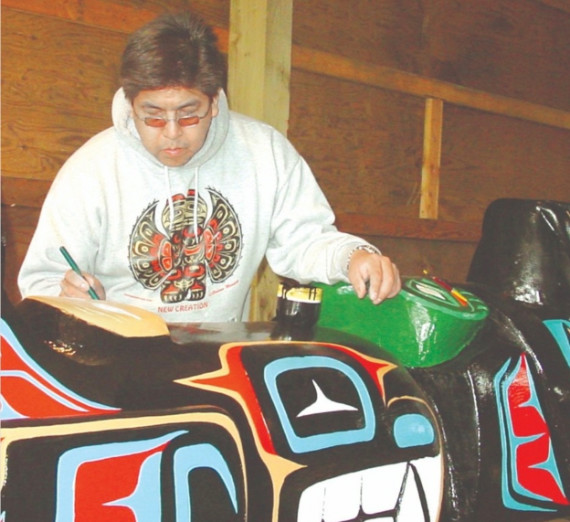
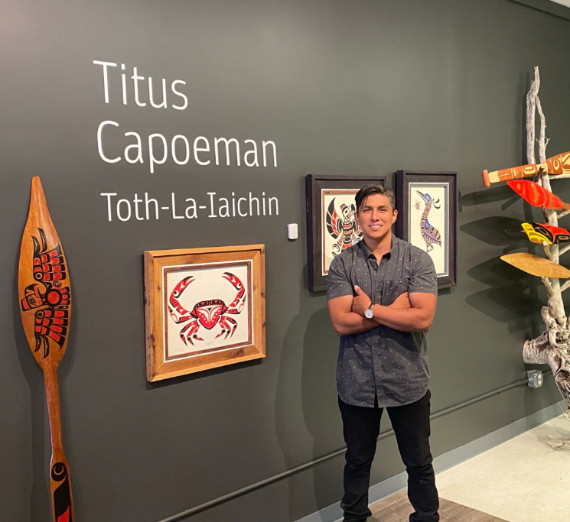
    Titus Capoeman is a Quinault and Nez Perce artist whose work is rooted in the traditions of the Canoe People. His primary artistic medium is Coastal Salish cedar paddles used for paddling traditional dugout canoes. After traveling more than 6,000 ocean miles in traditional canoes, those experiences inspire his paddles and Coastal Salish formline artwork. Inspired by his late father, renowned Quinault artist Randy Capoeman, Titus carries forward generations of Indigenous knowledge through carving, painting, and cultural education. A United States Marine Corps veteran and person in recovery, he uses art as a path for healing, resilience, and cultural preservation. Today he teaches throughout the Pacific Northwest in tribal communities, schools, museums, universities, and Veterans Affairs programs. His work has been featured in exhibitions in Ocean Shores, Spokane, and Tacoma, Washington.

    Primary Mediums

    • Coastal Salish cedar paddles
    • Coastal Salish formline painting and carving
    Artist Claire Edmo

    Claire Edmo

    Tribal Affiliation: Shoshone-Bannock Tribe

    Artist Biography

    Growing up on the Fort Hall Indian Reservation in southeastern Idaho, Claire Edmo creates artwork that reflects her Indigenous identity through memories of native plants, mountain landscapes, and written reflections. She primarily works as a painter while also exploring relief printmaking, beadwork, basket weaving, and ceramics.

    Exhibition Works

    • In the Distance — Watercolor
    • Bowl and Pitcher — Oil on Canvas
    • Camas — Ink on Paper
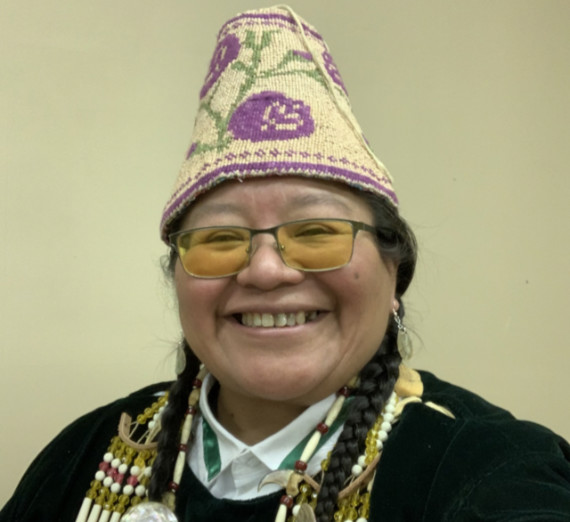
    Artist Julie Edwards in traditional Native American accessories and hat.

    Julie Edwards

    Confederated Tribes of the Colville Reservation; descendant of the Wenatchi, Nez Perce, and Yakama Peoples

    Artist Biography

    Julie Edwards is an Indigenous weaver whose twined sally bags reflect the teachings of her grandmother, Lucy Pe-el Saluskin, and the master weavers who mentored her. Through basketry, language, and cultural education, she helps ensure these traditions remain living practices. Her military service, tribal law enforcement, and language revitalization work have strengthened her commitment to community and cultural preservation.

    Primary Medium

    • Traditional twined sally bags
    • Plateau basket weaving
    Decorative Image

    Jeff Ferguson

    Tribal Affiliation: Spokane Tribe

    Artist Biography

    Full-time freelance photo/videographer Jeff Ferguson is a Spokane Tribal member who holds an A.A.S. in Photography from Spokane Falls Community College and B.A. in Communications from Whitworth University.
    Born in Pullman WA he was raised and currently resides in Spokane. He has lived, worked and traveled extensively throughout the U.S. and abroad. His fine art work has been shown throughout the Northwest. His editorial work has been published locally, regional and nationally and internationally with video work shown online, television and screened at film festivals around the world.
    In addition he has also had the honor of serving on the Spokane Arts Commissions, the Forks Chamber of Commerce Board of Directors and as a panelist for Artist Trust in Seattle and twice as a juror for Terrain in Spokane. He also serves as a Board member for KSPS PBS Public Television and for the Northwest Native Chamber of Commerce.
    Much of his inspiration stems from the beauty of the Northwest, his Native heritage and from great artists such as Edward Curtis, Lewis Hine, George Flett and Andy Warhol. Current issues, true-life events and the unique individuals he has met along his journey inspire his editorial and documentary work.
    Although most of his work has been commercial, editorial, portraiture and sports photography his passions lie in fine art photography, documentary video, nature and landscape photography and cultural preservation although is not predominantly working with Indigenous elders at home and abroad.

    Decorative Image

    Jacob Maurice Johns

    Tribal Affiliation: Hopi Reservation

    Artist Biography

    Jacob Johns (Akimel O’odham / Hopi) is a multidisciplinary artist whose work serves as both a personal lifeline and a collective offering. Rooted in ancestral memory and forged through lived experience, Jacob channels the internalized stress of navigating a fractured world into the painful but necessary process of humanity’s reunification. Through painting, immersive installations, and experimental video, Jacob transforms the complexities of modern Indigenous identity into vibrant works that act as conduits for healing—both individual and communal.
    Pushing tradition into the future, Jacob’s innovative artistic practices explore human evolution and collective transformation. Each creation becomes both mirror and map: reflecting ancestral truth while charting new pathways forward. Through every brushstroke and innovation, Jacob reclaims cultural knowledge while expressing a vision of reunified humanity that transcends colonial constructs of reality.
    Jacob’s creative force is inseparable from a life dedicated to advancing international climate policy and cultivating a world rooted in justice, health, and possibility. This global advocacy continues to shape a visual language infused with urgency, ceremony, and resilience. In 2023, while defending a peaceful gathering in New Mexico, Jacob was shot—an act of violence that became a defining moment. Rather than retreat, Jacob transformed the wound into deeper purpose, using art to heal, to expose, and to invite the world into sacred narrative space—where story, spirit, and form converge to help us all relax into the healthy, livable future we deserve

    Decorative Image

    Roin Morigeau

    Tribal Affiliation: Confederated Salish & Kootenai Tribes

    Artist Biography

    Roin Morigeau is a multi-disciplinary artist and beadworker based in sƛ̓xatkʷ (Spokane, WA). After a spinal injury in 2010, Roin began making work as a form of protest and healing. Their studio practice includes drawing, painting, carving techniques, installation and beadwork. Roin received the 2023 Centrum Emerging Artist Residency and the 2021 Artist Trust GAP grant. Their work lives in public and private collections including ARTSWA, The City of Spokane, and has been shown in numerous group and solo exhibitions including the Chachalu Museum, University of Oregon's Museum of Natural and Cultural History, and was hosted at the Ronna and Eric Hoffman Gallery of Contemporary Art at Lewis & Clark College, 516 Arts In Albuquerque, yəhaw̓ in King St. Station at Seattle Office of Arts + Culture, Bryon Oliver Gallery, Sacred Circle Gallery at Daybreak Star Indian Cultural Center, and Eastern Washington University. As a cultural worker, they were an inaugural founding member of the 2023 Spokane Falls Two-Spirit Powwow Committee. Roin is proudly Séliš/Scandinavian/Scottish stʕámiyaʔ (Two-Spirit).

    Contact the Myrtle Woldson Performing Arts Center

    211 East DeSmet Avenue
    Spokane, WA 99258
    (509) 313-4776