
Degree Requirements for Organizational Leadership
Organizational Leadership - 36 Credit Program of Study
The Master's in Organizational Leadership Program requires students to attain 36 credits of study.
- 24 credits in ORGL Core Courses and
- 12 credits in ORGL Elective Courses
Core Courses (24 credits required):
- ORGL 500 - Organizational Leadership (3 credits)
- ORGL 501 - Methods of Organizational Research (3 credits)
- ORGL 502 - Leadership and Imagination (3 credits)*
- ORGL 503 - Organizational Ethics (3 credits)
- ORGL 504 - Organizational Communication (3 credits)
- ORGL 505 - Organizational Theory (3 credits)
- ORGL 506 - Leadership and Diversity (3 credits)
- ORGL 680 - Leadership Seminar (3 credits)
Core Course Descriptions:
COML/ORGL 500 - ORGANIZATIONAL LEADERSHIP (3 credits)
An introduction to organizational leadership begins with an examination of the questions: How do leaders explain the causes of dysfunctional thinking and/or behavior in themselves, other leaders, or in organizations? How do they understand the differences among a variety of styles of leadership and models of organizations? How do they apply the theories of leadership and the principles of organizational behavior to actual situations? How do they formulate a broad, integrative perspective from which to view leadership and organizational behavior? Drawing from the social science, this integrated course focuses on research and models of leadership relevant to defining and achieving collective goals in a variety of organizational settings.
COML/ORGL 501 - RESEARCH METHODS (3 credits)
Gall, Gall, & Borg note that research is a systematic and persistent approach to answering questions (2006). This course meets that charge head on as we attempt to explore the philosophies of research and how to answer questions that we are passionate about. Through engagement with primary research and exposure to current methodologies and the inquiry process, this course requires the development of a full research proposal (e.g. literature review, rationale for the proposed questions, formal research questions and/or hypotheses, and proposed method description.)
ORGL 502 - LEADERSHIP AND IMAGINATION (3 credits)
3-day On-campus Residency
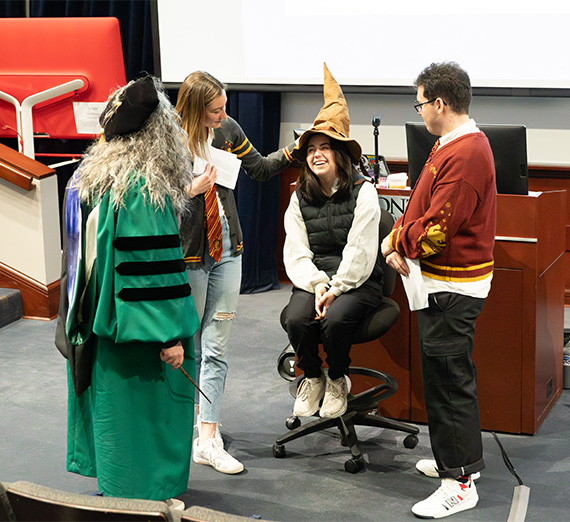
Why is creative imagination an important leadership capacity? How do leaders employ their imaginative processes within the organization? What can leaders do to stimulate and nurture their imagination? Through the theme of 'seeing and seeing again' perspectives from the liberal arts (i.e. art, drama, history, literature, music, psychology) students are challenged to apply and expand their creative and imaginative capacity. This experiential class provides opportunities to meet and engage with class members as well as faculty and staff in a face to face setting, establishing relationships to support your success throughout the program and beyond graduation.
COML/ORGL 503 - COMMUNICATION & ORGANIZATIONAL ETHICS (3 credits)
Worldviews inform personal, social, political, and professional lives. They influence our perception and practice of leadership, how we respond to adversity, how we relate to others and what we understand to be our purpose. Through a modified case study approach students are challenged to explore human life from two radically opposing worldviews, examining ethical dilemmas of leadership within the context of moral choices and implications of decision-making. Defining personal worldviews in online postings will help students identify and clarify personal motivations, behaviors, and reactions to ethical problems in the organizational setting.
ORGL 504 - ORGANIZATIONAL COMMUNICATION & LEADERSHIP (3 credits)
I’m convinced that when historians 100 years from now or 200 years from now try to describe our times, they will say we are living through the third great communication revolution in the history of western civilization.
-Lyman Bryson
All organizations -- from Microsoft, to churches, to social clubs, and universities -- rely on communication, and being able to communicate strategically is crucial to meaningful participation. This course will explore contemporary concepts about the meanings and functions of communication in organizations. Organizational communication encompasses not only communication within businesses, but also within large private or nonprofit associations, larger community groups, and governments both large and small. We will cover such selected topics in organizational communication research, such as culture, socialization, systems theory, communication and technology, and globalization.
ORGL 505 - ORGANIZATIONAL THEORY (3 credits)
In this introduction to the study of organizations, students are exposed to a synthesis and integration of major traditions in organizational theory. Emphasis is placed on grounding in theoretical concepts and their practical applications, exposing students to the chaotic and constantly changing world of organizations. Students will learn to view organizations from multiples frames and perspectives, applying the frames to interpret organizational behavior. Knowledge of organizational theory will be applied to a collaborative group project designing a “real-life” intervention.
ORGL 506 - LEADERSHIP AND INTERCULTURAL COMMUNICATION (3 credits)
The identity I am thinking of is something that hovers between a [hu]man and the rest of the world: a midpoint between his view of himself and theirs of him—for each, of course, affects the other continually. A reciprocal fluxion, sir. There is nothing absolute about this identity of mine.
-Cornell & Hartmann, 1998
Who we are, whether we are comfortable with this idea or not, is shaped in part by the social roles we occupy and how society sees us in those roles. As we will see from the very beginning of this class, our social roles, the class we are born into, our gender, all have implications for our lives. We will explore intercultural communication as a tool for bridging differences and learning about identities, practices, and cultures.
ORGL 680 - LEADERSHIP SEMINAR (3 credits)
The Leadership Seminar serves as the capstone experience of the master’s program in Organizational Leadership. Students create a research portfolio, project, or thesis as evidence of a synthesis of the program.
Electives (12 credits required)
Choose graduate level elective courses from elective lists provided in the Department of Organizational Leadership catalogue or from other graduate divisions of Gonzaga University that will enhance your leadership preparation. Not all electives are offered each semester - check the current class schedule on the Zagweb for elective courses available. (Up to 6 credits of graduate coursework may be approved for transfer from other accredited institutions.)
Elective Course Descriptions
(for classes offered on a regular basis):
ORGL 510 - Renaissance Leadership for the 21st Century in Florence, Italy
This course will help emerging leaders develop new perspectives and strategies, bringing healthy, creativity and energy to their organizations. Drawing upon the creative processes of artists, painters, architects, musicians, and writers, students will apply the same dynamics of creative thinking to the practical work of leaders. An interdisciplinary approach explores the power of Renaissance thinking as it applies to renewal, rediscovery, invention and creativity.
COML 513 - Renaissance Rhetoric and Contemporary Leadership (3 credits)
14-day Residency in Florence, Italy
Communication and leadership are closely intertwined, whether in our current period of post-modernity or during the European Renaissance. Fifteenth century Italy, Florence in particular, saw a flowering of the arts and scholarship unmatched in history. This can be seen in the rhetoric of art and architecture, religious preaching, political writing and oratory, and in the humanistic philosophy that emerges from it. This course examines this period through readings, discussions and on-site visits to historical settings in Florence and Siena, in order to formulate the critical questions necessary to bring these ideas to our contemporary world. Using the Italian Renaissance as the canvas, we will study multiples examples of rhetoric, both written and visual.
ORGL 516 - Organizational Development
This course focuses on how OD consultants, internal or external, can support both leaders and all members of an organization in achieving their goals, mission, and vision. Students will explore ways to conduct systematic diagnosis of organizations, consider how to create and implement effective OD interventions, and investigate multiples methods, tools, and technologies used to implement major change effectively in organizations. Through consideration of the predictable human dynamics involved when orchestrating the implementation of major disruptive change, students will develop an awareness of the nature, application and practice of the profession of Organizational Development.
ORGL 517 - Organizational Change and Transformation (3 credits)
3-day On-campus Residency
Managing change is a critical skill to support organizations in achieving their goals, mission and vision. Building on theories from the field of change management, the experiential learning in Spokane will introduce multiple interventions, reinforcing that different situations require different approaches. The course is appropriate for people in various levels and types of organizations, providing tools to support leading change effectively.
ORGL 518 - Transforming Leadership
How do contemporary leaders go beyond the social exchange theory to convert followers into leaders and leaders into moral agents? This course offers a comparison of transactional and transforming leadership by examining past leaders and events. An examination of the dynamics of transformation and how leadership can facilitate it within individuals and organizations will help students develop new insights into the theory and practice of transforming leadership.
ORGL 520 - Negotiation and Conflict Resolution
This course provides an overview of conflict on different levels, from micros through mezzo, macros to violent international conflict. Using real-life situations and case studies, students will practice skills and strategies for dialogue, decision-making, and ultimately conflict transformation and system change. This application is generic and therefore appropriate for all professions whether formally or informally involved in resolving conflict.
ORGL 522 - Leadership, Community, Empowerment, Collaboration and Dialogue in Valyermo, California
Includes a 5-day residency at St. Andrews Abbey in Valyermo, CA
What is the meaning and purpose of life and activity? How is need for such meaning and purpose encountered in community? How does the leader develop community to facilitate individual growth and collective flourishing? Through study, experience and scholarship students explore and practice the leadership processes of empowerment, collaboration, and dialogue in the context of creating structures and processes for sustaining and transforming community. At the Benedictine Abbey students become participant observers in a five day emersion designed to explore, practice, and come to an expanded understanding of the role and purpose of the leader’s involvement and commitment to building and sustaining meaningful and purposeful community.
ORGL 524 - Leadership in Human Resources
In this course students will explore the changing role of the human resource leader in organizations. The growing emergence of the human resource leader as an organizational change agent will be examined as well as the skills necessary for success. Topics include policy and practice within organizations; selecting, training, motivating, evaluating, and compensating employees; labor relations; and applicable legislation.
ORGL 530 - Servant Leadership
In this course students will explore the changing role of the human resource leader in organizations. The growing emergence of the human resource leader as an organizational change agent will be examined as well as the skills necessary for success. Topics include policy and practice within organizations; selecting, training, motivating, evaluating, and compensating employees; labor relations; and applicable legislation.
ORGL 532 - Leadership, Justice and Forgiveness
Emotional discipline based in love calls a person toward meaningful responses to human suffering. Such responses are grounded in discernment regarding human conflict, oppression, power, and harm, and the opportunities—personal, familial, societal, and global—that rise from the crucible of potential that is our humanity. The course engages students toward self-responsibility in the context of reconciliation, and the depth of heart, mind, and spirit that leads to healing and growth in community with others. Students will work to apply the interior leadership necessary for discernment and action within oppressive systems.
ORGL 550 - Team Building and Leadership (3 credits)
3-day on-campus residency
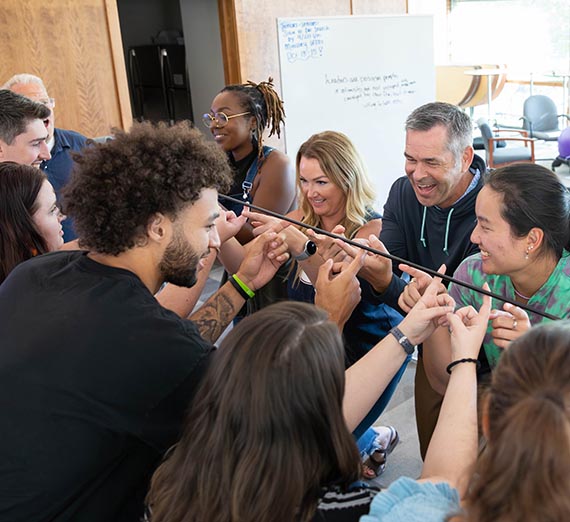
This three-day intensive program is designed to increase students' knowledge and understanding of leadership and team development through a combination of information sessions and active participation in cooperative, challenge activities. Challenge activities are designed to enhance students’ critical thinking skills, creativity, problem-solving ability, and ability to work effectively as a team. These activities present opportunities to taking leadership roles, recognize leadership styles, identify what works and what doesn’t work in given situations, and apply lessons to real life situations. Topics include the communication process, leadership models and styles, stages of team development, ethics, diversity, and visionary or principle-centered and creative leadership.
ORGL 551 - Advanced Team Building and Leadership Intensive (3 credits)
3-day on-campus residency, Prerequisite: ORGL 550
This three-day intensive program is designed to be taken along with ORGL 550, building on key concepts learned. The advanced session shifts the focus from group participation to group facilitating through team building and leadership development activities.
ORGL 660 - Readings in Social Systems (1-3 credits)
This individualized study course is based on readings in a specific topic designed in consultation with the instructor. Students will discuss the selected readings on a tutorial basis with the instructor and prepares an annotated bibliography or bibliographical essay. Although individualized, this course is treated as a seminar in which students share their work with each other and the faculty member assigned to the course.
ORGL 661 - Readings in Human Behavior (1-3 credits)
This individualized study course focuses on the investigating of scholarly research findings in an aspect of the behavioral sciences defined by the student and instructor. Students will prepare a written report of findings on the research problem selected. Although individualized, this course is treated as a seminar in which students share their work with each other and the faculty member assigned to the course.
ORGL 670 - Projects in Organizational Leadership (1-3 credits)
This independent study course consists of a formal research project investigating a problem in applied organizational or social research conducted under the tutelage of the instructor Although individualized, this course is treated as a seminar in which students share their work with each other and the faculty member assigned to the course.
ORGL 671 - Projects in Group Behavior (1-3 credits)
This independent study course consists of a formal project of original research in a topic of group behavior that proceeds from a research design approved and monitored by the instructor. Although individualized, this course is treated as a seminar in which students share their work with each other and the faculty member assigned to the course.
ORGL 681 - Leadership & Storytelling (3 credits)
3-day On-campus Residency
Stories permeate virtually every dimension of our existence as noted in the familiar quote: “Civilizations have existed without the wheel, but no society has ever existed without story.” With groundwork in narrative, the class focuses on the kind of leadership that is demanded by the current world situation: Leaders who lead from their real selves or, Authentic Leaders. After exploring an understanding of authentic leadership, the course will shift focus to a key tool for leaders: the leadership story.
ORGL 689 - Leadership & Hardiness (3 credits)
3-day Residency at Mt. Adams, WA
This course will introduce students to existential psychology and psychological hardiness in the context of organizational leadership. Students will gain an understanding of existentialism through a personal exploration of meaning and how meaning informs psychological attitudes and existential courage during personal and organizational adversity. Partnering with an organization student will engage various sources of feedback related to culture, climate, structure, and workforce and provide the organization a tangible plan for developing and/or sustaining a resilient organization. Students will learn to deconstruct and operationalize psychological hardiness through scholarly literature, classroom exercises, simulations, and a climb at Mt. Adams, WA.
ORGL 690 - Special Topics Course
This seminar explores new theories and issues. The specific theme of this course varies each time it is offered because the field of organizational leadership is constantly evolving.
Past topics have included:
ORGL 690 - Leadership and Accompaniment (3 credits)
14-day Residency in Cali, Columbia
This course, in partnership with Javeriana University in Cali, was designed to meet the Jesuit, Catholic, and humanistic mission of Gonzaga University. Engaging directly with local community leaders, students will gain first-hand experience of asset-based community development models. Students will learn how to conduct a needs assessment and how to apply leadership and social responsibility frameworks on the individual, mezzo and macro levels. Strategies for thinking and practicing ethical leadership, an increased self-awareness, and cultural sensitivity are explored through critical reflection and action. This course includes excursions to local historic sites, museums, small cultural events, and a trip to a finca cafetera (coffee farm).
ORGL 690 - Organizational Behavior (3 credits)
3-day On-campus Residency
Organizations are dynamic systems that interact with their environment and this interaction affects human behavior. A deeper understanding of self and others’ behaviors will help to improve interpersonal and organizational skills. This course will expose students to the major concepts and theories of organizational behavior including: motivation, satisfaction, dysfunctional behaviors, teams and group dynamics, organizational justice/injustice, trust, perceptions and attitudes, and conflict and negotiation.
ORGL 690 - Organizational Theory, Application, and Adaptation (3 credits)
This course will focus on the “real world” - your world. Organizational theory comes to life as we gain a greater sense of relevance and meaning, creating real impact by completing an organizational diagnosis for a non-profit organization in your community. Other concepts addressed in the class include change management, assessing readiness for change and research to better understand academic service-learning.
Communication and Leadership Courses Can be taken as Elective Credit.
Tilford Center
502 E. Boone Ave.
Spokane, WA 99258-2616
(509) 313-3569
www.gonzaga.edu/sps
ORGL Contact
Teresa Crane
Program Specialist
(509) 313-6645
crane@gonzaga.edu