
Erasmus Reflections from a Visiting Scholar, Mihai Murariu
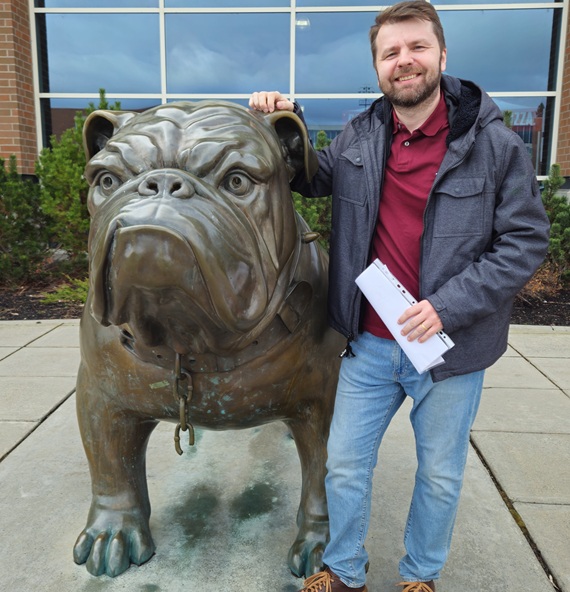
With a fellowship from the Erasmus+ program, West University of Timisoara, Romania faculty member Mihai Murariu visited Gonzaga's campus in April 2026. He shares his reflections of his time on campus below.
I flew 9000 km to reach Gonzaga. I was able to do this with the encouragement of my friend and colleague Adrian Popa and with the support of the Erasmus+ program, which successfully holds on to its principles of cooperation and knowledge exchange even in eras marked by historic turbulence. I found here not only a fascinating region full of contrasts – shifting in a relatively quick succession from ocean to forested mountain peaks, to arid plains – but also an incredibly welcoming community on campus, which helped me feel right at home.
The wonderful vistas stuck with me even as I delivered my public lecture, proving once again the importance of geography when considering the choices and strategies made by human society. Thus, my lecture dealt with both persistent patterns and chaotic changes within past and present international systems, focusing on the competition between autocratic continental societies and open maritime societies. I sought to show how the use of the sea has been at the heart of the creation of modernity and – ultimately – the global international society. Indeed, the sea has traditionally linked together various communities through the spread of trade and new ideas, yet one must also consider its disruptive potential in leading to increased competition, political rivalries, and, on occasion, warfare.
Today, as around 80% of the global trade takes place on seas and oceans, the importance of freedom of navigation and of collaborative efforts among nations remain as important as ever, if not more so. Furthermore, in a world marked by the drone revolution and artificial intelligence, one is faced with the increase in vulnerabilities posed by various historical maritime bottlenecks across the globe. The discussion also focused on the competitive advantages of open maritime states in predatory international environments, showing how unity around democratic norms can withstand the onslaught of autocratic rivals, and how, no matter their apparent strength and stability, autocratic regimes are fundamentally brittle at their core.
Aside from this, I was fortunate to be part of a series of discussions with students in a classroom lecture and with colleagues in faculty meetings. These discussions ranged from the importance of political communication and the search for authenticity, to the impact of charismatic leaders and of political polarization, as well as the evolution of higher education and what this will mean for the future.
All in all, I was inspired by my experiences on campus and in the wider region, and, of course, by the depth of conversations I had with students and colleagues, which align wonderfully with the values of the Erasmus+ program.