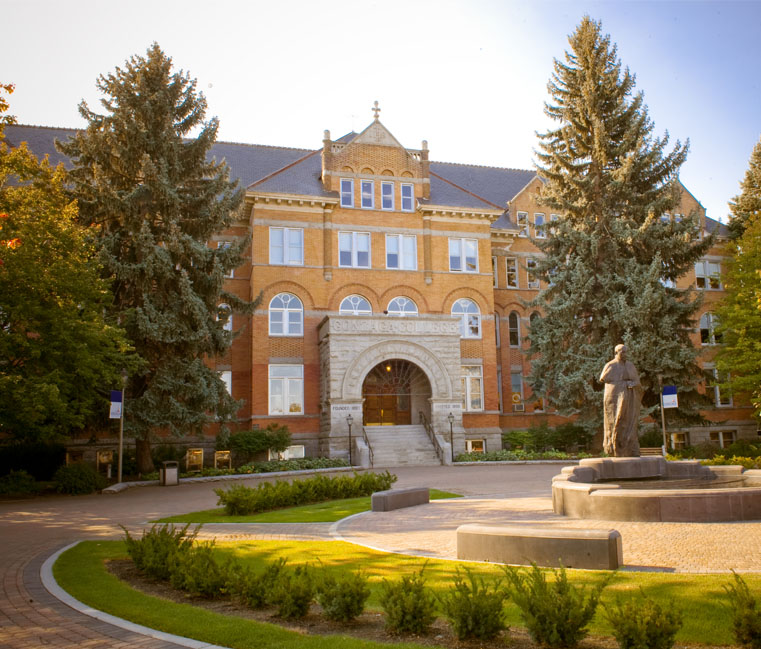

Gonzaga University 502 E Boone Ave. AD Box 49 Spokane, WA 99258
Phone: (509) 313-6753
Office Location Rebmann 203
Mark Alfino teaches for the Philosophy Department at Gonzaga University. His teaching and research interests are broad, but tend to focus on two general problems: the nature of language and the nature of values. He publishes on topics in ethics and, in recent years, has been working on the topics of Happiness and Wisdom.
Dr. Mark Alfino has been a member of the Philosophy Faculty at Gonzaga University since 1989.
Dr. Kirk Besmer
Associate Professor of Philosophy
Gonzaga University Philosophy Dept AD Box 47 Spokane, WA 99258
Phone: 6746
Kirk Besmer received his Ph.D.from the University of Notre Dame. His interests include Continental philosophy, especially Phenomenology and Existentialism, and the philosophy of technology. His most recent publication is: "Embodying a Translation Technology: The Cochlear Implant and Cyborg Intentionality." Techne: Research in Philosophy and Technology. Vol 16 (3) Fall 2012. 296-316.
He is currently on sabbatical.
Dr. Dan Bradley
Assistant Professor
502 E. Boone Ave. AD Box 47 Spokane, WA 99258
Phone: (509) 313-5976
Office Location Rebmann 009
Dan was awarded a PhD from the National University of Ireland in 2008, an MA in Ethics and Cultural Studies from University College Galway in 2003 and BAs in Philosophy and Biology from Gonzaga University in 1999. His research focuses on the phenomenology of religion engaging Continental thinkers (including Ricoeur, Marion, Derrida, Levinas, Heidegger, Husserl, and Kierkegaard) and the neo-Platonic mystical tradition (including Augustine, Ignatius of Loyola, and Teresa of Avila). This year he is teaching Human Nature, Ethics, Phenomenology, and Philosophical Hermeneutics.
Associate Professor of Philosophy and Director of Graduate Studies
Philosophy Department Gonzaga University AD Box 50 Spokane, WA 99258
Phone: 509 313 6743
Office Location Rebmann 211, 1205 North Astor
B.A. in Philosophy, Louisiana State University, 1981 (Phi Beta Kappa); M.A. in Philosophy, Northwestern University, 1985; Ph.D. in Philosophy, Northwestern University, 1989. My teaching and research interests are in ancient Greek philosophy (especially Socratic method, Aristotelian virtue ethics, and friendship), philosophical anthropology/human nature, Christian existentialism, and philosophy of education. Most recently, my research has focused on the historical and conceptual relationships between philosophy, Christianity, and natural science, and the problematic status of the "war narrative" that has emerged in the last century to characterize the Christian-science relationship. I have offered a course covering this material, PHIL 446 Philosophical Reflections on Christianity and Science, each spring since 2006. My most recent graduate seminar, in Spring 2010, examined Aristotle's First Philosophy in the Metaphysics.
I am the coordinator of the Gonzaga Socratic Club, which promotes philosophical inquiry into Christian doctrine, worldview, and practice. Information about the club can be found at http://guweb2.gonzaga.edu/faculty/calhoun/socratic/.
Recent publications:
“Human Exceptionalism and the Imago Dei: The Tradition of Human Dignity.” Human Dignity in Bioethics: From Worldviews to the Public Square, ed. Steven C. Dilley and Nathan J. Palpant. Routledge Annals of Bioethics. Routledge (forthcoming December 2012).
“Prospects for Human Dignity before and after Darwin.” Human Dignity in Bioethics: From Worldviews to the Public Square, ed. Steven C. Dilley and Nathan J. Palpant. Routledge Annals of Bioethics. Routledge (forthcoming December 2012).
“From Solitary Individualism to Post-Christian Stoic Existentialism: Quests for Community, Moral Agency, and Transcendence in the Films of Clint Eastwood.” The Moral Vision of Clint Eastwood, ed. Brian Clayton and Richard McClelland. University of Kentucky (in press).
Dr. Mark Chakoian
Lecturer
502 E. Boone Ave. AD Box 47 Spokane, WA 99258
Office Location Rebmann 105
Office Hours Monday, 3-5 T/Th 10:45-11:45
Education: Ph.D. Philosophy, Loyola University (Chicago, IL 2011); M.A. Philosophy, Loyola University (Chicago, IL 2007); B.A. Philosophy, Mathematics, Bradley University (Peoria, IL 2004)
My scholarly interests include distributive justice (particularly Thomas Pogge's World Poverty and Human Rights), ethics in everyday life (such as the ethics of consumption), race theory and feminism.
Dr. Jay Ciaffa
Associate Professor of Philosophy
AD Box 47
Office Location Rebmann 103
Jay Ciaffa received his BA in Philosophy and History from Cal State, Chico (1982), and his MA and PhD in Philosophy from Tulane University (1991). He regularly teaches courses in African American Philosophy and Healthcare Ethics. In the Fall of 2011, he offered a graduate seminar entitled "Nietzsche and the Ancients." He also serves as an Ethics Consultant on the Deaconess Hospital Ethics Committee. HIs publications include articles on Heidegger, African and African American Philosophy, as well as a book entitled Max Weber and the Problems of Value-free Social Science.
Fr. Timothy Clancy
Associate Professor of Philosophy and Director of Honors
Gonzaga University Philosophy AD Box 30 Spokane, WA 99258
Phone: 509-313-6701
Office Location Hopkins House
Education: B.A. Gonzaga University (1980), M.A. Loyola University of Chicago (1982), M.Div. from Jesuit School of Theology at Berkeley (1989), S.T.L. from Jesuit School of Theology at Berkeley (1991), Ph.D. Loyola University of Chicago (1999)
Professor Clancy's teaching and scholarship focus on Hermeneutics, Romanticism and the Philosophy of Religion.Clancy is currently also Director of Gonzaga's Honors Program
Dr. Brian Clayton
Associate Professor
AD Box 62 Spokane, WA 99258-0062
Phone: 509/313-6744
Fax: 509/313-5718
Office Location Rebmann 201
Office Hours Fall 2011: Monday, Wednesday 1000-1100; Tuesday, Thursday 1100-Noon; other hours by appointment
BA (Philosophy) 1978, Trinity
College (Deerfield, IL); MA
(Philosophy) 1980, University
of Notre Dame (Notre Dame,
IN); PhD. (Philosophy) 1987,
University of Notre Dame
(Notre Dame, IN).
Dr. Clayton has taught at
Gonzaga since 1986. He is
currently the Director of the Gonzaga University Faith and Reason Institute. He regularly teaches courses on Human Nature, Ethics, C.S. Lewis, Walker Percy and Faith & Reason. He has a special interest in contemporary popular film and its relationship to philosophical topics, especially virtue ethics.
Dr. Theodore Di Maria
Associate Professor, Chair, Philosophy Department
Gonzaga University Philosophy AD Box 47 Spokane, WA 99258
Ted received both his B.A. (1986) and M.A. (1988) in philosophy from Northern Illinois University, and his Ph.D. from Marquette University in 1999. His primary research interests are currently in modern philosophy, particularly the theoretical philosophy of Kant, but he also has research interests in existentialist thinkers and ancient philosophy.
Education: B.A.,summa cum laude, Seattle University (1998); M.A., Fordham University (2001); M.Phil., Fordham University (2002); Ph.D., Fordham University (2003)
Professor Henning's scholarship and teaching focus on the interconnections among ethics, metaphysics, and aesthetics. His books include The Ethics of Creativity (2005), Beyond Metaphysics? Explorations in Alfred North Whitehead's Late Thought (2010), Genesis, Evolution, and the Search for a Reasoned Faith (2011), Beyond Mechanism (2013), and Being in America (forthcoming).He is currently working on a book tentatively titled, "The Reluctant Steward: Ethics after Climate Change." (See his website for complete scholarship listing and curriculum vitae.)
He teaches courses on ethics, philosophy of human nature, environmental ethics, ethics of global climate change, and Alfred North Whitehead.
Dr. Henning joined the faculty at Gonzaga in 2008.
Dr. Charles A. Hobbs
Philosophy Lecturer
AD Box 47
Phone: (509) 313-4249
Fax: (509) 313-5718
Education: M.A. and Ph.D. from Southern Illinois University; B.A., West Georgia College.
Hobbs' areas of specialization are the history of American philosophy and ethics, with general areas of competence including political philosophy, modern philosophy, and ancient philosophy. His current research projects deal with: (1) John Dewey's relationship with ancient philosophies such as Epicureanism and Aristotle's virtue ethics; (2) the relationship between Dewey and the development of American anthropology (a collaborative project with U. of Notre Dame anthropologist Gabriel Torres); and (3) classical pragmatism as an approach to philosophy of death and dying.
Dr. Hobbs regularly teaches such courses as Philosophy of Human Nature, Ethics, American Philosophy, and Political Philosophy. Prior to Gonzaga, Hobbs was for three years ('08-'11) a visiting assistant professor at Saint Mary's College, Notre Dame, IN.
recent publications include:
-"Reconsidering John Dewey's Relationship with Ancient Philosophy". International Philosophical Quarterly Vol. 53, No 2, September 2013
-“Why Classical American
Pragmatism is Helpful for Thinking about Death”. Transactions of the C.S. Peirce Society Vol. 47, No. 2, 2011
-"Naturalism, Death, and Functional
Immortality”. Contemporary Pragmatism Vol. 6, No. 1,
June 2009
-“Peirce’s Tychism and the Epicurean Swerve”. Southwest Philosophical Studies Vol. 30,
Spring 2008
Dr. Thomas Jeannot
Professor of Philosophy
502 E. Boone Ave. AD Box 47 Spokane, WA 99258
Education: A.B.
Saint Louis University (1978), Ph.D.
Saint Louis University (1992).
Areas
of expertise: Marxism, Hermeneutics, Ethics, and Classical American Philosophy.
Bernard J. Coughlin, S.J., Professor of Christian Philosophy
Department of Philosophy Gonzaga University AD Box 49 Spokane, WA 99258
Phone: (509) 313-6720
Office Location RB 105
Ph.D.: Boston College, 1988
B.A.: Seattle Univerisity
(philosophy), 1982
B.A.: Seattle University
(theology), 1982
Dr. Quanhua Liu
Associate Professor of Philosophy
502 E. Boone Ave. AD Box 47 Spokane, WA 99258
Phone: (509)313-3950
Office Location Rebmann House 202
Quanhua Liu received Ph.D. in philosophy from Duke University (1994), MA and BA in philosophy from Peking (Beijing) University (1985 and 1982 respectively). His current research interests lie in Chinese philosophy, comparative philosophy, and modern and contemporary philosophy.
Dr. Ellen Maccarone
Associate Professor of Philosophy
AD Box 47
Phone: (509) 313-3955
My BA is in Political Science from The George Washington University (1995); my MA is in Philosophy from Colorado State University (1998) and my PhD is in Philosophy from The University of Florida (2004). My areas of interest are Normative and Applied Ethics, particularly Business Ethics and Feminist Ethics. I am also interested in International Developmental Ethics, Ethics and Food, and Ethics and the Professions.
Graduate Seminar taught Fall 2008: Theories of Justice
Dr. Richard McClelland
Professor of Philosophy
Gonzaga University Philosophy AD Box 47 Spokane, WA 99258
Phone: 509-313-6761
Office Location Rebmann House 213
Graduated from Reed College in 1970 (BA in Literature; elected to Phi Beta Kappa);attended Princeton Theological Seminary, Princeton, NJ 1970-71; graduated from Oxford University (Jesus College; BA, 1975; MA, 1980; both in Theology) and Cambridge University (Corpus Christi College; Ph.D., Ancient Greek Philosophy, 1985). I have taught at the University of Notre Dame (1981-85), Seattle Pacific University (1985-92), Seattle University (1993-99), and have been at Gonzaga since 1999. My special areas of interest are philosophy of mind, moral psychology, and the intersection of both with contemporary cognitive neuroscience, anthropology and ethology (animal behavior). I have special interests in the emotions, empathy, other forms of nonrational cognition and their regulation.
Dr. Wayne P. Pomerleau
Professor of Philosophy and The Robert K. and Ann J. Powers Chair of the Humanities
502 E. Boone Ave. AD Box 50 Spokane, WA 99258
Phone: (509)313-6750
Office Location Rebmann 204
Degrees: Ph.D. from Northwestern Univ., 1977; M.A. from Northwestern Univ., 1972; AB from Georgetown Univ., 1968
Areas of Expertise: History of Modern Philosophy, Philosophy of Religion, and Philosophy of Human Nature
Published Books: Twelve Great Philosophers: A Historical Introduction to Human Nature and Western Philosophies of Religion: Great Religious Epistemologies from Augustine to Hick
Dr. Erik Schmidt
Associate Professor of Philosophy
Gonzaga University Philosophy Department AD Box 48 Spokane, WA 99258
Phone: (509) 313 - 5975
Office Location Rebmann 205 (Rebmann is a former dorm across from St. Aloysius)
Office Hours Dr. Schmidt is in Florence for the Fall 2011 semester.
BA (Philosophy) 1993, Wheaton College (Wheaton, IL); PhD (Philosophy) 2003, Syracuse University (Syracuse, NY). Dr. Schmidt has taught at Gonzaga since 2003. His current research addresses the intersection of moral psychology and practical reason and he is also working on issues related to the philosophy of art.
Education: J.D. (University of Oregon, 2006), Ph.D. (Philosophy, University of Oregon, 2002), M.A. (Philosophy, University of Oregon, 1997), B.A. (English Literature, University of Washington, 1991).
Areas of Teaching: Philosophy of Law/Jurisprudence, Social/Political Philosophy, International Ethics, Ethics, Human Nature
Professional Service: Managing Editor, The Journal of Hate Studies Research Interests: philosophical perspectives on hatred, migration law & policy, critical regionalism, critical race theory, intergroup conflict, peace and conflict studies.
Recent Publications: “Immigration Regionalism (eco)” (U.C. Davis Law Review, 2012), “The Tale of ‘the Tribe’ and ‘the Company Town’,” (University of Oregon Law Review, 2012), “Pastures of Peonage” (with Keith Aoki et al., Northeastern University Law Review, 2012), “Welcome to Amerizona – Immigrants Out!” (with Keith Aoki, Fordham Urban Law Journal, 2011; reprinted in Immigration and Nationality Law Review, 2012); “(In)Visible Cities” (with Keith Aoki et al., Oregon Review of International Law, 2009); “Four Du Boisian Contributions to Critical Race Theory” (Transactions of the C.S. Peirce Society, 2001; reprinted in Du Bois: A Critical Reader, Ashgate, 2010).
Professor Tkacz specializes in the history of medieval philosophy and the philosophy of nature. Much of his research is devoted to recovering the contributions of the thirteenth-century thinker Albertus Magnus to the development of scientific method and the metaphysical foundations of empirical science. Professor Tkacz also serves as President of the Society for Thomistic Natural Philosophy.
Dr. Rose Mary Volbrecht
Professor of Philosophy
502 E. Boone Ave. AD Box 48 Spokane, WA 99258
Phone: (509)313-6756
Office Location Rebmann 104
BA, Mathematics, Houghton College, 1974 MA, Philosophy of Religion, Trinity Evangelical Divinity School, 1977 PhD, Philosophy, University of Notre Dame, 1983
Specialties: Ethics, including Health Care Ethics and Feminist Ethics
Ethics Consultant: Providence Urban Ethics Committee and RENEW (Regional Ethics Network of Eastern Washington)
Recent publications:
With Anita Tarzian, Dianne Hoffman, and Judy Meyers. "The Role of Healthcare Ethics Committee Networks in Shaping Healthcare Policy and Practices." Healthcare Ethics Committees Forum, 18 (March 2006): 85-94.
“Schaivo Uncertainty Can Be Avoided.” Guest column for The Spokesman-Review, April 10, 2005.
With Judy Meyer, RN, PhD. “The Story of the POLST form: How a Grassroots Effort Can Make a Difference in End-of-Life Care.” Delaware Nurses Association Newsletter. March, 2005.
With Myron Bloom, MD. An Ethics Primer for the HolyFamilyHospital Ethics Committee, Spokane, WA., 2004.A twenty-five page introduction to ethics and the work of the ethics committee for use by new members.
Nursing Ethics: Communities in Dialogue. Upper Saddle River, NJ: Prentice Hall,2002.
Dr. John Wagner
Associate Professor of Philosophy
502 E. Boone Ave. AD Box 47 Spokane, WA 99258
Phone: (509)313-6752
Education: B.A.
Catholic University of America (1970), M.A.
Catholic University of America (1971), Ph.D.
Catholic University of America (1979).
Areas
of expertise/interest: Medieval Philosophy, Metaphysics, Chinese
Philosophy
Professor Rukavina came to Gonzaga in 1958 and was promoted to Professor of Philosophy in 1970. He was named Professor Emeritus of Philosophy in 1999. The Department's annual lecture series is named in his honor.