Structural Integrity: Joshua Schultz and Reimagining the Built Environment
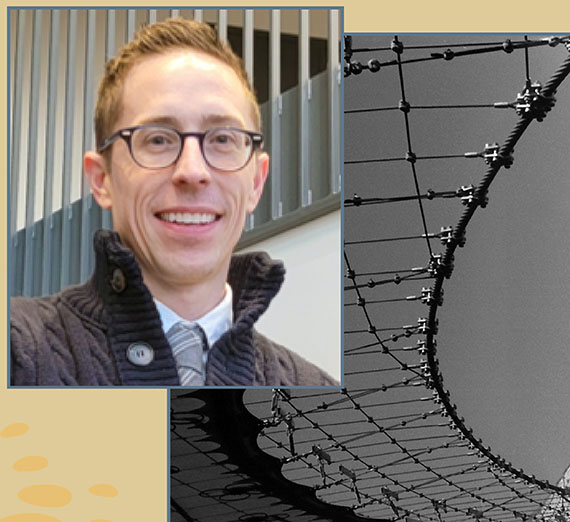
In the world of civil engineering, "lightweight" usually implies efficiency, but for Joshua Schultz, PhD, it’s currently carrying a lot of professional weight.
Between a newly published book, a prestigious award shortlisting, a packed speaking schedule and his usual structural engineering courses, Schultz is carving out a prominent space at the intersection of sustainable design and structural ingenuity.
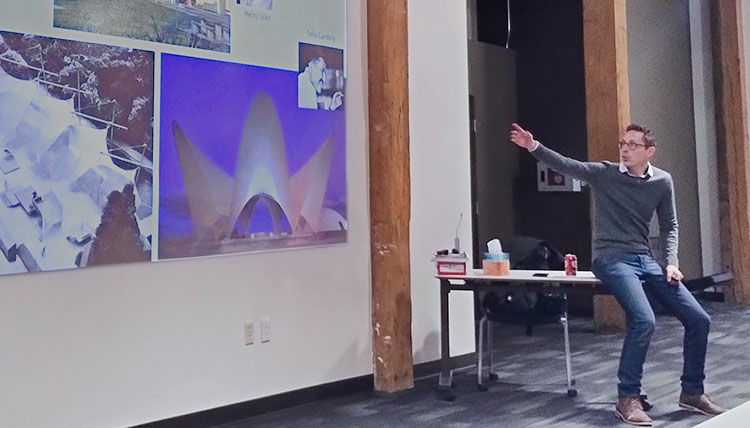
The civil engineering associate professor’s next appearance is in the Hemmingson Auditorium on Thursday, March 26, where he presents a keynote talk for the Gonzaga Institute for Climate, Water and the Environment.
Reimagining the Built Environment
The upcoming talk, "Structural Design of Lightweight Architecture: Reimagining the Built Environment," tackles a heavy reality: the building industry produces nearly one-third of global solid waste, and concrete alone accounts for 8% of annual global CO2 emissions.
Schultz argues that the path forward isn't just about building more—it’s about building smarter.
"In the face of climate change and resource scarcity, the need for innovative, sustainable approaches to construction has never been more urgent," says Schultz. "Lightweight architecture offers a transformative solution, emphasizing efficiency, adaptability, and environmental responsibility."
The 6 p.m. event is free and open to the public, co-sponsored by the Gonzaga University School of Engineering & Applied Science.
A "New Classic" in the Making
The talk draws heavily from Schultz’s new book, Structural Design of Lightweight Architecture (Routledge, Jan. 2026), co-authored with Christian Stutzki. The text has already made waves in the industry, earning a spot on the shortlist for the 2026 Architectural Book Award and reaching #1 for New Releases in Structural Engineering on Amazon.
Industry critics are already drawing comparisons to foundational engineering texts. A recent review in Booklaunch noted that Schultz’s primer "promises to give classics a run for their money," praising its engaging storytelling when explaining tactics to make buildings safe.
Deep Gonzaga Connections
While the book reaches a global audience, its roots are firmly planted in Spokane. Schultz developed much of the course material while teaching at Gonzaga, and the impact is already being felt in the classroom. Content of the book has been integrated into the Advanced Structural Design course, and Schultz expects it will serve as the foundation for a new Lightweight Structures technical elective.
Schultz notably credited several past Gonzaga students in the book's acknowledgments for their work on images and research, including Daniel Camp Seats, Marisa Uribe, Alexis Ewing, Joseph Bowen and Drew Barlow.
Schultz brings a wealth of "real-world" experience to his academic role. Before joining Gonzaga, he worked at the renowned firm Skidmore Owings and Merrill (SOM) in Chicago. Today, he balances his teaching with roles as Founder of Schultz Engineering and Senior Structural Engineer at Siegel Structural Engineers, ensuring his students receive instruction that is as practical as it is theoretical.
The Center for Climate talk is the latest in a series of high-profile engagements for Schultz this academic year. In January, he headlined an event for the Structural Engineers Association of Washington (SEAW) in Spokane, a session attended by several of his own structural engineering students. In February, he gave multiple lectures in the UK – culminating in a visiting lectureship at Cambridge University.