For Such a Time as This
The Inspiration and Resolve Behind President Passerini

Her strategy: Collaborative innovation and collective action.
How did Katia Passerini first learn she had a penchant for seeing needs, identifying solutions and moving into action?
It wasn't when she first became a professor. Or earlier when she discovered she was ill-prepared to use the technology needed in her MBA program. It was way back in elementary school that young Katia – a child of educators – saw an opportunity to put chaos at bay with a reasonable intervention.
Katia's teacher at a public school in Rome, Italy, often stepped out to visit with the neighboring teacher, leaving the children unattended for far too long to expect there wouldn’t be mischief. Katia, who surmised there had to be a way to keep some order, led her fellow students in a game of throwing wadded up paper balls around – the goal being to keep friends occupied while remaining quiet. Anyone who made noise or attracted attention from the principal down the hall was out.
It’s a charming preview of a future Dr. Katia Passerini, president of Gonzaga University.
A month after her official first day as a GU employee – and a month shy of her presidential inauguration – I sat down to learn more about the inspiration and resolve behind a woman already known for her intellect and vision as well as her humor and energetic charism.
In This Story
Faith in Action
Taking a sip of espresso from a tiny cup, Passerini says she's been reading and learning much about the life of St. Ignatius and Gonzaga's connection to someone who had such “transformational power.” But long before she knew of Ignatius of Loyola, who founded the Society of Jesus, which developed universities intent on helping students develop as people with and for others, she received inspiration by two other saints.
"One was St. Vincent de Paul because of his understanding of the fact that charity and philanthropy, as beautiful as they were, needed to be organized,” Passerini says. “He took it upon himself to convince noble women and ladies of charity to open orphanages and hospitals."
She recounts the story of St. Vincent de Paul celebrating Mass in France during a pandemic when he asked for food donations for a particular family that had lost several members. By the end of the Mass, there was a substantial pile of food, and it dawned on de Paul that food is perishable – that generosity is wasted without organization.
"That inspired me,” Passerini says, “because I also like to see a problem and figure out what must be done. I don’t necessarily have the solution – that comes from working with others – but I really like that action-oriented faith.
Her other favorite saint is Mother Elizabeth Ann Seton, a non-Catholic woman of nobility who became Catholic after her husband died from tuberculosis. While tending to him in Italy where he was quarantined, Seton saw how the Catholics interacted and cared for those in need. She returned to the U.S. having lost her husband and children and founded a system of Catholic schools where all children were accepted, regardless of their families’ ability to pay for parochial education.
Those virtues have grown in Passerini specifically through her experiences in Catholic higher education.
Today, her view of the connection between a higher mission and education is broad. “Even if you’re not committing to a life dedicated to Christ, you can still have a commitment to changing people’s lives through education.”
Her Strongest Supporter
Judicious use of time resonates with the 50-something-year-old mother of three in many ways. After one month living on the west side of the U.S. compared to a couple of decades on the East Coast, a sense of practicality is a welcome find in the lifestyle of the Inland Northwest.
“My first impression of this area – going back to how I like to get things done – is that people tend to want less drama for getting things done,” says Passerini. “In New Jersey and New York, there is more political positioning, but what I’ve noticed here is people just want to say, ‘OK, let’s figure it out.’ ”
A major perk for herself and her husband, Arturo Pagán, is Spokane’s small airport and being able to get through security in mere minutes. Despite already having experienced the challenges that come with a small airport – like not having many options if a major flight is canceled, as happened when she went to Mexico – she still says, "I love coming back and everything is so much simpler here."
But relative to knowing her new city’s features and places to visit – she relies on Arturo for that. During the summer when she had relocated to Spokane and he was still on the East Coast, Arturo was texting her suggestions for places in Spokane to eat.
“He is always sending me information,” Passerini says. She laughs that it’s been comically annoying at times, especially when he was in Rome – her hometown – and he was informing her of things she should see there.
As often as possible, Arturo Pagán appears in places where President Katia Passerini is. He’s recognized easily with his charming smile and beaming pride as Passerini’s husband of 25 years.
While earning his master’s in international affairs at the George Washington University, Pagán embarked on a three-week excursion to the Caribbean with an environmental policy class. A student named Katia would be arriving from Rome in time to depart from Washington, D.C., with the class – a flight Pagán missed due to oversleeping. Fortunately, he made it on a later flight and the two finally met that night on the dance floor.
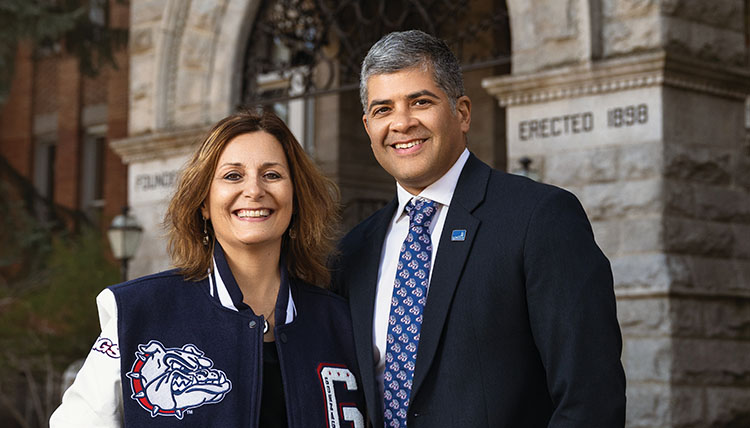
“She was brilliant, smart, engaging and a great dancer," Pagán says. “That was it, I was in love.”
A Brooklyn native and the son of Puerto Rican migrants who came to New York in the ’60s, Pagán grew up inspired by the deep Catholic roots of his family.
He has built an impressive career over the past 24 years as the deputy director for human resources at the United Nations Population Fund. Pagán supports 5,000 HR business partners across 150 countries.
“A huge motivator for me is to be able to help people that I don’t even know,” he says. “I’m not running the programs myself, but every time I travel, I get to see the impact of the work we’re doing.”
Pagán and Passerini watch movies on the rare occasion they’re home at the same time, and he takes time off to accompany her to conferences, wherever they may be.
As for life in Spokane, Pagán says: “One of the beauties of living in a smaller place is you feel like everyone knows each other, and it just makes this place really special.”
The couple’s youngest son, Diego, lives with them and attends Gonzaga Prep. Older sons Luis and Michaelangelo live in New York and Chicago, respectively.
Driving Potential
Asked how she’d like to be known or remembered as a leader, Passerini ponders only a short moment before answering, “Innovative and collaborative.”
But the professor of management information systems who became a department leader, grew into a provost and is now Gonzaga’s president says, she is equally interested in helping others find their potential.
“I know this may be controversial,” she says, “but a business leader I have admired is Steve Jobs, specifically for how he pushed others to think differently. It got to a point that he was obnoxious, but there are also these stories of how people would present him with an idea and he would obsess over the aesthetics as well as the functionality of a product. They would tell him something couldn’t be done and he would tell them to come back with a solution. And sure enough, they did.”
She continues, “I did not know what my potential was until someone pushed me to think differently, and then, sure enough, I was able to do things.”
That person was Mark Somers, dean of the business school at New Jersey Institute of Technology where she first taught as an assistant professor – someone she describes as a brilliant person who knew how to engage people in questions that led them to solutions on their own.
“He never once told me what to do or gave me an opinion or just an answer to a question,” she recalls. “And he always saw a potential that I didn’t see in myself.”

Close Encounters
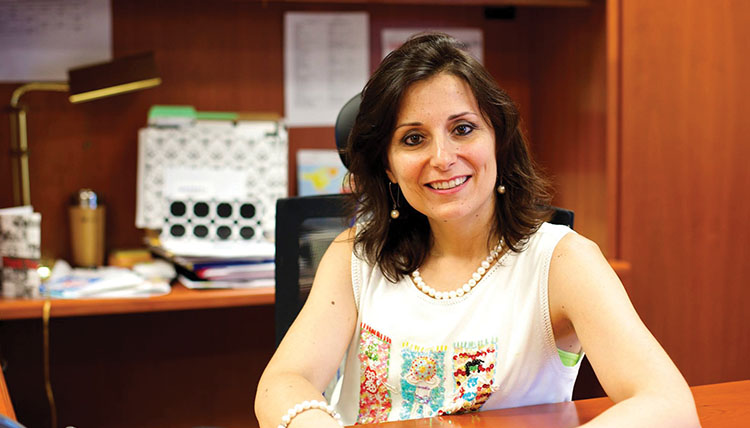
President Passerini shared that mentor Mark Somers “pushed” her to see potential she didn’t know she had. He agreed to share his reflections with Gonzaga Magazine.
Did you see something different in Katia that made you sure she already had the potential to excel as a leader, or were you guiding her the same way you might with any person?
I hired Katia as an assistant professor when I was dean of the School of Management at New Jersey Institute of Technology, and from the very beginning it was clear to me that she was going to be very successful in whatever career path she chose to pursue. Katia is authentic, sincere, has a strong commitment to others and to community, and demonstrates humility while, at the same time, is committed to achieving challenging goals. Research has consistently demonstrated that this is the most desirable leadership profile and also not common, so Katia is different in a very good way. She is pretty much self-motivated so to the extent that I pushed her it was to keep her from falling into the trap of doing ordinary things very well. I can assure you that Katia does not want to be ordinary and she is very open to new ideas and points of view even when they might be seen as unconventional.
As you’ve seen her career path develop, what strikes you?
Before I became an academic, I worked in management development and then in market planning and analysis. As managers’ careers advanced, I noticed that far too many became different people and lost their way by becoming arrogant and self-important. What strikes me about Katia is that she has not lost her sincerity or humility as her career has advanced. As president of Gonzaga, I can see Katia advising a student in much the same way she did as an assistant professor or discussing new educational initiatives with faculty as a colleague rather than as “the boss.”
What are your hopes for her in this presidency?
Katia will define her success in terms of the success of Gonzaga’s students, faculty, alumni and other key stakeholders. My hope and expectation is that Gonzaga will continue to progress and Katia will be remembered as a leader who navigated a challenging environment while ensuring that no one was left behind.
Getting Techy
President Passerini’s interest in technology piqued when she arrived in the U.S. for graduate school at the George Washington University. “I had always loved organizing processes, but there was more of a culture of technology and our student teams were using Quattro (or was it Lotus?) and collaborating on charts and I had no clue what to do. I was so embarrassed,” she says. “And so I realized I needed to learn more about technology, and then I loved it.”
During her MBA, Passerini worked at the World Bank and loved seeing how people interacted with technology.
As an expert in management information systems, it is unsurprising Passerini also has keen interest in the growth of artificial intelligence, a hot topic for colleges and universities. In spring 2025, she authored an article for Seton Hall’s Stillman School of Business, titled “Reluctantly Innovative: Will Universities Survive the GenAI Learning Revolution?” and co-presented “Not So Fast: Mapping the Learning Speed and Sophistication in GenAI,” at the Hawaii International Conference on System Science.
These interests and related skillsets will no doubt serve Passerini well at Gonzaga. This year, University Advancement and Information Technology Services have launched a customer relationship management system that will improve how databases across campus work with one another. GU continues to strive for funding to move ahead with the Tech Hub with Lakeside Properties to open an aerospace manufacturing facility. The new Institute for Informatics and Applied Technology is systematizing – among other things – how artificial intelligence is used responsibly and woven into the core curriculum. There are facilities upgrades to orchestrate, global branding to achieve, enrollment cliffs to mitigate – and technology will be at the forefront of those evaluation processes and outcomes.
Those are the kind of challenges Katia Passerini finds invigorating.
Thinking Globally and Inclusively
Where Passion & Expertise Meet
President Passerini’s career has included a number of opportunities to highlight her areas of personal expertise and passion. Among them: global engagement and women in leadership..
Passerini doesn’t just enjoy traveling internationally – she thrives on connecting with other leaders and learning how collaboration can benefit all involved. In previous positions, she has been a champion for global engagement, international business development and Fulbright scholar programs. While at Seton Hall University, she hosted the president of the United Nations General Assembly, discussing priorities for peace, prosperity, progress and sustainability.
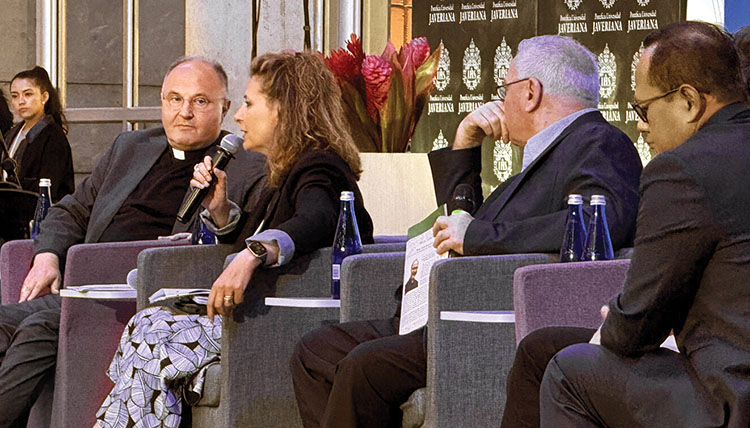
During her interim presidency at Seton Hall, she wrote in the university magazine: “With nations, peoples and cultures growing ever closer, the time is right for our University to further advance its ideals across the globe.”
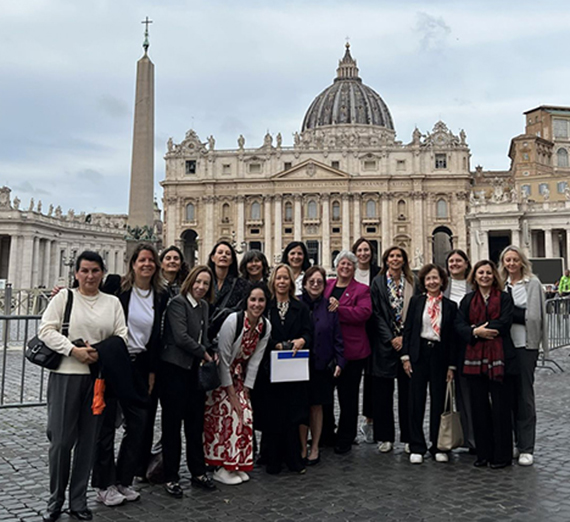
She brings that same perspective to Gonzaga, hoping to continue making GU an internationally known name. And within her first month as GU employee, she took a first step to making it happen. Gonzaga is now a member of the Federation of International Catholic Universities. She has served on its administrative board since 2022 and became vice president this year.
As early as 2015, she was a champion for the expansion of women’s roles in science and technology, seeking and receiving funding from the National Science Foundation to attract and retain women faculty in STEM fields at St. John’s University. While a dean there, she was a panel speaker at the 2018 United Nations International Council for Small Business Forum, where she said the UN’s sustainable development goals “cannot be achieved and will not be sustainable without increased women's involvement and participation.”
Learning How to Zag
Amid the operational functions of the University, acclimating to a new city and continuing her leadership in international Catholic higher education consortiums, President Passerini is most excited about learning “the Gonzaga way.”
She marveled at the turnout of staff members and faculty who volunteered to help students move into dorms and the assortment of activities planned for new Zags and their families on Welcome Weekend. When she commented on this to the chief mission officer, Ellen Maccarone replied, “It’s the Gonzaga way.”
Witnessing students in the Kennel during a game last winter, she saw the familiar stomping and chanting that is crucial in “how to Zag” for basketball.
She’s looking forward to her own newness wearing off a bit so she can sneak into a lecture or a performance or a group of students hanging out and not have to be formally introduced. “I want to enjoy those experiences,” she says.
And the new president is very aware of the incredible network of Gonzaga alumni, too, who can demonstrate how strong the community is even miles away from campus. She’s hoping that business trips to other cities where there are Zags will include opportunities to have dinner with small groups and get to know people personally.
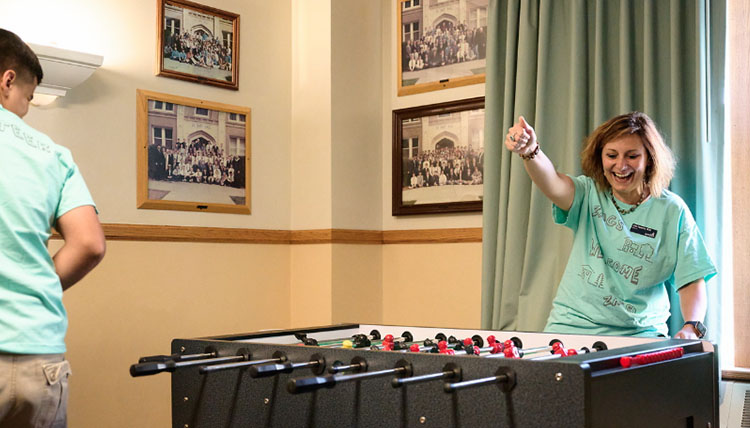
Unsurprisingly, Passerini has also learned that connecting with Zag alumni and fans across the country and around the world is as simple as wearing a Gonzaga shirt in the airport.
“It’s crazy, absolutely crazy!” she says. “Every time I wear a Gonzaga sweatshirt anywhere I travel, I’m going to meet someone with a Gonzaga story.”
Based on early interactions with students and lively exchanges with alumni and parents, plus Passerini's boundless energy and enthusiasm, all signs point to Gonzaga's new president fully embodying what it means to Zag.
- President's Office
- Gonzaga Magazine