
The Living Continuum of Leadership
United by mission, three leaders steward the Gonzaga story.
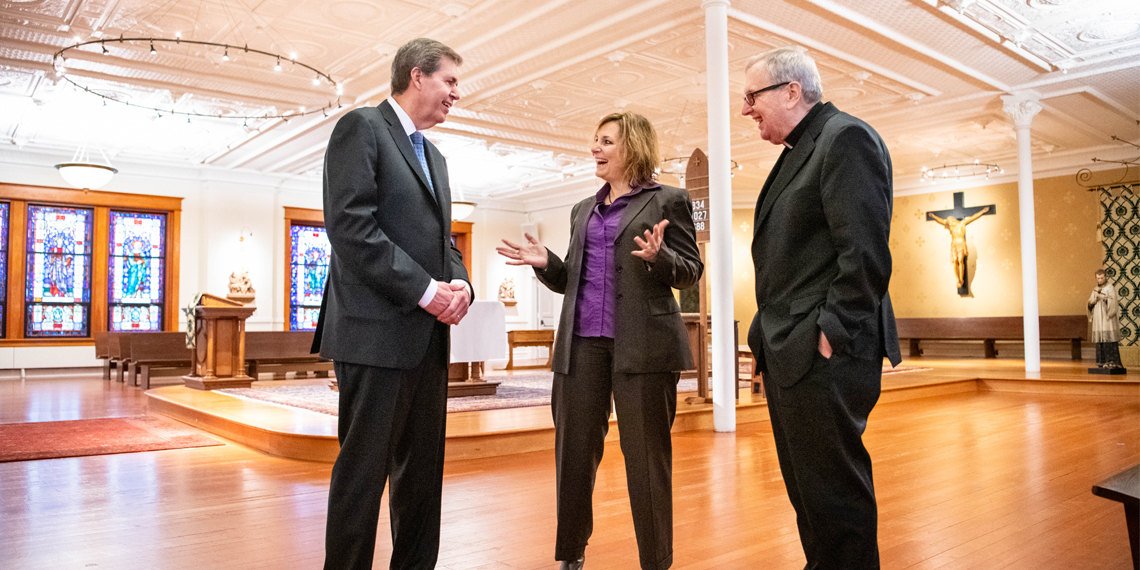
The floor spoke first.
Not loudly, just the soft creak of century-old wood doing what old wood does when it recognizes familiar footsteps. In the student chapel, beneath the pressed-tin ceiling once hidden and now restored to its original dignity, three Gonzaga University presidents stood shoulder to shoulder while a student photographer adjusted his lens. Sam, a journalism major from the Class of ’26, leaned forward, camera lifted, watching history quietly arrange itself into a frame.
On the left stood President Emeritus Thayne M. McCulloh, D.Phil. In the center, current President Katia Passerini, Ph.D. On the right, former president Father Robert J. Spitzer, S.J.
Someone, both affectionately and appropriately, had already nicknamed them “Gonzaga’s Holy Trinity.” They shared breakfast earlier that morning, connecting over coffee and the kind of conversation that refuses to fit into an agenda because it belongs more to relationship than schedule. Spitzer and McCulloh reminisced. Passerini listened, asked and added. Institutional memory met institutional future, and neither felt the need to prove anything to the other. They did not speak like successors and predecessors. They spoke like colleagues who understood the same promise from different decades.
The chapel itself seemed to keep time with them.
McCulloh mentioned the floors were original, boards that had held generations of prayers, anxious exam mornings, friendships formed in late-night conversations, Zag weddings, moments of grief, and the quiet relief of finding one’s place. Gonzaga buildings rarely behave like architecture — they behave like witnesses. The room carried a rhythm, not measured in minutes but in recurrence. Through footsteps, pauses, laughter, silence, then footsteps again, the past did not sit behind the present here. It moved alongside it.
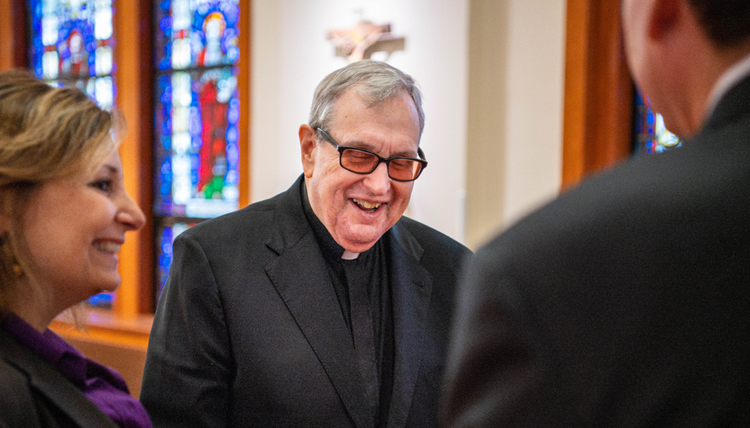
Spitzer told the story of helping orchestrate the chapel’s renovation, including securing the stained-glass windows, and replacing avocado green and harvest gold with something closer to permanence. It was restoration recalled not as nostalgia but as honesty. Jesuit education often works the same way: remove distraction, reveal intention and allow what has always been true to become visible again.
Conversation drifted naturally from memory into present work. Passerini spoke about recent trips to Washington, D.C., advocating for higher education and Gonzaga in Florence, and to Olympia, where she and a student met with lawmakers about financial aid reductions affecting Washington students hoping to attend Gonzaga. As they spoke, the rhythm of leadership unfolded in real time and they sounded less like presidents and more like friends reunited after long travel, not because they shared the same years but because they shared the same vocation.
Then came a question that turned the morning gently playful.
“If you three were siblings, what would your birth order be?”
Laughter arrived almost immediately and stayed for a while. Passerini, an only child, decided she would be the youngest, her independence paired naturally with curiosity about the story she had stepped into. Spitzer described himself as the peacemaker, the second born who gathers people into understanding. McCulloh acknowledged the organizing instinct of the firstborn, the steady responsibility to hold structure so others can flourish. Lighthearted answers revealed decades of leadership building systems reconciling people and charting forward movement. Together they represented the distinctly Jesuit ways of community in motion and harmony formed not by uniformity but by attunement.
Each of these leaders has stewarded major philanthropic efforts in Gonzaga’s history. Each understands deeply how benefaction sustains the mission. Yet during the entire morning, impact was never described in dollars. It was described in names. Jesuit education has always insisted education is relational before it is institutional. Alumni and friends do not support Gonzaga because the University needs money. They support Gonzaga because someone once believed in them and it’s in their hearts to pay it forward.
Three presidents in one room is unusual. Three presidents in conversation is even more rare. Three presidents comfortable enough to laugh about sibling dynamics and then discussing public policy advocacy reveals something deeper than coincidence. The moment carried weight not because of hierarchy but because of continuity. Spitzer helped shape the spiritual and intellectual identity. McCulloh guided growth and national stature. Passerini now carries the work into a changing higher-education landscape marked by rising student need, increasing costs of living and ever-changing public opinion. Different eras, yet the same purpose resonated with them all — educate the people the world needs most. The photograph Sam captured holds stewardship across generations, in a relay race where the baton is Gonzaga’s enduring mission.
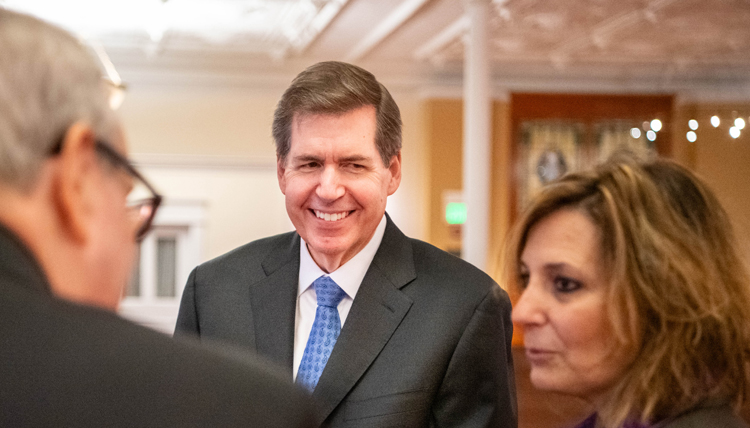
The University moves forward not by leaving its past behind, but by letting it keep pace. Philanthropy is participation in a story already underway, joining the cadence that has been sounding here long before any one presidency and will continue after all of them. Every scholarship extends a conversation begun long before a student arrives on campus. Every gift becomes part of the continuity visible in that chapel. Every donor becomes, in a quiet way, another voice at that breakfast table, advocating for access, opportunity and impact. The three presidents never measured impact in dollars because they see what generosity makes possible: belonging, formation, courage and hope. Supporting Gonzaga is less like funding an organization and more like joining a lineage, stepping into a rhythm already being kept.
Your support helps ensure that one day, decades from now, another floor will creak beneath another set of footsteps and recognize them as part of the same story.
- Academics
- Alumni
- Faith & Mission
- Global Impact
- Student Life
- Alumni
- University Advancement
- President's Office