Then and Now: The Sweet Science of Boxing Legends
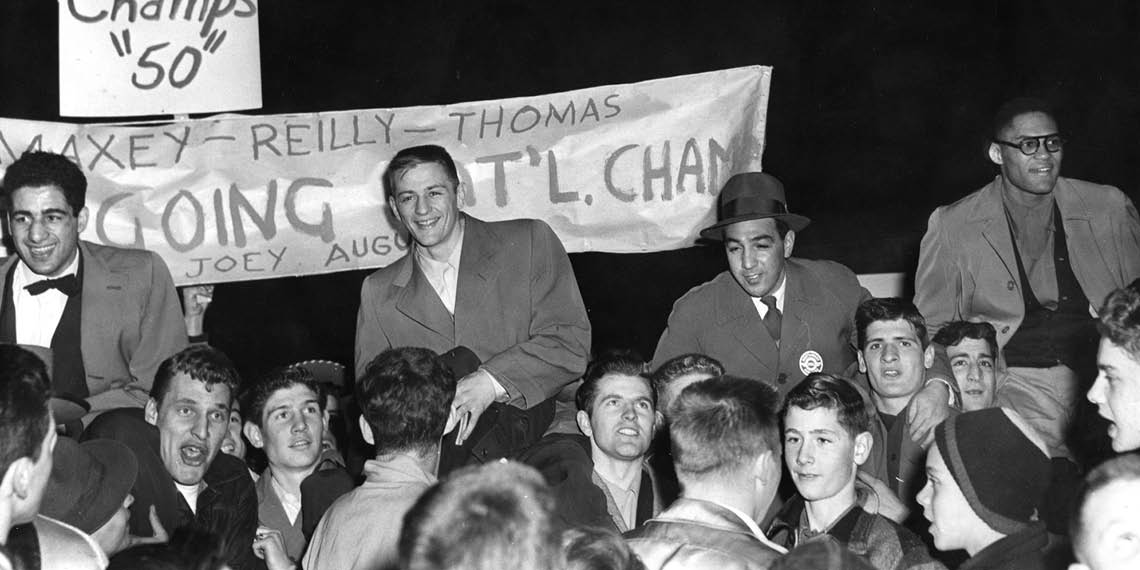
Hollywood screenwriters couldn’t have captured a story any better than the tale lived out by three Gonzaga boxers and their coach, Joey August.
It was 75 years ago that this undermanned but voraciously determined team of three – Carl Maxey, Eli Thomas and Jim Reilly – and their father-figure-of-a-coach defied all odds and brought home Gonzaga’s only national athletic championship, the 1950 collegiate boxing title.
Gonzaga didn’t have all the accoutrements of the big schools of that time. Coach and his wife, Norma, housed several student-athletes in their basement, the school’s training facilities and weight room were archaic, and a small band of Bulldog backers – the Ringsiders – canvassed downtown business owners to raise funds for travel when Maxey, Thomas and Reilly each captured their Pacific Coast Collegiate weight-class championships and qualified for the nationals. According to news accounts at the time, it was close to midnight before the team’s scheduled flight to Pennsylvania that the goal was met and the team was assured their trip.
The three-man team was pitted against larger schools and odds for the Bulldogs were low. But Reilly, a local kid who grew up admiring August and the Gonzaga program, won his first bout and the points he received would prove essential for what was to follow.
Thomas completed his first of two undefeated seasons and captured the 155-pound title, setting up the final bout between 1948 Olympian Chuck Spieser and Maxey.
Maxey, a precision puncher who grew up in a Tacoma orphanage, spent two years at Spokane County Juvenile Detention Center when the board at the orphanage decided Blacks were no longer welcome there. Two years later, Father Neil Byrne, S.J., gave Carl a place he could call home at the Coeur d’Alene Indian Mission School.
Maxey had been targeted with prejudice and harassment most of his young life, but in the ring, it was man vs. man. In Jim Kershner’s book, “Carl Maxey: A Fighting Life,” August recalls Maxey coming to his corner between rounds in this close title fight, saying, “I haven’t trained all these years for nothing, Joey. I’m going to go out there this round and win.”
He did so, helping the Bulldogs win the team championship, tying the University of Idaho for the national title.
The Spokesman-Review ran photos of a crowd swarming the team as they deboarded the airplane at Geiger Field upon their return home. A motorcade escorted the team through town to a high-energy rally back on campus. Kershner wrote that this national title put Gonzaga on the map.
Maxey completed a law degree at Gonzaga and championed the rights of underrepresented people both locally and across the nation. He was one of the country’s foremost civil rights attorneys, throwing punches to strike down prejudice and inequality. When he died in 1997 at 73, he left behind his wife, Lu, and attorney sons Bill and Bevan, who continue Carl’s practice.
Thomas’ early life wasn’t easy either.
“Dad was severely dyslexic,” says Michele Thomas, Eli’s daughter who is creating a documentary about his life and the success of this boxing team. “Eli was raised in Butte, Montana, but was required to go to Gonzaga High School for his first semester and get a 2.5 G.P.A. or better before he could enroll in college and join the team. So, Norma August worked with him every night to overcome his learning obstacles.”
Following college, Thomas operated his dad’s menswear retail store in Butte and a similar store in Anaconda, Montana, before opening Eli Thomas Menswear in San Jose, California, which is still in business 66 years later. He was commissioner of the California State Athletics Commission for seven years, and started the Police Athletic League in Santa Clara County, staging an annual golf tournament to raise money to help build gyms and baseball fields for underprivileged children. Eli died in 2022. He and wife, Dorothy, had 11 children.
Reilly grew up on a ranch near 29th and Regal in Spokane, where he milked the cows every morning before school. The chiding by school kids about his milk-stained shoes followed him into parenthood so he made sure to shine and polish his kids’ shoes every Sunday, his daughter Kathleen Reilly says.
Reilly coached and counseled at a free gym he and fellow boxers opened for youth and was volunteer director of the annual Inland Empire Boxing Tournament. He had a long career in beer sales and distribution and remained steadfast friends with Thomas and Maxey. Reilly died in 2017. He was 88. He and wife, Shirley, had five children.
The common denominator in the success of these three Zags was their mentor, Coach August.
A boxer himself in amateur bouts as a young adult, Augustbrought out the best in those he coached. Reilly gave him credit for opening the door for countless young men who benefited from the “sweet science,” as Joey called boxing.
No one understood “sweet science” better than Maxey, who was big and strong, but also had finesse.
“From Joey I learned more than a good defense and a good jab,” Maxey is quoted as saying. “I learned discipline, individualism and integrity.”
August went on to own and operate Joey’s Tavern, a legendary pub now known as Jack and Dan’s. He later bought a local beer distributorship and often employed Gonzaga part-time coaches and athletes to help them make ends meet, always reaching out to help others.
Here’s a salute to the men who lifted up a team, a university and a community. Happy 75th anniversary to one of Gonzaga’s greatest triumphs.
Recommended reading: “Carl Maxey: A Fighting Life,” by Jim Kershner, University of Washington Press, 2011.
- Alumni
- Alumni
- Gonzaga Magazine