
Coach Fortier’s Advice for Hard Seasons: Keep Going. You Can Do This.
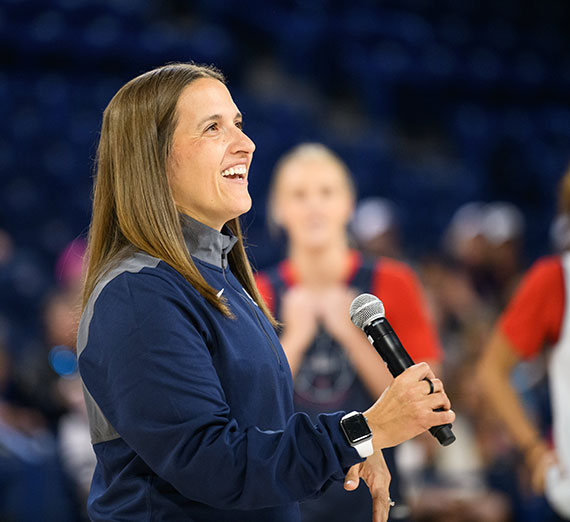
For more than a decade, Lisa Fortier has lived inside those moments. She has built one of the most successful programs in women’s college basketball. Players describe her as a balance of demanding and deeply caring, competitive and grounded. Spokane knows her well as the coach pacing the sideline in the Kennel who they might also bump into at their local Costco.
This year, on Mother’s Day morning inside the Spokane Veterans Memorial Arena, Coach Fortier will stand at the commencement podium as someone who has spent the last year learning what it means to stay steady when life changes without warning.
In 2024, Fortier was diagnosed with cancer.
“It was unexpected,” she said. “Your plans only go so far.”
For Fortier, the experience was never just about the illness or her recovery. It became an uninvited education in vulnerability, identity and perspective. It slowed a life that had long moved at the pace of practices, recruiting trips, scouting reports and game preparation.
“I think I just moved so fast,” she said. “A lot of us do through life. I didn’t take the time until then to really notice and appreciate things.”
The experience also revealed parts of herself she had not fully examined before. She speaks candidly about the fear of losing her hair, the discomfort of watching her body change and the realization that coaching had begun to consume more of her life than she recognized.
“It exposed the way I’d allowed the job to kind of run me a little bit,” she said.
Still, true to the spirit that has defined her teams for years, Fortier did not retreat from the difficulty of battling cancer. Instead, she leaned toward it. During her treatment, she adopted an unusual phrase for the disease that had disrupted her life: “make cancer my new best friend.”
She wasn’t welcoming cancer with that mantra—it was that resisting reality, she discovered, was different from facing it.
“The adaptability, the adjusting and the sticking through it,” she said, “that’s the part where we find success on the other side.”
That message now sits at the heart of the commencement address she has spent weeks writing and rewriting, occasionally while inventing elaborate distractions to avoid finishing it. She joked, “Anything to put it off!”
Long before coaching became her calling, Fortier planned to become an English teacher. Writing, she admits, still matters deeply to her. She is less nervous about speaking publicly than she is about finding the right words. And the words she ultimately wants graduates to carry with them are not about trophies, rankings or career ladders. They are about staying.
“There’s good stuff on the other side of staying,” she said.
It is a striking message to offer graduates entering a world that often rewards speed, reinvention and easy exits. Fortier sees across college athletics, as increasing numbers of athletes move quickly toward whatever feels easiest or most immediately rewarding. But her own life, she believes, has been formed by loyalty and commitment.
“I found the right fit for me,” she said of Gonzaga. “And then I stayed here and we worked through hard things together.”
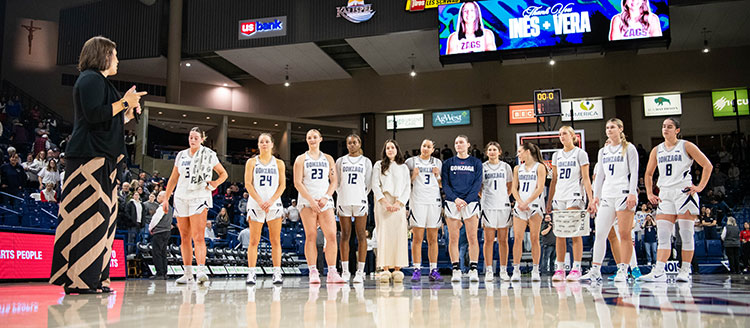
That same philosophy has shaped the culture of Gonzaga women’s basketball. Some of her assistant coaches have remained alongside her for more than a decade. Former players return to Spokane years after graduation not merely to revisit old victories, but because the relationships endured.
“It feels like family,” Fortier said. “Alumni become your friends. They’re always family, but it becomes a different relationship when they leave the nest.”
Former players have walked through loss, divorce, career changes and life transitions with Fortier accompanying them. Alumni Day, she says, is one of her favorite days of the year because it reminds her that what was built together lasted beyond the final buzzer. In many ways, that enduring sense of belonging mirrors what Fortier says she loves most about both Gonzaga and Spokane.
“I like to be part of something that’s not just about me,” she said.
She describes Spokane not in terms of celebrity or recognition, but community. The familiar faces at the store. Parents in the stands with her at youth sporting events. The interconnectedness of campus, church, neighborhoods and relationships formed over years rather than moments.
“You’re not lost here,” she said. “In the Inland Northwest, you get to feel like you’re truly part of something.”
That sense of rootedness also shapes her faith, which she describes as inseparable from both her personal life and her work at Gonzaga. Having the freedom to pray with players, speak openly about belief and work within a community where faith remains visible and lived has become one of the defining gifts of her career.
“It’s one of my favorite parts of Gonzaga,” she said.
When Fortier reflects on the people who shaped her, she speaks first about mentors. About the late Dr. Jerry Krause, whose philosophy of lifelong learning and integrity still guides her today. About her parents and teachers who stood for what was right regardless of the cost. And about faith itself. Then, almost instinctively, she circles back to gratitude. The kind built in hospital rooms. In locker rooms. In hard seasons. In communities that remain with you when plans fall apart.
On Sunday, thousands of graduates will walk across the stage carrying ambitions, anxieties, carefully constructed plans and hopes for the future. Fortier knows many of those plans will change. Some unexpectedly. But she also knows that difficulty is not evidence of failure.
“I would like them to know that adversity is normal,” she said. “That’s part of life. We will all go through those moments.”
And when those moments come, her hope is that graduates remember they are more capable than they think they are. That growth can happen even in hard seasons. That resilience is often quieter than triumph. And that sometimes, the bravest thing a person can do is remain present long enough to be transformed by what they are walking through.