
Solving Energy Issues Together
“How might we do that?”
That simple question, in the face of challenges no one has solved before, is a question Heather Rosentrater (’99) has asked throughout her journey from Avista Corp. intern to President and CEO. Through partnerships and new technology, “exciting solutions” are closer than ever.
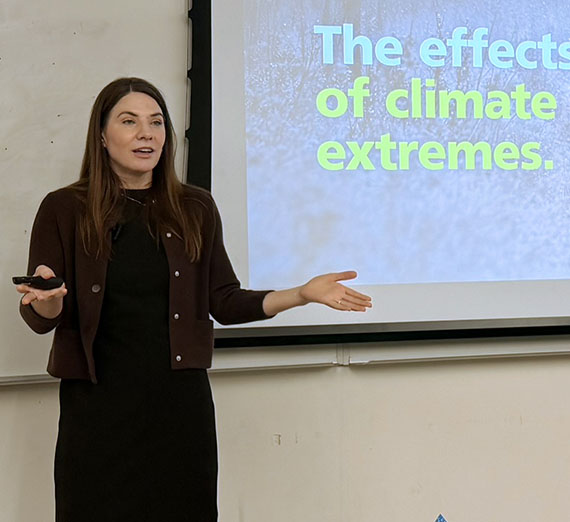
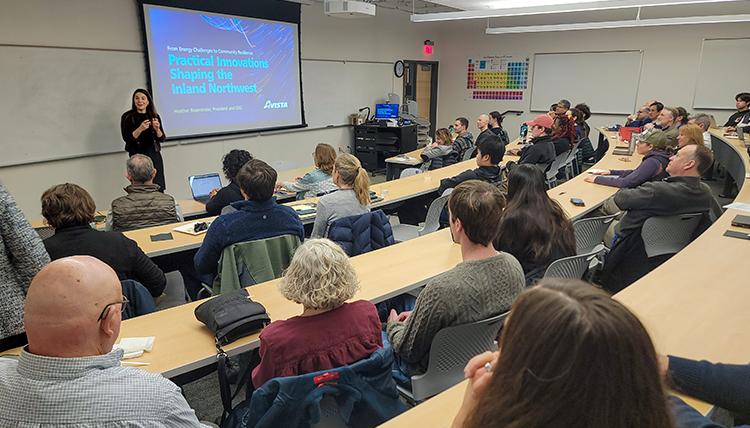
In February, Rosentrater presented the School of Engineering and Applied Science’s keynote Renouard Lecture for National Engineers Week. As the first female CEO in the 136-year history of Avista, she reflected on a career and unexpected leap to leadership of the company that provides electric service and natural gas service to over 1.5 million people in 30,000-square-mile territory.
Back when Avista was Washington Water Power, she was working on fuel cells at the company while also sitting in Gonzaga classrooms learning technical theory, which, she says, “kept me focused on my studies, because I was getting to apply them.”
Speaking to a room full of engineers in every discipline, Rosentrater said, “It's probably one of the most important challenges we have – supporting the transition into clean energy in an affordable, reliable and safe way for our communities.”
Having been in the energy industry for 30 years, she has seen her fair share of transitions in energy demand. There were conversations about building nuclear power plants, talks of deregulation, upheavals from the early-2000s energy crisis that bankrupted many providers, and speculation that fuel cells would replace the grid.
Today’s power industry faces a “trilemma” of developing energy systems that are affordable, clean and reliable. Rapidly-changing technology and extreme climate impact the existing system in new, unexpected ways. Rosentrater recalled the 2021 heat dome when Avista had to ask industries and residents to curtail their usage which she said is not something a service company ever wants to do. “What we learned was that we can't look back anymore and expect to be able to predict what we’re going to see moving forward. We have to have different planning assumptions and build the system with more flexibility in mind.”
She expects energy use to increase as well as the demand to figure out how to control it.
One solution is a “micro grid” – the likes of which will soon be reality at Spokane’s Martin Luther King Jr. Family Outreach Center – to be a resiliency hub with solar power, electric vehicle charging and a natural gas backup generator. Another is the Scott Morris Center for Energy Innovation, where simulation can evaluate the power grid’s capacity safely.
To keep that collaboration going, Rosentrater credits her Gonzaga education for a foundation in service, critical thinking, and “respectful conversations, but not shying away from having different opinions. Just having a liberal arts foundational education in a technical career has been a huge importance to me.”
Avista’s internship program today is vastly different from what Rosentrater had, involving students in electrical, mechanical and civil engineering, plus cybersecurity and other STEM fields. Those summer programs ask students to apply their “curious minds” to research and innovation, supporting solutions to real-world challenges.
“Every time we hear presentations from the students, we are blown away with the kind of work that they've been able to do, and the new eyes they bring to the problems they're solving,” Rosentrater said. “We are so much better because we learn from them.”