
Research of Consequence: McKinstry Program Empowers Research
The McKinstry Fellows Research Program continues to reshape how students in the health sciences explore critical health challenges. Gonzaga undergrads and University of Washington medical students often pair up under the guidance of faculty research leads on topics with real-world impact.
Two of this year’s projects address Parkinson’s disease mobility and rural hospital mental‑health outcomes.
For Gonzaga Associate Professor of Human Physiology Clint Wutzke, whose work centers on gait and balance in individuals with Parkinson’s disease, the fellowship has fueled four years of continuous discovery.
Wutzke’s team began with what participants affectionately called the “Whack‑a‑Mole study,” replacing a traditional paper‑and‑pencil executive‑function test with a full‑body version using Blaze Pods. When pods lit up outside a participant’s field of view, individuals with Parkinson’s took noticeably longer to locate and step toward the next target. “That’s where these non‑motor symptoms would play a larger part,” Wutzke explains, highlighting how cognitive load disrupts movement initiation.
Subsequent projects examined torque production at the ankle and knee, revealing that reduced strength – even on the less‑affected side – correlates with fear of falling. Another study explored gait variability on treadmills and over ground, including dual‑task trials where participants walked while counting backward by sevens.
These aren’t easy tasks, Wutzke notes saying, “They are all sweating, focusing more on that than on their walking performance.”
Most recently, his team piloted a novel balance‑assessment system that asks participants to “draw” shapes with their center of mass. Early results show promise for both assessment and training, and Wutzke plans to take the system into assisted‑living communities. The fellowship, he emphasized, also transforms students: “It gives these students an opportunity to interact with members of the community and to hear their stories.”
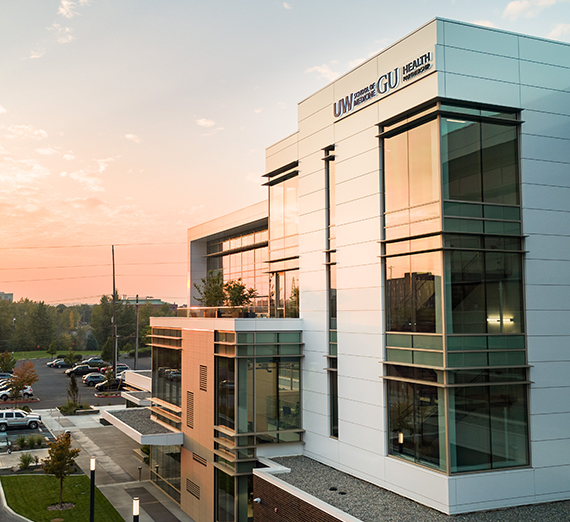
All of his work occurs within the Human Physiology labs in the UW-GU Health Partnership building, where Wutzke’s undergrads have opportunity to learn alongside UW medical students.

The team’s findings were striking: 58% of hospitalizations included a mental‑health diagnosis, far above the national average of 38%. “They have nowhere else to go,” Matousek says, pointing to limited outpatient mental‑health access in rural regions. Patients with mental illness also carried significantly more chronic conditions, and early trends suggest higher emergency‑department use and readmission rates.
For Matousek, the fellowship is as much about training as it is about data. “This was a beautiful way for our undergraduate public health students to be introduced to research,” she says. Medical students, too, stepped into leadership roles, mentoring undergraduates and shaping study design.
Together, these projects reflect a growing model of interdisciplinary, community‑rooted research – one that prepares future clinicians and public‑health leaders while addressing urgent regional needs.
“We’re looking at health‑focused questions and ultimately improving the lives of people in our community,” says Wutzke.
Learn more: