
Gonzaga Professor Examines Alfred North Whitehead’s Legacy at International Philosophy Conference

Alfred North Whitehead and the Enduring Questions of Modern Science
Though he is less well known today, a century ago Alfred North Whitehead was an academic rock star. After a productive career teaching mathematics in Cambridge and London, in 1924 he sailed for America to take up a philosophy position at Harvard University. A year later, in the fall of 1925, he published one of his most widely read works, Science and the Modern World — a bold call to rethink the foundations of science by considering a more organic, relational and value-laden view of reality.
Today, Whitehead is recognized as the founding thinker in the schools of process philosophy and process theology, which take their names from his 1929 treatise on metaphysics, Process and Reality. A century later, the world now described as postmodern is marked by skepticism toward absolute certainties, an emphasis on contextual knowing and a growing recognition of the limits of reductionist and mechanistic thinking.
A Postmodern Moment for Rethinking Science
In December, Gonzaga University Professor of Philosophy and Environmental Studies & Sciences Brian G. Henning was invited to attend an international conference celebrating the 100th anniversary of the publication of Whitehead’s Science and the Modern World. The conference, held in Zhuhai, China, brought together philosophers, scientists and transdisciplinary scholars to explore how science might evolve within this postmodern context.
The tensions Whitehead identified — between abstraction and concreteness, mechanism and organism, fact and value — remain unresolved but increasingly urgent in light of global ecological, social and epistemic crises.
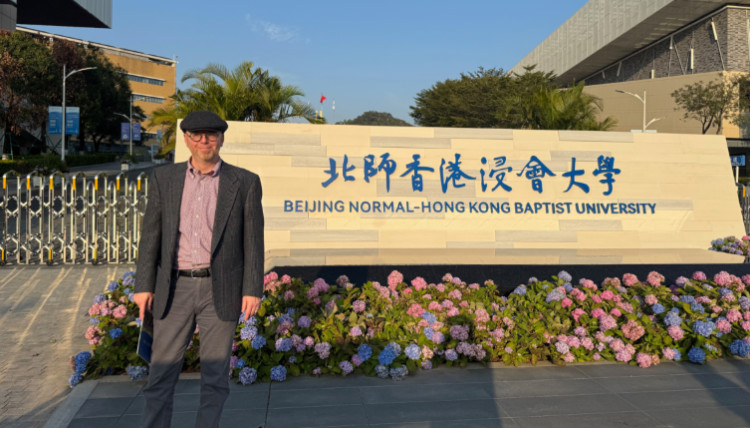
Gonzaga Faculty Engage in Global Philosophical Dialogue
By reflecting on Whitehead’s vision from the vantage point of the postmodern world, conference participants considered how humanity might move beyond its modernist inheritance toward a more integrative and life-affirming cosmology. The gathering welcomed diverse perspectives that challenge reductionist assumptions, rethink categories such as life, matter and mind and reimagine science as part of a dynamic, relational and meaning-filled universe.
Henning’s participation reflects Gonzaga University’s commitment to engaging global conversations that address some of the most pressing intellectual and ethical questions of the contemporary world.
Whitehead’s Influence on the Origins of Environmental Ethics
Henning’s conference paper, “Alfred North Whitehead and the Origins of Environmental Ethics,” argued that Whitehead’s philosophy anticipated the field of environmental ethics by nearly 50 years. He suggested that Science and the Modern World may have influenced Aldo Leopold, whose “land ethic” is often cited as foundational to the discipline.
Regardless of whether that influence can be definitively traced, Henning emphasized that process philosophers deeply shaped the early development of environmental ethics. Scholars influenced by Whitehead authored the first dissertation in the field, convened the first conference, published the first article in a major academic journal and wrote the first monograph on environmental ethics.
Process Philosophy and the Future of Environmental Thought
Henning contends that, on any reasonable measure, Whitehead and his philosophy should be recognized among the chief intellectual grandparents of environmental ethics. By centering relationships, values and lived experience, Whitehead’s work continues to offer resources for rethinking humanity’s relationship with the natural world.
A century after Science and the Modern World was first published, Whitehead’s ideas remain strikingly relevant — not only within philosophy, but also for addressing the ethical and ecological challenges shaping the future of life on Earth.
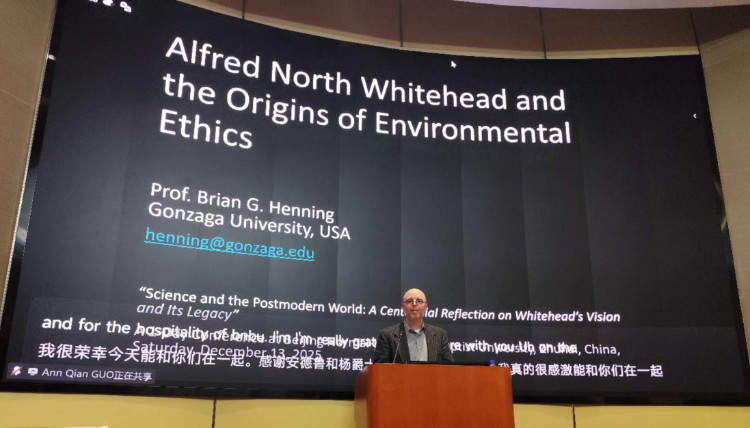
Continue the Conversation
Explore Gonzaga University’s Philosophy and Environmental Studies & Sciences departments, learn more about faculty scholarship and discover resources connected to Alfred North Whitehead’s ongoing intellectual legacy.
Note: AI tools assisted with organization and optimization. Story content remains unchanged.