
Zags in Tech: Exploring the Future of AI at the IEEE Rising Stars Conference
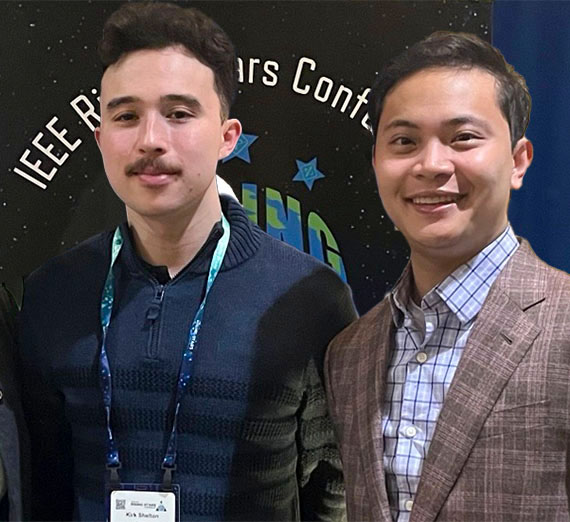
What happens when you take two of Gonzaga’s engineering minds and drop them into the heart of the global tech scene? This past winter break, Miguel Alcira (Electrical Engineering) and Kirk Shelton (Computer Engineering) headed to Las Vegas for the IEEE Rising Stars 2026 Conference.
From January 2–4, Miguel and Kirk joined industry giants and young professionals at the premier event for the next generation of electrical and computer engineers. The conference served as a high-octane look at the future of tech, covering everything from the hardware powering the AI revolution to the ways technology is transforming the arts.
Attendance for these students was made possible by the SEAS Dean’s Excellence Fund, which provides critical support for high-impact learning opportunities.
Beyond the Classroom: Real-World Takeaways from IEEE Rising Stars
What inspired you to attend the IEEE Rising Stars conference?
Kirk: As IEEE Vice President, I wanted to connect with members involved in student leadership. I’ve learned that it's always best to start networking now. Attending Rising Stars allowed me to learn from others’ experiences, share ideas, and bring back insights to strengthen our Gonzaga IEEE chapter.
Miguel: This conference is the pinnacle for young professionals in ECE looking to understand the new wave of innovation and challenges from top companies. To help cultivate my career, Rising Stars offered me the opportunity to connect and deepen my understanding of industry-standard techniques.
What was one standout moment or takeaway from the event?
Kirk: The “AI Hollywood” talk was intriguing. I never knew how artists use artificial intelligence to quickly generate visual storyboards from text prompts or scripts. Even makeup artists utilize AI tools as an affordable alternative to costly traditional prosthetics.
Miguel: A key moment for me was the presentation on hardware development for AI. While many think AI relies solely on software, the reality is that data transmission and reliability depend on hardware. Additionally, the power industry is vital to these data centers; new techniques will be the only way to supply those massive energy needs.
Has this experience shaped your academic or career goals?
Miguel: Rising Stars definitely shaped my career trajectory. Before the conference, I thought industries like manufacturing, power, and aerospace were "bubbles" separate from IT and electronics. I realized that all EE industries interplay with one another and serve as different applications of core topics.
Did the conference connect with the reason you wanted to study engineering?
Miguel: I want to study electrical engineering because it combines theoretical and practical work. It's the place where "invisible forces" meet tangible results. Seeing how large companies scale theoretical concepts for human use strengthened my pursuit of the industry.
How will you connect the conference to your Gonzaga courses or projects?
Kirk: It inspired me to think about how my work can benefit society. Seeing projects like a non-spill cup for the blind reinforced the importance of designing solutions that are both technically sound and socially impactful.
Miguel: I see a connection to the specializations Gonzaga offers. Students can develop their understanding of specific industries and tools through our curriculum. For example, if a student wants to pursue telecommunications, Gonzaga's EE track offers classes in communication and wireless systems that demonstrate the theory behind that design.
Why did you choose your degree program at Gonzaga?
Kirk: I chose engineering after the fair during GEL Day; I was fascinated by how rapidly technology evolves and wanted to understand the processes behind it. My First-Year Seminar let me explore different subdisciplines, which confirmed my decision to study computer engineering. I was drawn to a path where I had no previous background; it challenged me to step out of my comfort zone.
Miguel: Gonzaga engineering offers real opportunities to develop hands-on skills alongside theoretical knowledge. The labs give us the chance to "rediscover" concepts from class for ourselves. Plus, the Senior Design program provides real-world experience where we practice both technical skills and professional soft skills.