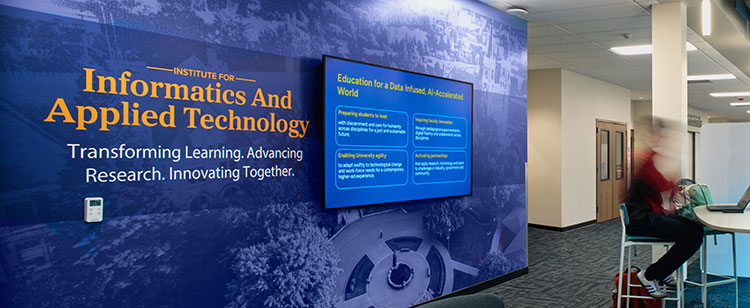
Raising a World: Gonzaga’s Human Approach to AI on Display
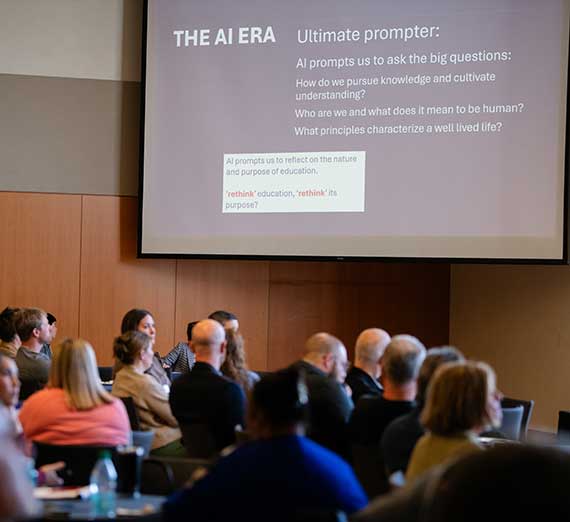
At a conference centered on artificial intelligence, the most resonant moments weren’t about code, capability or computational scale. They were about formation and what it means to become fully human in a moment when technology is evolving faster than any one institution, industry or individual can fully grasp.
The tension between rapid innovation and enduring human questions brought nearly 300 educators, students, business leaders and community partners to Gonzaga University on April 23 and 24, 2026, for the second annual Value and Responsibility in AI Technologies Conference hosted by the Institute for Informatics and Applied Technology.
While many institutions globally are racing to keep pace with artificial intelligence, Gonzaga is asking what AI means for the development of the whole person and is convening communities to approach that question together. Attendance increased from roughly 180 participants in 2025 to nearly 300 this year. More telling than that was who showed up:
- K–12 teachers and administrators from across Washington state
- University faculty, staff and researchers
- Students
- Entrepreneurs
- Regional business leaders
Each group arrived with its own curiosities.
What emerged was shared conversation that followed the thread from elementary education to retirement. Across a full day of programming, the conference traced that living continuum. This thread, which could be traced as a pipeline to be optimized, was instead followed as a human journey shaped by relationships, decisions and moments of transition. Gonzaga’s approach acknowledges that the implications of AI are not confined to a single stage of life. They ripple across all of them, reshaping how individuals learn, how they understand themselves and how they contribute to the world around them.
“This is about building a continuum of purposeful engagement with AI that spans a lifetime,” says Reisenauer Family Director of the Institute for Informatics and Applied Technology Jay Yang, Ph.D. “By connecting university learning with K-12 education and industry empowerment, Gonzaga is creating a model where individuals develop technical literacy and skills, confidence and capacity to navigate changes, so as to lead with intention and meaningful contributions over time.”
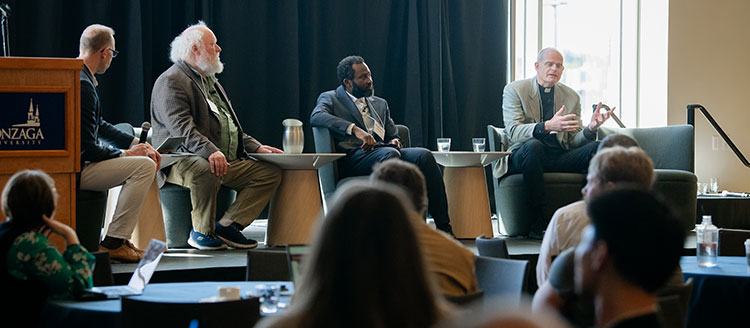
The conference opened with a panel of Jesuit scholars exploring a question rarely centered in conversations about artificial intelligence: how does this technology shape the formation of the human person?
Panelists examined how AI challenges assumptions about identity, agency and moral responsibility, while also offering new opportunities for reflection and growth. One speaker, working directly with leading AI developers, offered insight into ongoing efforts to embed ethical reasoning within emerging models. What might have been expected as a niche conversation became a truly compelling moment because it named what many were already sensing—that the most urgent questions about AI are actually not technical, they are deeply human.
During a student panel and research showcase, participants presented projects, prototypes and perspectives that reflected both technical fluency and thoughtful engagement with AI’s broader implications. Their work drew sustained attention for its curiosity, reflection and grounded nature. The showcase featured more than two dozen research and demonstration projects, creating space for interaction between students, faculty and industry partners. Conversations extended beyond presentations, becoming points of connection between disciplines, experience levels and ideas and application.
In the afternoon, the conversation turned toward the workforce to examine what organizations are actually seeking in a time of rapid change. The answer was clear—and consistent: expertise and AI skills matter, but they are not the differentiator. What organizations need are individuals who can navigate complexity, lead through uncertainty and support others as they adapt. People who understand how systems work and how people experience them. In other words, industries are looking for critical thinking, ethical discernment and care for the whole person—Jesuit principles Gonzaga has always prioritized. As AI continues to evolve, those capacities are not becoming less relevant; they are becoming essential.
The conference marked a significant expansion in community engagement.
Approximately one-third of attendees represented Spokane-area businesses, reflecting a growing interest in how AI intersects with regional industry and economic development. At the same time, nearly 50 K–12 educators participated through a program supported by the Gates Foundation, which has committed continued investment in Gonzaga’s “Navigating AI” initiative. Together, these partnerships point toward a broader vision, in which education is not isolated within institutional boundaries, but connected—intentionally and continuously—to the communities it serves.
If the conference clarified anything, it is that no single group holds the answers to AI’s most pressing questions, rather, progress will depend on connection. The Institute for Informatics and Applied Technology at Gonzaga is advancing that work by expanding opportunities for students, educators and industry partners to collaborate on real-world challenges—developing innovations that bridge disciplines and sectors. At the same time, Gonzaga is investing in faculty development to ensure that teaching and research across disciplines continue to evolve thoughtfully alongside emerging technologies.
“Artificial intelligence is reshaping the world at a pace no single institution can navigate alone,” says Gonzaga University President Katia Passerini, Ph.D. “Gonzaga is leading through partnership—aligning education, industry and community to ensure that innovation is guided by purpose and responsibility. Investment in the Institute for Informatics and Applied Technology is an investment in people, including graduates equipped to lead with clarity, integrity and measurable impact in a rapidly changing world. We are thankful to the many who are supporting the institute through their engagement as advisors, strategic thinkers, sponsors and philanthropists.”
Like a good AI prompt, this work is iterative, relational, and ongoing.
Conference sessions and highlights will be made available online. For those interested in supporting continued growth, opportunities exist to invest in programs that expand access, deepen learning and extend Gonzaga’s impact across education, industry and community.
Because raising thoughtful, capable adults in an age of AI cannot happen in isolation. It takes a world.