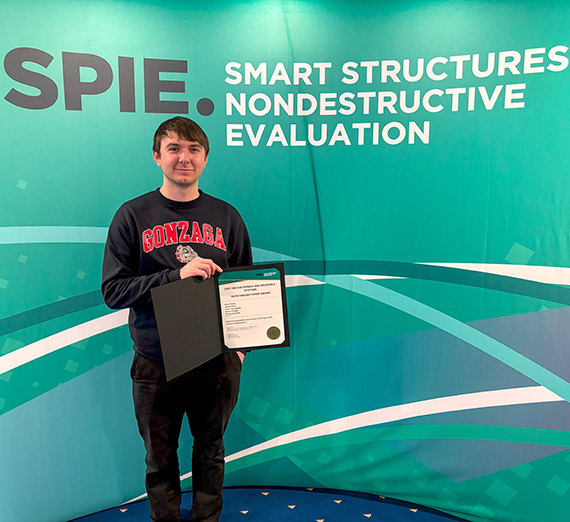
Dillon Kamin is a current student and in this Q&A he shares what it's like pursuing an on-campus M.S. in Data Science at Gonzaga.
Why did you choose Gonzaga and the M.S. in Data Science (MSDS) program?
I chose Gonzaga for a few reasons. Having done my undergrad at WSU in Pullman, I was already somewhat familiar with Spokane and have a great community of friends in the area. Regarding the program itself, I've always been drawn to interdisciplinary subjects, and I believe data is the common thread that connects all, if not most, domains. I also strongly value an ethical approach to technological progress, which is sometimes lacking in modern data science applications. Gonzaga's MSDS program stood out to me because it emphasized both the interdisciplinary and ethical aspects.
How was the Classroom Experience and how was it different from Undergrad?
The experience here has been a refreshing change of pace from my undergrad. Because my cohort is small, it's been easy to build genuine and productive relationships with my peers and professors. This creates a focused yet easygoing atmosphere that I find perfect for learning. There's also a lot of freedom built into the projects and presentations, which is quite different from my undergrad coursework. This has allowed me to explore niche topics I might have otherwise missed.
What is it like being a Zag?
My favorite part of being a Zag, thus far, is the sense of belonging. There's a massive network of people who truly care about student success, and not just academically but holistically. That support has already opened several doors for me and is something I appreciate dearly.
Being in an on-campus program, what is life off-campus in Spokane like?
Moving from Pullman to Spokane has been a change. I'm originally from the greater Seattle area, so the busier vibe and opportunities for fun are something I'm used to and have missed. In the relatively short time I've been here, I've enjoyed the local food scene, live music, and a number of scenic walks along the Centennial Trail. I've also been getting back into climbing recently, and the city's climbing gyms are great!
What is your favorite part of the MSDS program?
Without a doubt, my favorite part of the program so far has been the faculty. Every professor I've had or interacted with has been a fantastic mentor. In my opinion, the quality of the faculty is the most important part of any program, so I've been extremely happy with the MSDS.
What do you hope to do with your degree?
After I graduate, I plan to pursue a PhD to continue doing research. I'm still narrowing down what exact niche I want to contribute to, but either way I plan to apply what I've learned in Data Science to something biomedical.
Can you give us a rundown of the research you are working on?
I am currently working in Dr. Zavanelli's Smart Bioelectronics lab, primarily on the development of a "Smart Patch" that measures seismocardiograms (SCG). Our goal is to use this patch to predict changes in emotional states. This technology could be invaluable for caretakers of patients with dementia or other similar conditions, particularly for individuals that are non-verbal. Thanks to the hard work of my undergrad peers in the lab, we have a prototype in place. I've been collecting data and seeing very promising results. The project has required me to learn and read a lot about seismocardiograms, signal processing, data analysis, and visualization. I've also been developing a few different machine learning models for sensor localization and data analysis, which the MSDS program has certainly helped prepare me for. Often during course lectures, we'll discuss a topic that gives me an idea for research, and I'll note it down for later. I've also been enjoying the application of data science ethics to my research, a topic which I am taking a course in currently.