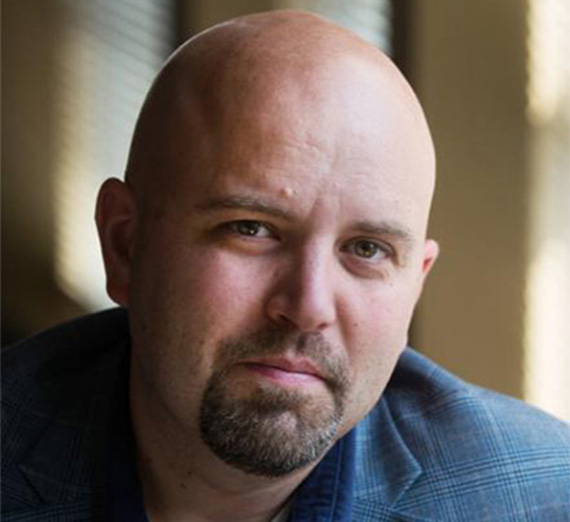
Get to know Grad School of Business professor and Associate Dean of the Undergraduate Business Programs, Dr. Chris Stevens.
1) What course(s) do you teach in the graduate program(s)?
This semester, I’m teaching MBUS 614 (Business Ethics) and two trailers in the Project Management space (Agile Project Management and Risk Management). I also teach Strategic Management and Entrepreneurship, and will teach all three next fall.
2) What is your career/research background?
I helped my father found a large construction firm in the midwest. I began that work when I was in my teens and grew and helped run the business until my early thirties — the last ten years was spent building our international consulting and construction business unit, so I spent most of my twenties living and working in Asia and Europe managing projects and teams around the world. When I went back to school for my MBA, I had a couple of opportunities to teach and I loved it. As an entrepreneurship professor who founded and worked with others who founded, I’m fascinated in why entrepreneurs make the decisions they do (e.g., to start something, to stop something, to fail and do it again), so much of my research focuses on motivation, passion, and the differences between types of entrepreneurs (women and men has been an important comparison set for me) and how they experience the entrepreneurial process.
3) What is the most exciting development currently happening in your field that isn't getting enough mainstream attention?
Post-covid, I think one of the more exciting developments in entrepreneurship is the legitimacy of “lifestyle” or “scalable” entrepreneurship — the idea that it’s okay to grow only so far or fast depending on what you actually want to do. A bunch of people who killed themselves pre-covid trying to grow to capture that new market, open themselves up to venture funding, and just look like a “real” entrepreneur are realizing that there is a perfectly wonderful space where a venture can fulfill the needs of a well-defined customer group, provide a sustainable income for those involved, and fulfill all the needs entrepreneurs start things to fill. Scalable ventures have long represented the balance of American industry (most ventures don’t grow beyond a modest scale), but a lot of people have been embarrassed by that label — I think that’s starting to change.
4) What do you look forward to every school year?
A new group of folks to develop relationships with and a new set of ideas. The energy of a new school year is something I always look forward to returning to.
5) What do you love most about Gonzaga?
I came here from a much larger institution because I felt like this was a place where you could create a legacy — a set of relationships and commitments that would last — and it is. I still connect with students I taught almost two decades ago, and they continue to add to our community by supporting the students I teach now. Zags help Zags, and that commitment has never wavered.
6) What advice do you have for students?
Connect. Given all of our commitments and the limits we (have to) put on everything we do, it can be easy to view class as a fixed experienced — you come to it and then you leave. I think the real value is when you find the time to connect with your colleagues and when you realize that everyone who teaches here wants to form those connections with you. Every meaningful interaction I’ve had professionally, at any level, has come from the relationships I’ve created.
7) What is a skill or hobby you have that would surprise your students?
Since I’ve reached that indeterminate age where I can be classified as “older” and “not so old” at the same time, I think most folks would be surprised that I have more hours played a higher gamerscore than my 16-year-old son. I play a lot of video games. At least that’s what my wife tells me.
8) What are you happiest doing when you are not working?
Cooking. I’m half Cajun (I’m from Louisiana) and half Italian, and the men of my family on both sides did all the cooking. I love to cook anything, and I’m particularly proud that both of my kids are great cooks.
9) What is your go-to Thomas Hammer or go-to lunch order?
I can’t afford the calories associated with it, but I love the occasionally PB&J at Hammer. I’m also a big soup man — I love soup, as long as it’s hot. I can’t do cold soup. Never.
10) What is one book (non-fiction or fiction) that you think everyone should read?
My favorite book of all time is A Walk in the Woods by Bill Bryson. I’ve read it/listened to it at least a hundred times. It’s a great book about hiking, but a better book about life. My second favorite book, also by Bryson, is A Short History of Nearly Everything — it’s perhaps the best book on science (and, I would argue, of general knowledge) that there is.