
Beyond the Agenda: Leadership Lessons from Florence
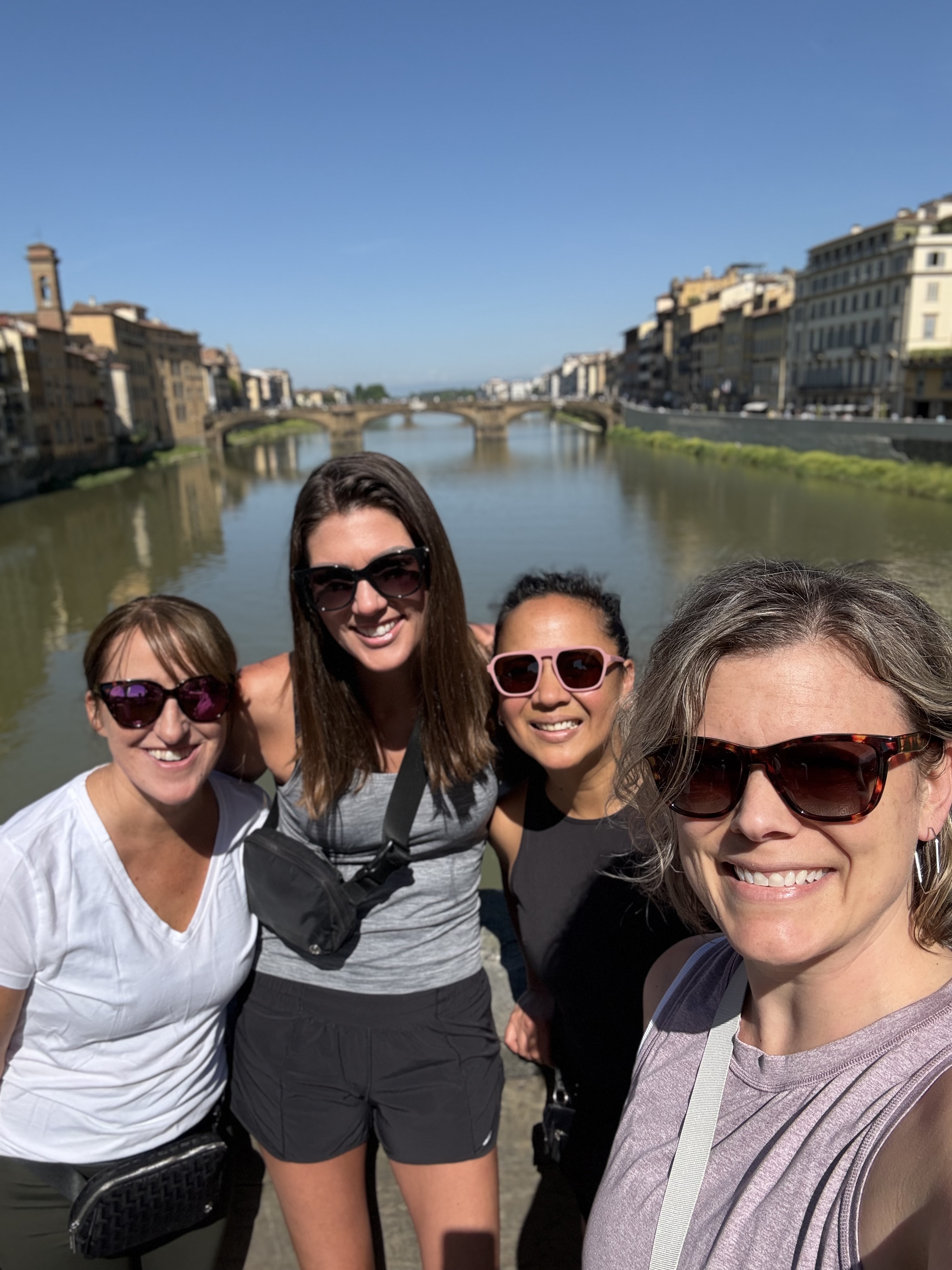
Church bells rang as the evening light hit the tile rooftops of Florence, reminding me it was time for the walk to dinner. As part of the 2026 Women Lead Florence Conference, three friends and I packed a bag and our passports and joined 15 other women from across the world in the heart of Tuscany for four days of leadership, learning, art and of course Italian cuisine.
And yet, what stays with me most is how seamlessly the extraordinary and the everyday threaded together like cobblestones beneath our feet guiding us somewhere both ancient and new.
We began as strangers, gathering on a Sunday afternoon for a welcome social at the Gonzaga in Florence campus, easing into introductions over appetizers and Prosecco. By evening, we were tracing the footsteps of historical female figures of Florence seeing the city not just as a museum, but as a living narrative of women who shaped it, often quietly, often overlooked, but always present. That reframing would become a theme: looking again, thinking deeper, asking better questions. It also became an invitation to share more honestly ourselves. I was reminded quickly that what’s most personal is, in fact, most universal. The more candid our stories became, the more they resonated across cultures and careers.
Monday invited us into those questions more directly. With the espresso made expertly by Pepe, the jet lag wore off and the conversations picked up speed. We explored what it meant to lead at the crossroads of place, power and global connection, ideas that felt both theoretical and deeply personal as each of us mapped them onto our own careers and communities. In those conversations with other women leaders, I found myself confronting a quieter realization: my view of myself is the only thing that continues to limit me.
Later, flour-dusted and laughing in an Italian cooking class, those same themes resurfaced in quieter ways: collaboration without hierarchy, learning through doing, trusting the process even when it’s unfamiliar. Leadership, it turns out, can look a lot like sharing a pasta roller.
By Tuesday, the rhythm had settled: intentional mornings, immersive afternoons, spontaneous evenings. A workshop on the ethics of care challenged us to consider leadership not as authority, but as responsibility, especially in moments of vulnerability. It’s one thing to talk about empathy in a conference room, it’s another to practice it across cultures, contexts and lived experiences. And in those practices, as we continued to show up more fully, it became clear that connection—not perfection—is what builds trust.
Later that day, standing before Michelangelo’s David, I felt the quiet weight of perspective. We had talked all morning about strength, fragility and perception and there it stood in marble, a centuries-old embodiment of all three. Leadership, like art, is ultimately about tension, the space between confidence and humility, visibility and restraint, bold moves and thoughtful pauses.
From there, our conversations moved beyond the classroom and into craft at the Leather School, where tradition and innovation meet and where leadership is as much about preserving legacy as it is about shaping what comes next. We listened, asked questions, and began to see how place informs purpose.
Wednesday took us into the Tuscan countryside, where rolling hills and rows of vines framed a conversation with Albiera Antinori, a reminder that leadership can span generations while still evolving. Over wine tasting and a two-hour closing lunch, reflections surfaced naturally. What had shifted? What would we carry forward? What would we leave behind with the empty espresso cups and the sunlit courtyard?
Somewhere between the structured sessions and the unstructured wanderings, the missed turns, the shared wine and the late-night walks home, something had softened. Titles mattered less. Stories mattered more. We didn’t just talk about leadership; we practiced it in how we showed up. And perhaps most meaningfully, I left knowing I now have a new world of opportunities and a network of mentors I can call on because of this experience.
Back in the city that final evening, as the bells called us once again into dusk, I realized the true “agenda” had always extended beyond the printed schedule. Yes, there were sessions and speakers and thoughtfully planned excursions. The real curriculum lived in the in-between moments, in the courage to speak honestly, the willingness to listen deeply and the decision to see the world (and each other) with more nuance.
Florence, with its layers of history and artistry, felt like the perfect backdrop for that kind of learning. A place where nothing meaningful is rushed. Where beauty coexists with imperfection. Where the past informs the future without dictating it.
We came for a conference and let’s face it, because it was in Italy. We left with something much harder to define and much easier to feel: a renewed sense of clarity, connection and possibility.
And perhaps that’s the most Florentine lesson of all; that growth, like great art, is rarely linear. It unfolds slowly, deliberately and often leaves a lasting impression long after you’ve moved on.