Engineering Professor Khare Receives NSF CAREER Award
![Professor gestures to a computer screen while three students stand behind him. [Ferro]](/__data/assets/image/0023/432734/Khare-NSF-Career-Award-2026-IMG_0698-sq.jpg)

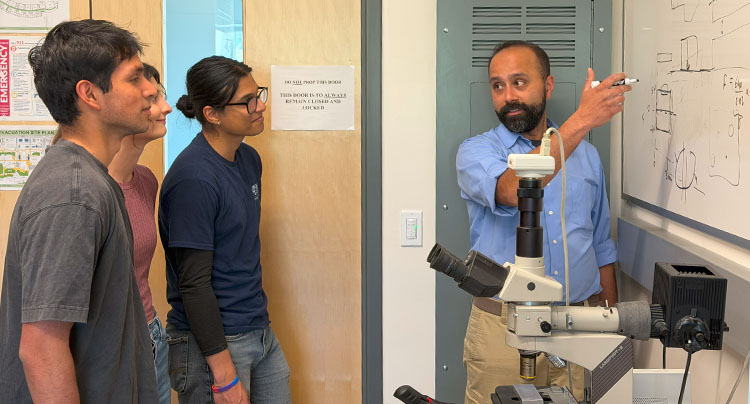
Harman Khare, Ph.D. has received the National Science Foundation (NSF) Faculty Early Career Development (CAREER) Award. Khare, an Associate Professor of Mechanical Engineering, is the first faculty member of Gonzaga University’s School of Engineering and Applied Science to earn this prestigious recognition.
The five-year, $548,632 grant will fund Khare’s project focused on the multi-length scale characterization and predictive design of low-wear polymer composite materials. Funded through the NSF’s Division of Chemical, Bioengineering, Environmental, and Transport Systems (CBET), the project begins on August 1, 2026 and runs through July 31, 2031.
The Prestige of the NSF CAREER Award
The NSF CAREER Award is among the most competitive funding opportunities available to early-career faculty across all NSF-supported disciplines nationwide. Unlike standard research grants, the CAREER program serves as a long-term investment in the next generation of academic leaders.
Khare’s selection highlights his potential to shape the field of materials science through intellectual contributions, high-impact mentoring, and broader societal leadership.
Research Focus: Transforming Tribological Design
The project addresses a challenge in materials engineering: reducing friction and wear that wastes energy and causes mechanical failures. Improvements in low-wear materials will benefit a wide range of manufacturing applications in aerospace, automotive and biomedical fields.
Low-wear polymer composites—polymers mixed with filler materials or other polymers — are often used to form protective films on sliding surfaces. This research will enable predictive design of these composites by investigating the interactions between fillers, polymer matrix, and opposing surfaces across a wide range of length scales.
An Impressive Early Career
Before beginning his CAREER award-funded research, Khare is participating in the Department of Energy’s (DOE) Visiting Faculty Program at the Pacific Northwest National Laboratory (PNNL). This is another highly competitive program. His work with Brian O’Callahan focuses on polymer composites, specifically on elucidating mechanochemical pathways for sliding interfaces.
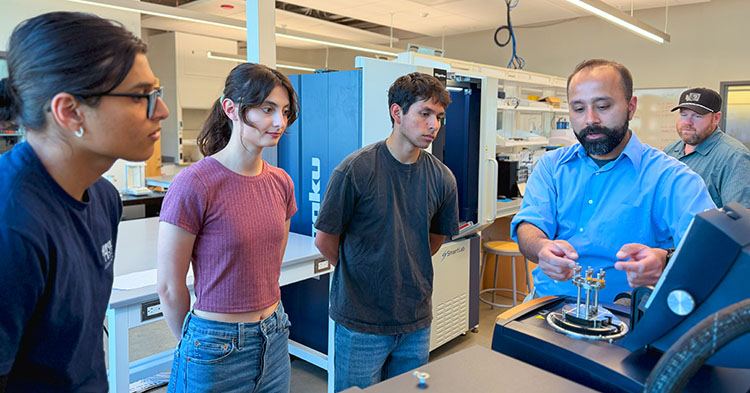
Khare was recently appointed as the Faculty Director for the Ferro Center for Materials Research, a hub for advanced materials characterization. In addition to directing undergraduate research in his tribology lab, he teaches courses in materials science, tribology, and manufacturing, and supervises capstone engineering design projects.
Khare brings an elite academic pedigree in surface science to this project. Before joining the Gonzaga faculty, he served as a Postdoctoral Researcher and later Manager of Research Projects at the University of Pennsylvania. He completed his graduate training in the Materials Tribology Laboratory at the University of Delaware.
A Proven Track Record of Undergraduate Mentorship
A hallmark of the NSF CAREER program is advancing the connection between research and undergraduate education. Through his Tribology Research Laboratory, Khare has encouraged dozens of students to pursue materials research interests.
Notably, his mentorship has guided two Gonzaga undergraduate researchers to receive the prestigious E. Richard Booser Scholarship from the Society of Tribologists and Lubrication Engineers (STLE).
Over his past eight years at the university, undergraduate co-investigators have been foundational in building the lab’s experimental framework.
“It takes a village to build a research program, and this award is a reflection of all of those relationships along the way. A special shout-out goes to the incredibly motivated and talented Gonzaga undergraduates I've had the privilege of working with over the last eight years. I wouldn't be here without them,” Khare said.
One of those past students, Lexi Durbin (’25, Mechanical Engineering) credits Khare’s mentorship in the lab impacted her preparation for a career in materials science.
“Dr. Khare displays a genuine interest in the growth of his research students and both provides structure and allows us to cultivate our own, independent, hands-on, learning experiences—a model which I attribute to the magnitude of knowledge I have gained in just the year I have been working in the lab,” she said.