
Juliane Mora’s Semester at Sea Brings Global Perspectives to Gonzaga Classrooms
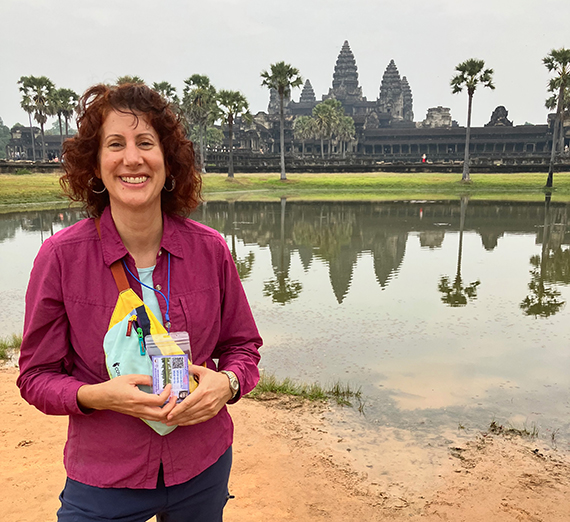
When Juliane Mora returned to Gonzaga University after a semester at sea with the nonprofit Institute for Shipboard Education, she brought back new perspectives on culture, communication, and experiential learning, all insights she hopes to share with her students and fellow faculty members.
As an associate professor in Gonzaga's Communication Studies department, Mora has spent her career studying communication and teaching.
Mora first learned about Semester at Sea while she was a master's student because one of her professors had participated as an instructor and returned with stories from around the world.
"I thought, 'Why have I never heard of this? It sounds really amazing,'" Mora recalls.
Since she was already finishing graduate school and could not participate as a student, she made a promise to herself that one day she would join the program as a faculty member.
This year, Mora made good on that promise, applying for the Semester at Sea program after earning tenure and becoming eligible for a sabbatical. The experience offered an ideal opportunity for a sabbatical project to enhance her teaching and scholarship, and she saw it as a unique chance to explore experiential education on a global scale.
The answer would take her across 10 countries and thousands of miles of ocean.
The Road to a Semester at Sea
Mora earned her bachelor's and master's degrees in communication from California State University, Sacramento, and a Ph.D. in communication and pedagogy from the University of Utah. She taught at several institutions before arriving at Gonzaga in 2017, originally hired to help integrate communication into Gonzaga's engineering curriculum. She incorporated communication lessons into engineering courses, helping students learn how to explain technical concepts to those inside and outside their field.
“Scientific and research presentations are just storytelling with data,” Mora says. “Why did you do this thing? What is it for? Why should I care?"
Currently, Mora teaches undergraduate communication courses that help students understand how we make meaning through symbolic action and the power of storytelling.
During her Semester at Sea journey, Mora served on the instructional team for Global Studies, the one course every participant takes during the voyage. As one of the team’s three professors, she helped create a curriculum that explored communication, culture, history, and global environmental challenges facing the countries they would visit. Mora also taught a class on international/intercultural communication.
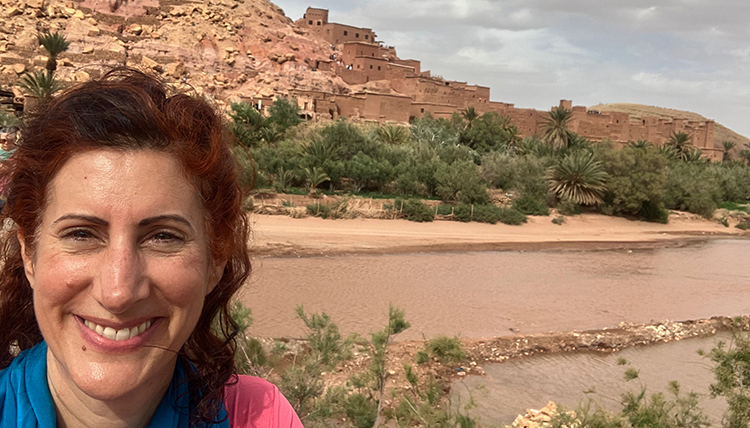 (Mora in Morocco)
For Mora, each destination offered opportunities to learn firsthand about the people, cultures and histories she had previously encountered only through books and research. Still, Mora says that if she had to pick three places from her trip for the beauty and culture that she witnessed, they would be the Atlas Mountains in Morocco, the Maasai Mara savannah in Kenya, and George Town, which is the capital of Penang in Malaysia.
After visiting all of these new destinations, Mora gained confidence from navigating such diverse communities, all with different forms of transportation, language, currency, and culture.
"I would go back to any of those countries by myself. That's how confident I feel after this experience."
Learning on the High Seas
Living aboard a ship for an entire semester created a learning environment unlike any traditional study abroad program.
Unlike students who spend a semester immersed in a single city or country, Semester at Sea participants continuously moved between cultures, perspectives and experiences. Days at sea were spent attending classes, preparing for upcoming destinations and reflecting on previous ports. Once the ship docked, participants could explore independently, join organized field programs or remain near the port city. After returning to the ship, conversations continued as hundreds of students and faculty shared stories from their travels.
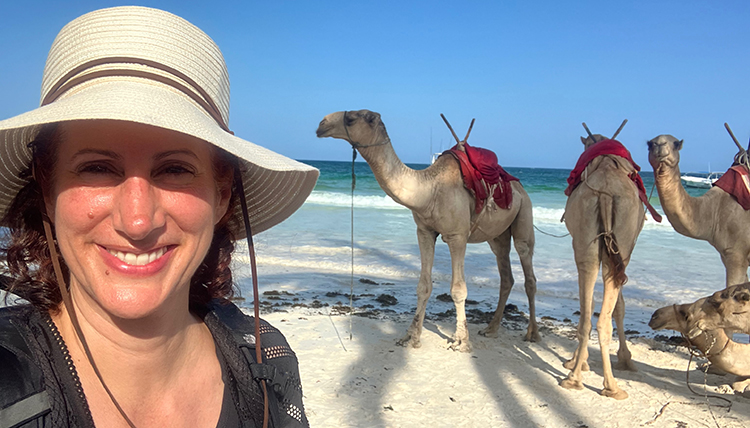 (Mora with some local camels in Kenya)
"Once you got back on the ship, there were 600 different adventures to hear about,” Mora says.
The ship itself also became a unique community. With more than 500 students, faculty, staff, lifelong learners and crew members living together, there was little separation between academic and personal life. "I got to know far more people than I ever would have if I was just teaching my own classes on campus," Mora said.
When asked what image comes to mind first when reflecting on the semester, Mora doesn't immediately think of a particular country; she remembers maritime traditions.
One of the voyage's most memorable events was Neptune Day, a centuries-old sailor tradition that celebrates crossing the equator for the first time. Another unforgettable moment came when the ship crossed the intersection of zero degrees latitude and zero degrees longitude, the point where the equator meets the prime meridian in the Atlantic Ocean.
“I was thinking, how many people in their lives actually get to do that?" Mora says.
Bringing Experience Back to Gonzaga
While Semester at Sea transformed Mora personally, she is most excited about what it will mean for her students. Gonzaga's Mission calls on students and faculty to consider the well-being of the poor, the vulnerable, and the planet. Mora believes seeing the world firsthand has deepened her understanding of those commitments.
She hopes to incorporate more global perspectives into her courses and encourage students to think about how their lives connect to people and communities around the world.
"It's important to be able to scale up and ask how the things we're doing here in Spokane connect to people we've never met in other parts of the world," Mora says.
For Mora, Semester at Sea was more than a voyage around the globe. It was a reminder that some of the most meaningful learning happens when people step outside familiar surroundings, engage with new cultures, and remain open to perspectives different from their own.
Now back in Spokane, she hopes to bring that same spirit of curiosity and global engagement into every classroom she teaches at Gonzaga.