
Engineering Collaboration in Action
Gonzaga Students and Selkirk Sport Drive Innovation Through Internship Experience
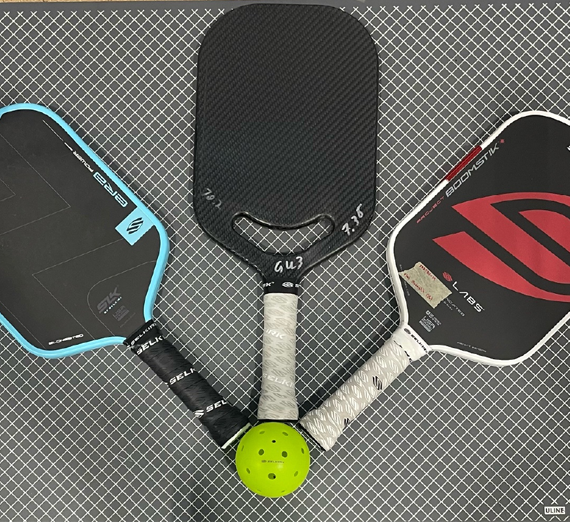
At the intersection of classroom learning and real-world application, a team of Gonzaga University engineering students demonstrated what is possible when talent, creativity, and opportunity align. Through a hands-on internship with Selkirk Sport, a leading manufacturer in the fast-growing pickleball industry, these students delivered not only a functional product but a compelling example of innovation, teamwork, and purpose-driven engineering.
The partnership reflects Gonzaga’s Mission to prepare students for both technical excellence and meaningful impact. For seniors Luke Alfonso, Ashton Bischoff, Jack David, and Ryan Spuck, the experience went beyond a capstone requirement, offering a direct introduction to professional engineering grounded in real industry challenges.
A Real-World Challenge
Selkirk Sport, headquartered in North Idaho, partnered with Gonzaga’s School of Engineering and Applied Science to explore new frontiers in paddle design. The student team was tasked with developing a fully functional pickleball paddle prototype using innovative materials and concepts not yet adopted by Selkirk, while meeting strict performance standards.
From the outset, students operated in a professional environment, from research and design to testing and manufacturing. “I would say the aspect of this project I liked the most would be the amount of freedom we were granted on our design process,” recent graduate Ryan Spuck reflected. “Selkirk had a rough goal they wanted us to achieve and left us a lot of room to get creative. This led to us designing a total of 13 paddles, all with a different material composition and performance.”
Collaboration That Drives Results
A defining feature of the experience was deep collaboration with Selkirk engineers, who provided mentorship, technical guidance, and access to specialized equipment. At the same time, the student team built strong internal systems, meeting multiple times each week, rotating leadership roles, and adapting quickly as challenges arose.
This structure strengthened their ability to manage complex work, refine manufacturing processes, and translate both technical data and user feedback into improved designs. The project became a powerful example of what happens when students are given ownership and supported by experienced professionals.
Innovation Through Iteration
Central to the team’s success was an iterative design approach. Rather than pursuing a single concept, they developed and tested multiple paddle prototypes, exploring materials such as carbon fiber, fiberglass, and Kevlar to evaluate performance characteristics including power, control, and durability.
One of the most notable innovations was the use of Kevlar, a material Selkirk had not fully explored in paddle design. Students also experimented with internal structures, including varying foam densities and “floating core” concepts, to expand the sweet spot and improve responsiveness.
Measuring Success
Success was defined by both performance and usability. Prototypes underwent rigorous testing, including deflection measurements and structural analysis aligned with governing standards. Just as important, the team incorporated real user feedback through playtesting sessions with Gonzaga’s pickleball community.
“I am most proud that we were able to get a lot of player feedback by working with the GU pickleball club,” Spuck noted. “It was an unforeseen partnership that I `wish happened earlier in the year, but it showed us how valuable player feedback is on this project.”
The results were strong: several prototypes met or exceeded key performance benchmarks, and standout designs achieved an effective balance of power and control. The students also delivered insights and prototypes that Selkirk can carry forward into future product development.
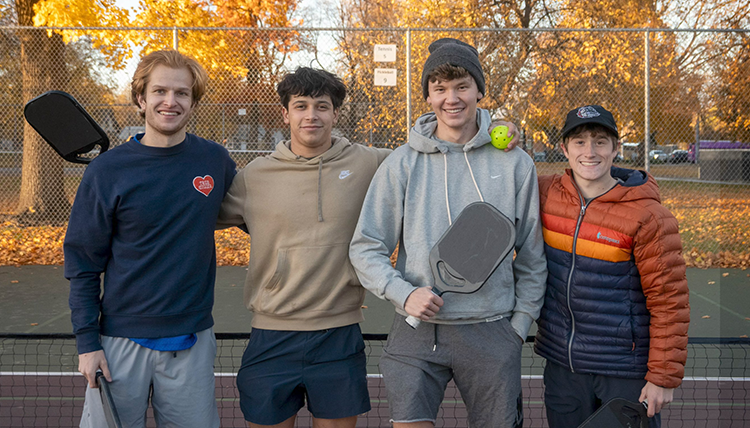
(L to R) are Jack David, Ashton Bischoff, Ryan Spuck, and Luke Alfonso.
Learning Beyond the Classroom
Beyond technical achievement, the internship sharpened essential professional skills. Students gained experience applying theory to real-world development, managing long-term projects, communicating complex ideas, and adapting to changing conditions in a production environment.
Instead of simulations, they are contributing to something tangible, learning as they go, and building confidence along the way, a shift from being a student to thinking like an engineer. “Learning from industry professionals taught us that there is more to design than formulas and numbers; performance and manufacturability play far greater roles than we had envisioned,” said Luke Alfonso. “This experience will positively shape our futures. It was rewarding seeing our paddles come to life with people enjoying them in the Spokane community.”