
Dr. James Hunter Retirement Q&A
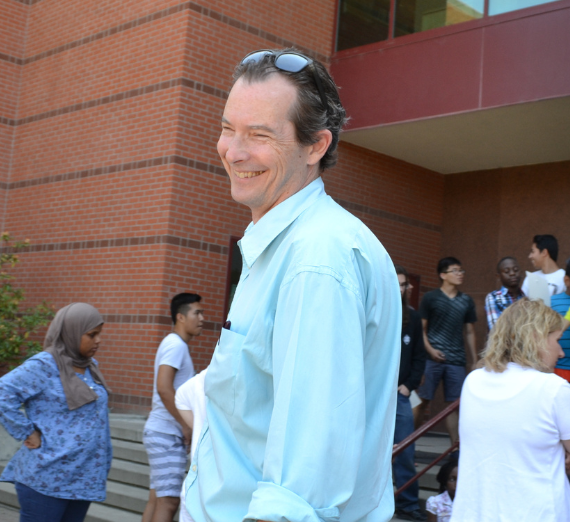
Dr. James Hunter, professor of Teacher Education, has retired after serving Gonzaga University for 29 years and has been awarded emeritus status. Before he stepped into retirement, Dr. Hunter reflected on his experiences in the following Q&A.
What originally brought you to Gonzaga, and what made you stay?
We (Bridget Green and I) moved here from Barcelona with an 18‑month‑old and a 7‑week‑old in 1993, mostly because we needed more support with the kids, and Bridget’s huge family mostly lives in Spokane. Bridget is a Gonzaga alumna, so she reached out to the English Language Center (ELC) and got an adjunct position. I then started working as an adjunct here in 1994.
As soon as I completed my MA, I was encouraged to apply for a full‑time position, which I did in 1997. The following year, my colleague Dr. Mary Jeannot started the Master of Arts in Teaching English to Speakers of Other Languages program, and I began teaching both ESL and graduate courses almost immediately. That symbiosis between the teaching and teacher‑training programs is exceptionally rare, but it has always been a crucial part of what engages and inspires me. Without that, we would have left a long time ago…
How has your role evolved over the years?
In so many ways! I was an untenured, “fixed‑term” faculty member of the ELC for 20 years before I joined Teacher Education in 2017 and was finally able to apply for tenure. I became director of the MA/TESOL program in 2010 and earned my PhD in 2012. So, in many ways, I did things “backwards”—raising a family first and then developing my career. (Shoutout to all the women in academia, for whom this is normal…) But despite that, I was able to build considerable experience—teaching every course in the MA/TESOL program at least once, as well as all ELC courses—which has served us well in Teacher Education as we consider what “lifelong education” means beyond the more traditional K–12 field. I also became, together with colleagues Drs. Mary Jeannot and Martha Savage, the de facto “expert” on matters of language and culture in the department, which positioned us well in the development of the Community, Culture, and Language program.
As you prepare for retirement, how does it feel to look back on your years at Gonzaga University?
Gonzaga has been my home for so long that I cannot really imagine what my career would have been like otherwise. I am extremely grateful for all the advice, mentorship, and formation that my colleagues and students have given me over the years. Things have not always been easy. And the English Language Center (ELC) had such a strong impact on so many students—not just ESL and MATESOL, but also the many intrepid undergraduates who sought out the cultural and linguistic diversity that the ELC has brought to Gonzaga for 50 years.
Do you have a meaningful memory that has stuck with you over the years?
I think the Summer Language Program has always provided the most meaningful moments in my work at GU. It is such a powerful example of collaboration, mentorship, cultural and linguistic immersion... all the things! 2018 was one of the biggest years: 400+ immigrant & refugee kids registered, with a daily average close to 300, speaking around 50 languages! I can't express how lucky I feel to have been a part of that, for so many years.
I'm also so lucky that I got to co-lead the Zambezi Study Abroad last year, being in community with so many truly lovely human beings: the local Zambezi teachers & students, the parishioners, the Zags who came on the trip, and especially my friend and brother, Jeff Dodd.
How have your students/colleagues influenced or shaped you over the years?
In uncountable ways! I've been exceptionally lucky to have had guidance and mentorship from many incredible women (and quite a few men, too) who have helped me to glimpse the possible, to think more deeply, to challenge myself, to reserve judgement, to listen.
What part of Gonzaga are you most proud of helping shape?
The Community, Culture, and Language program, for sure. I've been told so many times how much impact the program has had on our Elementary Cert (and Community Education) candidates, in terms of what they notice, how they talk about it, and how they teach. We challenge CCL students in lots of ways—immersing them in Marshallese, Kinyarwanda, Tlingit, Farsi... and a whole slew of critical perspectives and field experiences—and they have consistently risen to the challenge. Building, and continuing to develop, CCL has been a very collaborative endeavor, and I know that my colleagues and students will continue to shape it.
What advice would you give to the next generation?
Keep fighting for, and shaping, a world that is not focused on the accumulation of individual wealth at the expense of humanity and the planet. But also (maybe more importantly!) have fun and enjoy life! There's so much to learn, so much to see and hear and taste, so many friends you haven't met yet...
Any plans for after retirement?
Bridget and I are planning to move to the Bradford area of Yorkshire, in the UK, in the next year, to be closer to our children and our English family. We don't feel like we're done teaching yet; we just enjoy it so much. I'd like to apply for a State Dept. Fellowship (like Bridget had in Colombia in 2025) in the next 2–3 years, but we are also dreaming about offering community language and literacy classes, and training teachers, in Bradford. And I'll keep making music, of course (leaving Spokane also means leaving my brothers in Floating Crowbar: Rick, Morgan, and Don). We've been playing together for 16 years and have recorded six albums, so parting is not such sweet sorrow; it sucks!