
Climate Institute Celebrates Five Years of Service and Scholarship
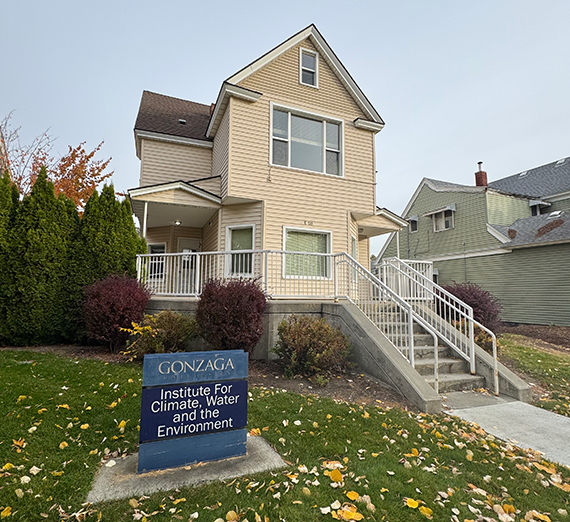
Gonzaga’s Institute for Climate, Water, and the Environment was founded in 2021 (and originally called the Center for Climate, Society, and the Environment) and quickly became a leader in climate justice work in the Inland Northwest and nationally.
The Climate Institute is celebrating its first half-decade of work providing resources and education to students, faculty members, community leaders and Gonzaga neighbors – all in service of its Jesuit mission to meet the challenges facing humanity and the planet. Institute Director Brian G. Henning shared some of the significant highlights of the Institute’s first five years.
Launching the Institute’s Climate Literacy Program
“College students engaging directly with young people in K-8 is impactful for both parties,” Henning says of the program featuring Gonzaga students teaching climate science in area classrooms. “We are helping young people understand how and why their climate is changing and what they can do about it in their own lives.”
Landing the Largest Grant in Gonzaga History
In 2024, the Institute was awarded $19.9 million through the EPA’s Environmental and Climate Justice Community Change Grants Program, designed to support projects aimed at reducing pollution, increasing community climate resilience, and building capacity to address environmental and climate justice challenges in the Spokane community.
Less than a year later, after a change in presidential administrations, this and about 350 other climate-oriented grants around the country were terminated by the federal government – an action that a federal judge later found to be unlawful, although that decision did not require reinstatement of the grant. Gonzaga and the city of Spokane have worked together to encourage reinstatement, so far to no avail.
Heat Mapping Spokane
“Quantifying the location and magnitude of urban heat islands in Spokane has been instrumental in providing decision support to local policymakers and community leaders,” Henning says of the work showing many low-income areas of the Inland Northwest have significantly higher temperatures during extreme heat events than higher-income neighborhoods with more trees and green spaces. “Over time, it is helping guide everything from urban tree plantings to the location of resilience hubs and even future parks.”
Welcoming a Vatican Leader
Cardinal Michael Czerny, S.J. (’68) visited Gonzaga in 2023 for a sold-out talk in the Myrtle Woldson Performing Arts Center. Czerny is the Catholic Church’s leader in environmental and sustainability efforts in his role as Prefect of the Vatican Dicastery for Promoting Integral Human Development.
“It was an honor to host one of Gonzaga’s most famous alumni,” Henning says. “After Pope Francis, Cardinal Czerny was the global church’s leading voice calling on all people of good will to hear both the cries of the poor and the cries of the earth together in an integral ecology. His visit helped remind our community that addressing climate change is central to our mission and our identity as a Jesuit, Catholic, humanistic institution.”
An Early Grant Sparks Community Connections
In 2022, the Institute was awarded a $100,000 Environmental Education grant from the Environmental Protection Agency, an award designed to help with community outreach.
“Not only did the Climate Institute greatly expand its ability to reach young people and educators in our region, helping them understand how they affect their climate and how their climate affects them, but we were also able to provide pass through grants to several local organizations who were able to expand their own environmental education efforts,” Henning says.
Recognition as National Leader
In the years since its inception, the Climate Institute has been recognized as a semifinalist for a national award and cited in the media many times, covering the Institute’s research and work in the community, recognizing the guest speakers who visit for the Institute’s For Our Common Home Lecture Series, and tapping Institute leaders for their expertise, as in this 2024 New York Times article on extreme heat in the Pacific Northwest.
“In a short time, the Climate Institute has become a nationally respected academic climate leader,” Henning says. “Our work is regularly featured in national and regional media outlets, helping share the impact of Gonzaga’s story. The publicity that coverage generated is estimated to be worth over $40 million over the last five years.”