
Building a Career in College Athletics
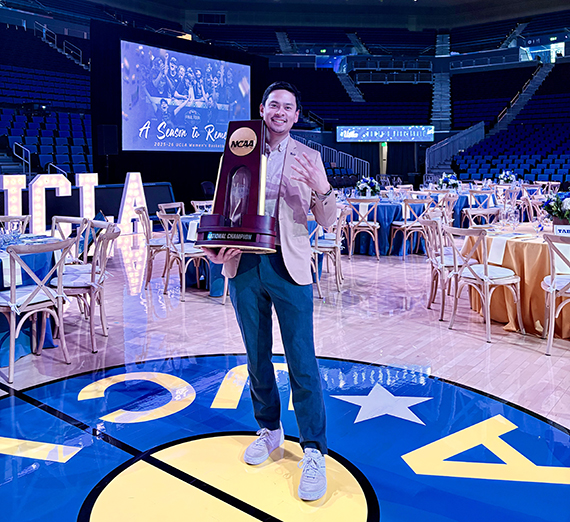
For Paolo De Guzman, earning a degree from Gonzaga’s M.A. in Sport and Athletic Administration (MASAA) was about more than just a credential, it was a launchpad into amjor college athletics. In this Q&A, he reflects on making history as the first in his family to earn a master’s degree, transitioning from game-day operations to donor development and why working in sports is the ultimate dream job.
Why did you decide to return to school for a masters degree?
My time at Washington State University and receiving my bachelor’s degree there played a major role in shaping who I am and what I want to accomplish in my career. After graduating, I felt that I was not finished learning or growing. I wanted to continue to challenge myself, step outside of my comfort zone, and build on everything I had experienced at WSU. Returning to school for my master’s through MASAA was a personal decision to invest in myself and my future. Being the first person in my family to earn a master’s degree makes this milestone especially meaningful to me and motivates me to make the most of the opportunity now and in the future.
Why did you pick MASAA and Gonzaga?
During my final year at Washington State University, I started researching graduate programs in Sports Management because I knew I wanted to continue my education. Having spent four years at WSU, I was already familiar with the Palouse and Eastern Washington region, so I already knew what Gonzaga was like. I’m also a huge sports fan, so I already knew about Gonzaga’s incredible successful basketball programs and McCarthey aka The Kennel! Beyond the location and sports culture, MASAA stood out because of its strong reputation, the quality of its courses, and the success of its alumni.
What do you do for work and what does your role look like?
I am currently the Associate Director of Development with UCLA Athletics, where my primary focus is fundraising and building relationships with our donors. I manage a portfolio of more than 150 current and prospective Athletics donors, working to increase their engagement and support while helping enhance the student-athlete experience. I also work closely with our donors to understand and address their needs and ensure they have a positive experience with UCLA Athletics.
In addition, I oversee the fundraising efforts for three programs: Baseball, Women’s Rowing, and Track & Field/Cross Country. I collaborate with the head coaches and coaching staff to provide the tools, resources, and guidance they need to maximize fundraising opportunities. I also help lead several ticketing responsibilities for major donors, including allocating seating for neutral site and away games, managing the courtside seats, and work on the improvement and upgrade processes for Football and Men’s Basketball season tickets
How has MASAA set you up for success in your career?
My time in MASAA prepared me for my career in college athletics by strengthening my leadership, communication, relationship building, and organizational skills. The program gave me a deeper understanding of the business side of college athletics, which I apply daily through fundraising, donor development, and working with coaches and athletic programs. Most importantly, MASAA gave me the confidence, experience, and connections to develop a successful career in college athletics.
What skills did you develop in the program and how have they set you up for success in your career?
The skills I learned while I was in the program are very similar to what other alumni have said. These skills would help me stand out compared to others.
- Collaboration & Teamwork: Working with my cohort on projects and assignments taught me how to communicate, contribute, and work effectively with different people
- Time Management: Balancing coursework, projects, and other responsibilities helped me become more organized and manage my time effectively
- Attention to Detail: The program taught me the importance of rechecking my work and making sure I was producing quality results
- Confidence: MASAA helped me become more confident in my knowledge, skills, and ability to contribute in a professional setting
- Career Impact: These skills have carried over directly into my role with UCLA Athletics and continue to help me grow professionally and stand out in the college athletics industry
What return on your investment have you seen so far?
For me, the return on my investment in MASAA goes far beyond the financial side. Earning my master’s degree from Gonzaga has given me a sense of pride and confidence in what I have accomplished, while also strengthening my professional credibility. More importantly, the program helped me grow as a leader and taught me how to collaborate, communicate, and build relationships, skills I use to this day. I see that investment continuing to pay off as I work toward my long-term goal of becoming an NCAA Athletic Director.
What was your experience with the faculty like?
My experience with the faculty was great because of the support, guidance, and personal interaction they provided for me throughout the program. I chose the on-campus program because I learn best through in-person instruction, and being able to engage directly with the professors made the experience even more valuable. I appreciated that the faculty were approachable and willing to help, both inside and outside the classroom, which made me feel supported throughout my time in MASAA. Shout out to Dr. Rickel and Dr. Smith!
What internships did you do and how did that experience help you decide what you wanted to do for your career?
I completed internships with the Washington Interscholastic Activities Association and the Spokane Empire (formerly Spokane Shock) of the Indoor Football League, where I worked in Game Operations. These experiences gave me the opportunity to work across different levels of the sports industry from high school athletics to semi-pro, and helped me better understand what I wanted to pursue in my career. They also taught me that it is okay if your career path changes along the way. Internships are a great opportunity to explore different areas, gain experience, and discover what truly interests you even if it leads you in a different direction than you originally planned.
What advice would you give to someone considering Gonzaga's MASAA program?
My advice would be to take the time to read through the alumni testimonials and learn about the different career paths MASAA graduates have taken. You will see how alumni have used the program to build their skills, make connections, and take the next steps in their careers. Their stories are a great way to understand the impact the program can have and what may be possible after graduating from MASAA.
What is it like to work in sports?
Working in sports is one of the most enjoyable and rewarding industries for me because I get to be surrounded by something I’ve been passionate about my entire life. As a sports fan, I get to spend time at iconic venues like the Rose Bowl and Pauley Pavilion while being part of a premier college athletics brand. Since my career is in college athletics, what makes it most rewarding is knowing that the work I do helps create the best possible experiences for student-athletes, coaches, and fans. The hours can be long and working weekends are often part of working in sport, but I wouldn’t have it any other way. My biggest advice is to not look at working in sports as just a job but as something you genuinely enjoy and look forward to every day.