
A Legacy of Listening: The Caseys’ Case for Civil Discourse
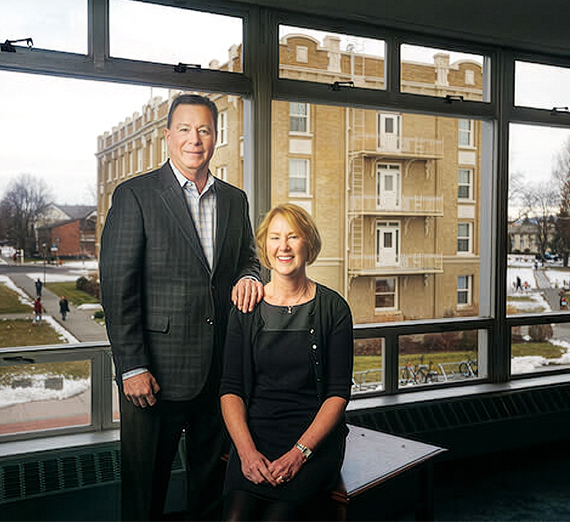
Mark Casey (’72, ’75 J.D.) had one request.
He and his wife, Kathy (’73), had already told their Gonzaga story. More than a decade ago, they sat for an interview about the University, their lives together and their decision to include Gonzaga in their estate plans.
He didn’t want to tell the same story again. Fair enough.
Because the more interesting question now isn’t how the Caseys came to Gonzaga University. It’s what, after all these years, they believe a Gonzaga education should send into the world.
For Mark, the answer has something to do with listening.
“I’ve learned to listen more than to speak,” he says. “You learn more by listening than you do by speaking.”
It is a lesson earned over a long legal career. Mark began as a prosecutor, where his responsibility was not simply to argue a position but to weigh facts, hear the defense and determine whether a charge was appropriate. Later, representing injured workers, he spent decades negotiating with people sitting on the opposite side of a case.
The parties did not begin in agreement and that was rather the point. Most cases, Mark says, could ultimately be resolved because people who understood the law and the facts could hear one another out and work toward a reasonable outcome.
That experience helps explain why Gonzaga’s Woodley Institute for Civil Engagement and Humanistic Dialogue caught his attention.
Established through the generosity of Tom (’69) and Nancy Woodley, the Institute is designed to make civil engagement something students don’t simply value, but practice. Through teaching, research, service, public events and community partnerships, the Woodley Institute brings students, faculty and community members together around difficult questions and differences in experience and worldview. Its work creates opportunities for students to strengthen evidence-based reasoning, navigate an evolving media environment and approach disagreement with both empathy and rigor.
When Mark first heard about the idea, its purpose immediately resonated. He imagined a place where people could “share ideas and try to communicate with one another in a non-hostile way.”
The Caseys aren’t imagining a Gonzaga where everyone sees things the same way. They are investing in one where students learn what to do when they don’t.
Mark has had some practice with that, too. For more than four decades, he has been involved with Big Brothers Big Sisters, first as a Big Brother and later in leadership roles that included service on the organization’s national board. His original match lasted 10 years, until his Little Brother, John, graduated from high school and aged out of the program.
The program ended. The relationship didn’t. John is now in his 50s. He still comes to the Caseys’ home for dinner and, Kathy adds, occasionally mows their lawn.
Years of national board service also put Mark at tables with people representing communities very different from his own. Sometimes that meant pushing back when priorities shaped around major metropolitan areas were proposed for communities across the country. Mark represented a region spanning Washington, Oregon, Montana, Alaska and Idaho. His argument was that communities are different; what works in one place may not address what people need most in another.
“Let us work within the system,” he remembers arguing, “but our priorities are a little different.”
Then something happened that sounds remarkably like what the Woodley Institute hopes to cultivate. People listened.
“The ones who would listen could understand the point of view that I was presenting,” Mark says.
Not necessarily adopt it. Understand it. It’s a distinction that matters, especially in the context of the Woodley Institute. Civil dialogue asks more of people than politeness. It asks them to encounter perspectives shaped by experiences different from their own and remain curious enough to understand what might be behind them. Sometimes that understanding changes the conversation. Sometimes it changes the solution. Sometimes it simply makes it possible to move forward together. That is what Mark hopes Gonzaga students will carry with them.
“I may not agree,” he says, imagining what a student might someday say after a difficult conversation, “but we’ve got to move forward.”
For Mark and Kathy, there is something familiar in that aspiration.
Their connections to Gonzaga’s Jesuit tradition are deeply personal. Two of Kathy’s uncles were Jesuit priests, including the late Fr. John “Jack” Evoy, S.J., who led Gonzaga’s psychology department. Mark counts the late Fr. Frank Costello, S.J., professor of political science, among his most important mentors and friends. Mark remembers the Jesuits as educators committed to community and service. Kathy remembers men who brought people together and taught by example.
Decades later, those relationships remain part of their Gonzaga education, along with the impulse to pass something forward. The Caseys have made a five-year commitment to the Woodley Institute at the beginning of something neither can know exactly where it will lead. There are students who have not yet entered its programs, conversations that have not yet happened and lives that may be shaped in ways impossible to measure today.
It’s an uncertainty that doesn’t seem to bother Kathy one bit.
“You start the ball rolling,” she says. “Other people will pick up where we leave off.”
The Caseys already know something about that. When Mark agreed to spend time with a boy through Big Brothers Big Sisters, there was no way to know then that a 10-year match would become a relationship lasting well into John’s adulthood. Mark simply showed up. Then he kept showing up.
Education works much the same way. A professor teaches a student. A mentor asks a question. Someone creates an opportunity and someone else enters it. What one person receives becomes something another may someday inherit.
“Mark and Kathy Casey’s generosity does so much more than simply provide funds to support civil dialogue programming for students,” says Director of the Woodley Institute for Civil Engagement & Humanistic Dialogue and Associate Professor in the Department of English Katey Roden, Ph.D. “In their attention to the role that listening plays in discourse across difference, the Caseys are shaping Woodley Institute programming to reflect core principles of Ignatian dialogue. Being slow to speak and quick to listen provides pathways to truly hear differing perspectives; listening well is essential in the work of coming to a common ground or establishing respectful opposition. As the inaugural director, I’m grateful for the intergenerational care Zag alums are offering brand new Zags; these are the kinds of foundational gifts and inspiring guidance that will help us build the Woodley Institute into a space for Zags to build community and repair rifts in an increasingly polarized world.”
President Katia Passerini, Ph.D., feels strongly about the Woodley Institute’s impact and expressed gratitude for the Caseys’ gift, saying, “I am so thankful for Mark and Kathy’s generosity to help fund Dr. Roden’s vision for the Woodley Institute. At a time when our society urgently needs people who can engage across differences with curiosity, respect and courage, this work could not be more important. The Woodley Institute, supported by gifts like this, will truly distinguish Gonzaga as a leader in this area.”
The Caseys have spent decades participating in that exchange through education, advocacy, mentorship, service and philanthropy. Their support for the Woodley Institute simply sends the ball in a new direction. Someday, a Gonzaga student they will likely never meet may find themselves across the table from someone who sees the world differently.
Maybe they’ll remember to listen before speaking. Maybe they’ll become curious about what shaped the other person’s thinking. Maybe neither will change the other’s mind. Perhaps, thanks to the Woodley Institute and support from people like Mark and Kathy, they’ll find a way forward anyway.
Mark and Kathy Casey started something they hope others will carry forward, too. Your support can expand the Woodley Institute’s opportunities for Gonzaga students to practice civil dialogue, encounter different perspectives and engage some of the most difficult questions facing their communities.
If you are interested in supporting the Woodley Institute, please contact Jeff Geldien, vice president of University Advancement, at geldien@gonzaga.edu.
Written with AI editing and stylistic assistance; reviewed and approved by Gonzaga University staff.