Medical Students Help Refugees Navigate Health Care
Navigating the maze of the U.S. health care system is often confusing, especially for non-English speakers who face significant hurdles.
The anxiety of an emergency room or urgent care visit is amplified when a language barrier impedes providing your health history.
In Spokane, students from the University of Washington School of Medicine saw the need and found a way to help. In 2010, they formed Clinical Refugee Navigators (CRN), a service group aimed at removing health care barriers for immigrants.
Recently, the group hosted a Patient Passport Day in collaboration with Refugee and Immigrant Connections Spokane (RICS) and other community partners, including Gonzaga University nursing students.
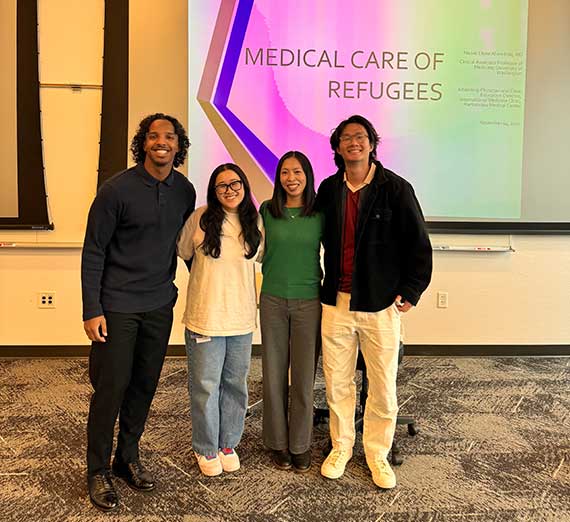
Led by second-year UWSOM students Alyssa Ong, Will Sham, and Zakriye Mohamed, the Refugee Clinical Navigators welcomed Spanish-speaking and Russian/Ukrainian-speaking community members to the UW-GU Health Partnership Building.
Refugee and Immigrant Connections Spokane spread the word in the immigrant community and provided translators and refreshments.
The aim was to assist immigrants in documenting their medical histories in a patient passport, which they can present to healthcare providers when a translator is unavailable.
Zakriye Mohamed understands the difficulties refugees face.
"My mother fled the ongoing civil war in Somalia," he said.
He was born in Ohio and grew up in Kent, Washington.
"We were low in income, but rich in love," said Mohamed. "Because my mother is a refugee, I know the experience firsthand. There's a lot of distrust for the medical community."
He'd never considered a career in medicine until a high school field trip to the University of Washington School of Medicine opened his eyes to the possibility.
"The idea of medical school seemed so out of reach for me, but that field trip made it seem real. That's where the spark happened."
Though medical school is rigorous, Mohamed made time to serve with CRN.
"Giving back is a big part of who I am," he said.
He learned from his mother's example.
"She'd stop and pick up students on our way to school on cold, snowy days," recalled Mohamed. "I was embarrassed, but she'd stop and say, 'It's cold— c'mon, get in!'"
He believes events like the Patient Passport Day significantly help build bridges of trust between refugees and the medical community.
"Being able to describe their medical history in their own language gives them a feeling of control," he explained.
Luis Castillo, assistant director of Refugee and Immigrant Connections Spokane, agreed.
RICS is a local non-profit working to identify and address barriers to the successful resettlement of refugees and immigrants in the Spokane area—UWSOM-Spokane partners with them at Patient Passport Day events and on World Refugee Day.
"The patient passport is a health record blueprint," he said. "It's now available in 15 languages. Each year, we try to specialize in different languages at the event."
UW medical students, assisted by GU nursing students, conducted interviews while working alongside interpreters to ensure patients could accurately communicate their health histories. The goal is to reduce the anxiety and discomfort that often discourage non-English-speaking patients from seeking care.
"We had 50 patients, including kids, this year," said Castillo."The partnership with UWSOM is really special. "They provided a beautiful space for everything. I'm thankful for this ongoing collaboration."
Molly Parker, an assistant professor of nursing at GU, said four of her students helped facilitate the interviews.
"They transcribed via interpreter and were able to ask deeper questions that provided a more detailed health history for the passports," she said.
It was Parker's first Patient Passport Day, and she came away impressed by the collaborative student-led effort.
"My students felt like it was the most hands-on event they've been able to do thus far," said Parker. "They felt like they were able to help and make a difference, and afterward they had a better understanding of the barriers refugees face."
For Mohamed, being part of the Clinical Refugee Navigators group cemented his desire to practice global medicine. He's part of the Global Health Pathway and plans to do an overseas rotation during his fourth year.
"CRN meant a lot to me—working with others who have the same passion made the experience so much better," he said. "I learned a lot from my partners who led the group with me."
Recognizing the hurdles that immigrants must surmount to access healthcare reinforced his career goals.
"I want to help bridge the gap," he said.
ABOUT THE UW-GU HEALTH PARTNERSHIP:
The University of Washington School of Medicine and Gonzaga University formed a Health Partnership in 2016 with a vision to improve health and prosperity throughout eastern Washington by transforming medical education, research and innovation. The combined strengths of each institution – deep community roots and world-class health and medical education – and the vast network of students, faculty and health care professionals is creating an impact by preparing the next generation of health care professionals to advance discovery and develop new ways to care for patients. https://www.gonzaga.edu/uw-gu-health-partnership