
Senior Spotlight: Carolina Gutierrez Rodriguez’s Research Seeks to Turn Teen Trauma into Positive Futures
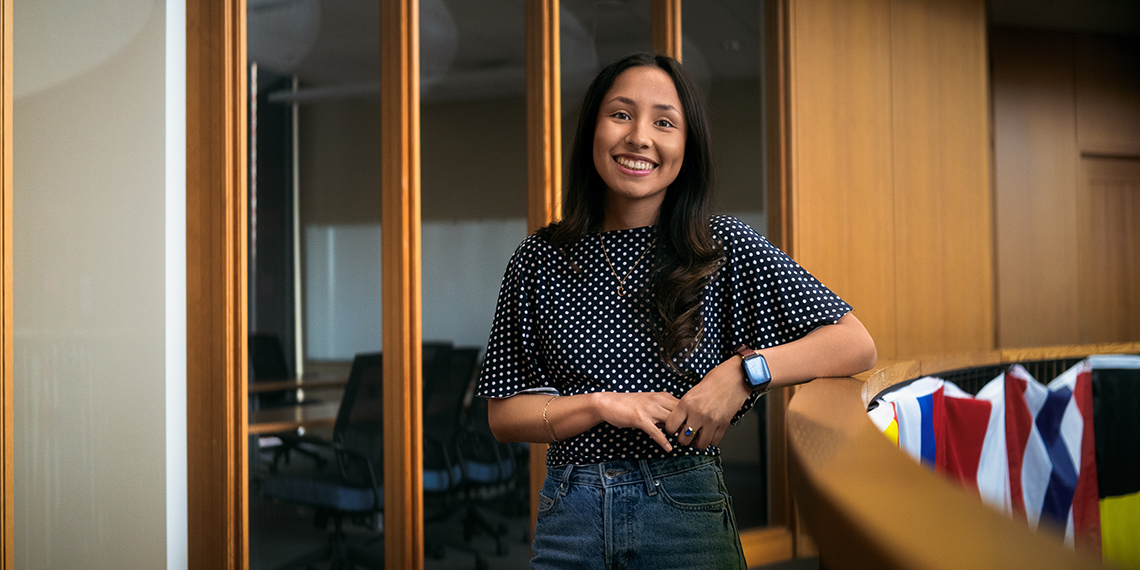
This piece is part of our Senior Stories series, in which we highlight GU students throughout the year.
Name: Carolina Gutierrez Rodriguez
Major: Psychology and Criminology
Hometown: San Bruno, California
College students are destined to influence the future of society, and for some, destiny begins before graduation. Gonzaga senior Carolina Gutierrez Rodriguez (’26) is on track to graduate with a degree in psychology and criminology, steps closer to fulfilling her own destiny. Striving to be an occupational therapist, slowly but surely, Rodriguez is becoming a trustworthy professional.
“I was definitely shooting for the stars when I was little,” Rodriguez explains. “The brain has always been my interest.”
Since the spring of 2025, Rodriguez has taken admirable strides towards completing her senior psychology research project, the capstone to obtaining her psychology degree. She is focused on proving her theory about how adolescent environments have significant effects on their development, acquiring first-hand evidence from a collection of Spokane high school students.
“I am theorizing that students who report higher levels of depressive symptoms, [it] will affect the way they speak about their life story.”
Rodriguez partnered with her psychology professor Mary Kate Koch to assist with her research project. Koch is a Gonzaga alum who returned to the university to teach the holistic care for mind, body, and spirit that Gonzaga embodies. When Rodriguez’s work showed curiosity into the psychology of vulnerable children, battling trauma and poor socio-economic status, Koch opened doors literally and figuratively.
Rodriguez explains, "because Dr. Koch already had the door open to Rogers High School, I was able to hop in with her, and we worked out interviews individually with Rogers’ students.”
It was nearing the end of the school year, so at least 30 restless students at Rogers High School could spare some time outside of the classroom. Rodriguez surveyed these students by asking four major questions:
First, Rodriguez was curious about the student’s high-point memory. This is a memory that, if the student were to write a book about their life, would be the most positive chapter.
Next, Rodriguez was wondering about the student’s self-defining memory. A memory like this could be positive or negative or neutral, so long it defines the student to their best perception.
Then, Rodriguez was concerned about the student’s low-point memory. A negative memory, particularly standing out in the student’s recollection for some unfortunate reason.
Lastly, aiming to redirect the sore subjects of the interview, Rodriguez asks the students one more question at the end: What brings you hope?
By meshing each of the student's memories together, Rodriguez inquires the positive or negative emotions that each student expressed in their responses, particularly examining their word choice.
Rooted from what she witnessed in her adolescent years, Rodriguez’s research is motivated by her experience of growing up in a minority community. Although she appreciates her home of San Bruno, California, Rodriguez is a unique seed that sprouted in a different direction than the peers she played alongside during elementary school.
“I grew up in that same environment and was set on a different path than them,” Rodriguez reveals. “A lot of them ended up with a criminal history or involved in deviant conduct.” Rodriguez clarifies “I do not want my neighbors, whom I once cared for, to be portrayed as delinquents,” and this narrative is one she endeavors to combat within her research.
Appreciating education, Rodriguez was enrolled in an all-girls private high school that consisted of small class sizes and close relationships. Wondering why this was her reality, while her old classmates ran into recklessness, Rodriguez graduated from high school with a mindset full of gratitude, to capitalize off the privilege of education.
Rodriguez senses that professionals can help adolescents anticipate their adulthood and potentially gain mental control over the social schemes they grew a part of.
“My goal for this is for other people to understand that the pathways an adolescent takes are not necessarily their choice, sometimes it is because they had no other resources to branch out and explore other things.”
And Rodriguez’s goals have great potential. After performing the interviews in the spring, she and Koch spent the summer collecting and coding the data to properly reflect on their research. The finish line is near. Rodriguez is typing up the final bits of her manuscript, where she draws connections between her hypotheses and the evidence, finishing the touches of her capstone project.
“Reading everything that's already been done in research and seeing how I can contribute to the field has been a really cool thing,” Rodriguez says.
Rodriguez is hoping for the opportunity to present her research at the American Psychological Association this upcoming spring, an external capstone to her accomplishments as an undergraduate student. But whether it is a prestigious presentation in front of professionals, or a traditional ceremony in front of her professors and classmates, Rodriguez has proven herself beyond a degree. Mary Kate Koch may have been the first one to see her potential, but eventually Carolina Gutierrez Rodriguez will fulfill her destiny, manifesting hardship into stewardship.
- Academics
- Careers & Outcomes
- Student Life
- Faith & Mission
- Health & Wellness
- Diversity & Inclusion
- College of Arts & Sciences
- Psychology