
Forging Belonging in the Law
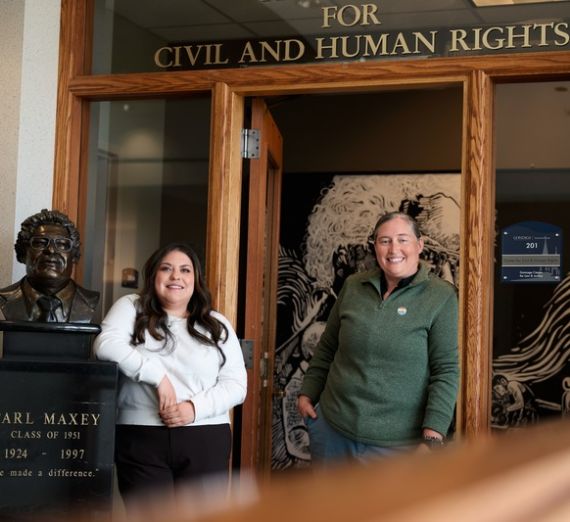
At Gonzaga Law, the Lincoln LGBTQ+ Rights Clinic and The Catholic Charities Immigration Clinic: Client Advocacy offer foundational clinic experiences and more, thanks to the individuals who lead them. For lecturers and supervising attorneys Sarah Harmon (’13 J.D.) in the Lincoln LGBTQ+ Rights Clinic and Vanessa Montoya in the Immigration Clinic, the work is deeply personal and rooted in lived experience. Their clients often come from communities they are part of: Montoya is the daughter of immigrants, and Harmon is a member of the LGBTQ+ community. Both share a persistent awareness that, statistically, individuals with their identities are underrepresented in the roles they hold.
Together, they bring perspectives that are illuminating and urgently needed in the legal field and in higher education. For them, the work is not only about teaching legal skills but also about reshaping who the law serves – and who sees themselves within it – while guiding students to discover their own paths in the profession.
Montoya knew education would be part of her path. Still, when she looked toward the legal profession, she struggled to see herself reflected there.
That absence wasn’t simply about representation – it shaped her sense of belonging. Now, Montoya encourages her students not just to find their place in the legal field, but to actively redefine it.
“The legal field is accessible to anyone,” she tells them. “And you should be able to move into the area that you want.”
She encourages students who share similar identities to her own to release the pressure to choose certain types of work solely because of their background, reminding them that their careers can be as expansive and self-directed as they choose.
“Sometimes, students tell me they feel like they’re betraying their community or family if they choose a path in business law,” Montoya explains. “I can see the weight lift when I encourage them to trust that instinct and to bring their lived experience with them because their perspective is not only valid, it’s something the field truly needs.”
For Harmon, the path to clinical work began in a very different environment: civil litigation. Even there, she felt a pull toward something more community centered.
Since 2022, Harmon has served as director of the Center for Civil and Human Rights and supervising attorney of the Lincoln LGBTQ+ Rights Clinic. In those roles, she has worked at the intersection of law, identity, and systemic inequity. Her students encounter a legal system that, as she puts it, is often stacked against LGBTQ+ individuals.
Harmon’s presence in the classroom and clinic carries particular significance for students.
“For students who are part of the community, they can see me – out and proud – in this profession,” she says. “That visibility creates a sense of belonging that many students have never experienced before.”
For students outside the LGBTQ+ community, the lesson is different but equally important: learning how to advocate as allies within systems that were not built for equity.
“This work – and these identities – very much belong in the law. There is space for them,” says Harmon.
Although each student takes away something unique, Harmon notes that all leave with a deeper understanding of belonging and the challenges faced by LGBTQ+ individuals.
At their core, both supervising attorneys consider it a privilege to train future lawyers. They are committed to creating clinical experiences that are both adaptable and humane; where advocacy is measured not only by outcomes, but by dignity.
“Whether the law will ultimately provide a remedy or not, what often matters most is that clients feel fully heard,” Harmon explains. “They deserve access to legal counsel free from assumptions or limitations, where the advice they receive does not change because of who they are, and where they are respected from start to finish.”
For Montoya, one of the most important lessons students learn is how to support clients in ways that prioritize the client’s own sense of safety and security – even when that looks different from what the student might expect.
“When we relate to these challenges because of our identities or the communities we’re part of, we can think we know what’s best,” says Montoya. “But no one knows that better than the client themselves.”
Even when legal remedies are limited, both attorneys emphasize the importance of empowerment – ensuring that clients feel heard, informed, and prepared. That impact is profound because of who Montoya and Harmon are: advocates who come from the very communities they serve.
Their presence offers something deeply meaningful, not only to their clients, but to the students learning from them – proof that belonging in the law is not only possible, but powerful.