
Then and Now: UW-GU Health Partnership Celebrates 10 Years

Dr. John Gilmer and Dr. Seth Dotson started their medical school education with the UW-GU Partnership in 2016, and reflect on the journey.
Ten years ago, when a group of 60 medical school students started their first year, they became the pioneer cohort of the UW School of Medicine-Gonzaga University Health Partnership. The innovative public-private collaboration launched with a bold vision: to transform regional health through research and education. Together, this alliance aimed at preparing the next generation of health care providers and anchor medical talent directly within the Inland Northwest.
Today, members of that inaugural class are delivering on that promise, providing vital care in communities across the region. As the Health Partnership celebrate this 10-year milestone, its impact is clear as these physicians--having evolved from local students to community doctors—help shape regional healthcare.
John Gilmer: Restoring functionality
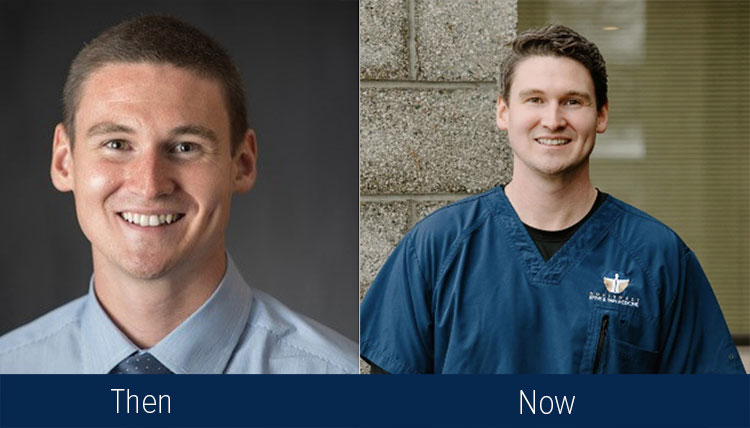
John Gilmer vividly recalls his first year of medical school.
"It feels like yesterday," he said.
Growing up in McCall, Idaho, Gilmer spent enough time at the local community hospital to know that his own future lay in healthcare.
"My mom was a respiratory therapist at the hospital," he recalled. "I grew up there. I hung out at the nurse's station, and they'd take me around to make beds with them. It was old-school medicine with doctors doing rounds while covering the ER."
Gilmer relished the opportunity to attend the UW School of Medicine in Spokane.
"It was a perfect location," he said. ""It was seamless—a great experience. I got to ski and mountain bike in my free time!"
He also enjoyed the University of Washington School of Medicine's multi-state medical education program (WWAMI), serving Washington, Wyoming, Alaska, Montana, and Idaho.
"During clinicals, I was in every state except Alaska," said Gilmer.
Initially, he thought he'd specialize in emergency medicine because in high school he'd worked as an EMT and firefighter. Working in the ER at Harborview Medical Center on the 4th of July changed his mind.
"I realized emergency medicine wasn't my calling and pivoted to internal medicine," he said. "I had such a great experience in Spokane during my rotation."
He matched into Spokane's Internal Medicine Residency, and that's when he discovered a branch of medicine he hadn't previously considered--Physical Medicine and Rehabilitation (PM&R).
"I saw a lot of patients in the ICU, but didn't get to follow them to see how they did," explained Gilmer.
One patient in particular stood out to him. The patient had suffered a stroke, and he really wanted to be able to say his wife's name again.
When the patient transferred to St. Luke's Rehabilitation Institute, Gilmer followed up.
"I wanted to know where this patient's story ends," he said.
That's when he met PM&R specialist Dr. Greg Carter, learned about the scope of the specialty, and made a lateral move to join the first PM&R residency class at St. Luke's.
PM&R medicine focuses on restoring functional abilities and quality of life for individuals with physical impairments or disabilities caused by injury, disease, or chronic conditions. That's what appealed to Gilmer.
"Those functional goals resonated with me," he explained.
Currently, Gilmer is part of Northwest Spine and Pain Management. He recalled helping an avid fly fisherman whose shoulder pain prevented him from engaging in the activity he loved.
"I do a lot of pain management," said Gilmer. "I work with people who've lost the ability to do something and help them do it again."
He credits his time as part of the first UW School of Medicine-Gonzaga University Health Partnership cohort for providing him with exposure to the many options a career in medicine offers.
"I learned how different doctors solve a problem," he said. "I'm really grateful. It's an invaluable way to gain that knowledge. Now, my mentor from my first year sends patients to me."
Seth Dotson: Investing in the program
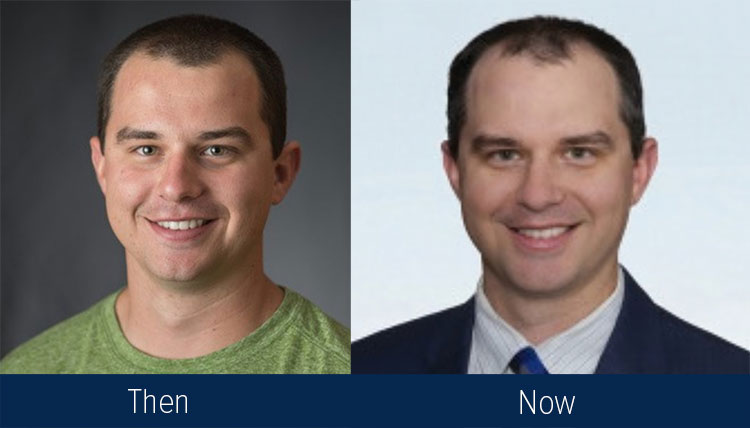
When Seth Dotson arrived in Spokane for his first year of medical school, he wasn't alone.
He and his wife, Hanna, started their education together.
"We met in high school," Dotson said. "I'm a year older, and I waited a year to apply, so we could attend together."
They grew up in Clarkston, WA, and as a kid, his life revolved around sports. He enjoyed playing football, basketball, and soccer.
What he didn't like were the injuries he incurred.
"I kept getting hurt," he said. "I had multiple joint surgeries due to injuries."
The local surgeon who cared for him opened his eyes to the possibilities of a career in medicine.
"He took great care of me, and even came to the hospital when he wasn't working after I got injured in a game," recalled Dotson. "He genuinely cared, and I saw an example of what you can do to help others with challenging life events."
Dotson entered medical school thinking he'd become a surgeon, but early on he discovered that pursuing the correct diagnosis and treatment excited him more.
"I really enjoy the puzzle-solving aspect of medicine."
He chose to specialize in endocrinology and recently completed a fellowship at the UW School of Medicine in Seattle.
"Endocrinology offers a great balance of long-term continuing care and interventive care," he said. "It's an education-based specialty."
Both of his parents are teachers, so educating his patients on how to navigate their healthcare issues feels natural to him.
Dotson works at Rockwood MultiCare, and his wife is a family medicine physician at MultiCare in Liberty Lake.
Their goal from the beginning was to stay in the area.
"Hanna and I did all but two or three of our rotations in Spokane, which was great!"
He's thankful for the bonds they created within their cohort as well as the connections formed with the faculty and the community.
"Our small class size brought us closer together," he recalled. "As the first class, we had an opportunity to help shape the program—we remain very invested in it."
Now, another family member is reaping the benefits of that investment.
"My sister-in-law just graduated from UW School of Medicine-Spokane," he said. "It's fun to hear about the differences in our classes."
Though he attended classes on the GU campus and his sister-in-law in the new Health Partnership building, Dotson is confident the quality of their education remains unmatched.
"UW School of Medicine excelled at getting us into the hospital and getting to see patients early," said Dotson. "They provided great exposure to other physicians in the community. That grounded me in how the books apply and the reasons I was pursuing this."
ABOUT THE UW-GU HEALTH PARTNERSHIP:
The University of Washington School of Medicine and Gonzaga University formed a Health Partnership in 2016 with a vision to improve health and prosperity throughout eastern Washington by transforming medical education, research and innovation. The combined strengths of each institution -- deep community roots and world-class health and medical education – and the vast network of students, faculty and health care professionals is creating an impact by preparing the next generation of health care professionals to advance discovery and develop new ways to care for patients.