
Then and Now: A Hoot, Boot and a Holler
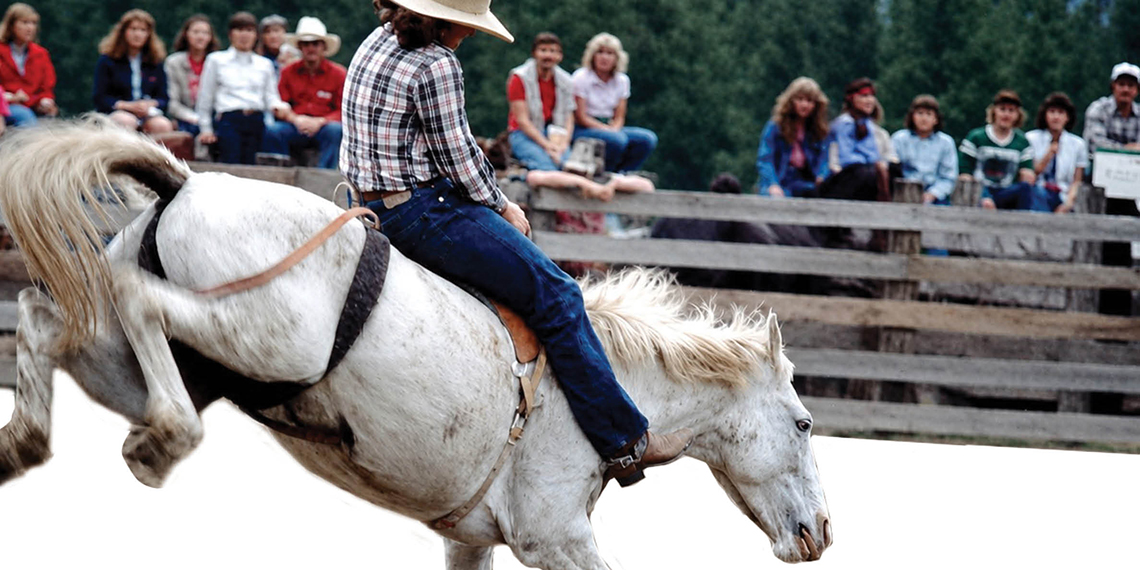
In fall 1982, Adam Caballero and Mark Musgrove, former Brophy College Prep classmates from Phoenix, were sitting in the Associated Students of Gonzaga University (ASGU) office talking about Aprilfest and ways to add more life to Gonzaga’s annual rite of spring. Then, Caballero recalls, the light came on: “How about a rodeo?”
What could go wrong?
Musgrove, then ASGU’s activities vice president, had a modest budget and the authority to put it toward student programming.
The pair pitched the idea to Dean of Students Sue Weitz and her office manager, Marilyn Nelson, and the plan quickly gained momentum. Nelson loved animals and raised horses. Weitz thought it sounded like exactly the kind of spirited, memorable event students would rally around.
They did.
Still, turning a brainstorm into a rodeo took plenty of work from a small crew. Musgrove handled the administration. Caballero was the gofer. Nelson knew the people who ran Dial-A-Horse stable and arena near Riverside State Park, and they, in turn, knew the stock contractors who could provide the bulls, horses and goats needed for a beginner-friendly rodeo: young, slow, mild-mannered animals in training rather than the rank stock seen in big-time arenas.
Dial-A-Horse, Caballero says, “really helped us out with logistics,” from setting up the arena and providing bleachers to hiring a rodeo announcer and staging two days of practice for student participants, most of whom had never been on a bronc or bull. “They even tilled the rodeo grounds and added some sawdust to soften the blow of being bucked off.”
The first rodeo in spring 1983 was the pilot with few participants and scant spectators.
“But they showed they could do it,” says Arnie Mondloch, ASGU president from 1983 to 1984. By the second year, it was gaining steam.
To help cover costs, student organizers secured $500 donations from both Joey August Distributors and the local Budweiser distributorship.
Weitz helped students obtain a Lloyd’s of London liability rider, the add-on insurance policy they needed for the one-day event. Parents came partly for the fun and partly to be sure their children were not biting off more than they could chew. Over the rodeo’s 25-year run, Weitz and Caballero recall, only a sprained wrist and a sprained ankle marred an otherwise joyful tradition.
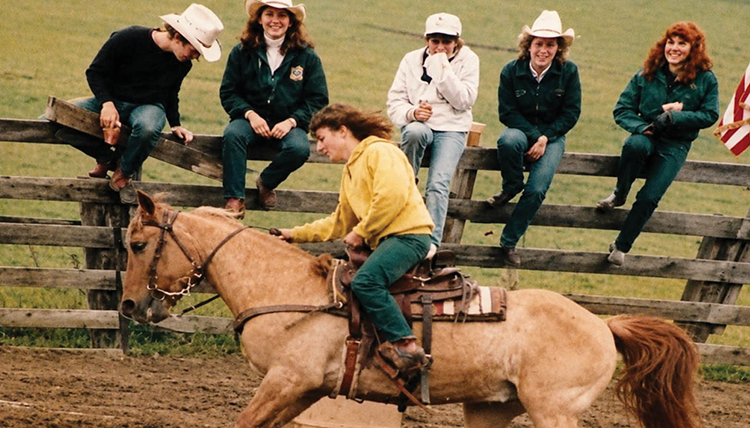
Organizers made sure women students were represented. Of the six events – bull riding, bareback riding, steer wrestling, wild cow milking, barrel racing and wild goat-tail tying – the latter two were specifically for women.
For Caballero, one of those events became life changing. “I met my wife, Christa Leigh, in the wild goat-tail tying competition,” he says.
As Leigh prepared to compete, she looked over at Caballero along the rail and told him, “I don’t have a ribbon.” He tossed her the bandana tied around his cowboy hat. A couple of days later, she returned it washed and ironed, and they began dating. Leigh (’85) worked as assistant buyer for The Bon Marche “Cube” department, and for the past 22 years as teacher’s assistant at Assumption-St. Bridget School in Seattle. The couple have been married for 39 years.
President Mondloch was a friend of the rodeo organizers but had no rodeo experience himself. None of that stopped him from teaming up in spring 1984 with two accounting classmates, friends and roommates “who never backed down from a ridiculous idea.” Together, The Executive Club, as they called themselves, competed in the wild cow-milking contest. Mondloch, from Mankato, Minnesota; Ken Cook (’84), from Saratoga, California; and John Bowers (’84), from Bellevue, Washington, bought suitcoats and ties from Value Village for the competition. Six teams of three cowboys competed at once. At the signal, they sprinted across the arena toward the cows. Teams would grab a rope strapped to the cow, grab the tail, and coax enough milk into a beer bottle to count.
Mondloch grabbed the rope barehanded, burning layers of skin from his palms. In the chaos, he dropped his beer bottle just as the cow went down.
“John yells to the student crowd, ‘Anyone have a bottle?’ and he is pelted,” Mondloch recalls.
Mondloch tackled the cow and the crowd cheered their president for his crowning effort. The Executive Club still finished second, despite the calamity.
“The wild goat-tail tying and cow-milking events were clearly the comic relief between the real events,” Mondloch says.
The rodeo drew many spectators from British Columbia, Montana, Washington and Oregon, but it was especially novel for students from California and elsewhere who had never seen such a rough-and-ready spectacle.
Throughout the event’s 25-year run, ASGU bused students from campus to the rodeo arena. In the early years, a barn party outside Dial-A-Horse featured bands such as Montana’s Mission Mountain Wood Band, free refreshments and rides back to campus.
Eventually, Dial-A-Horse discontinued its service, and moving the event to venues such as the Stateline arena, the Spokane Fairgrounds and other sites created more work than student organizers could reasonably sustain.
“Eventually, interest waned and liability became a pretty significant worry,” Weitz says.
Years later, Caballero visited Nelson in her office, where she had stored safety equipment for student rodeo participants. She reached beneath the pile, pulled out a T-shirt and tossed it to him. It commemorated 25 years of the Gonzaga Student Rodeo. “I was touched to have been a part of it,” Caballero says, “and obviously, so was Marilyn.”
Caballero (’83) is retired from a 40-year career in marketing and sales in energy and utility grid automation and lives in Lynnwood, Washington.
Musgrove (’83) was a longtime owner of Universal Entech, a waste and recycling company in Phoenix. He is now retired in his hometown.
Mondloch (’84) began his career at Arthur Andersen, then spent 21 years at Microsoft, primarily in partner business development. Now retired, he lives in Sammamish, Washington, and serves as vice chair for administration on Gonzaga’s Board of Regents.
- Alumni
- Alumni
- Gonzaga Magazine