
Reflections from Mussel Camp
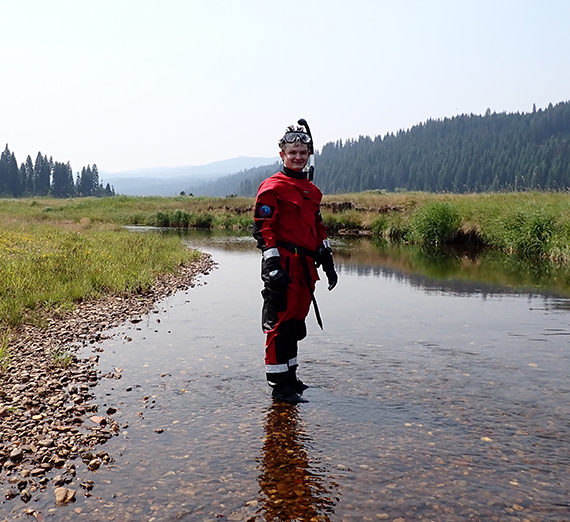
My name is Will Gillick and I am a senior studying biology with plans to go to medical school. I worked as a research assistant at the Current Archives Lab and got to snorkel for native freshwater mussels under the mentorship of Professor Jens Hegg. We study the hard part of the shell on freshwater mussels to learn about the animal’s life history.
A highlight of this summer was snorkeling in local rivers to survey the freshwater mussel populations. We snorkeled in the North Fork Coeur d’Alene River, the Little Spokane River at Waikiki Springs, and the Red River and American River in Idaho to look for native western pearlshell, western ridge and floater freshwater mussels. We spent three nights at Mussel Camp, hosted by the Xerces Society, where we found close to 6,000 western pearlshell mussels in a 50-meter stretch of the American River in Idaho.
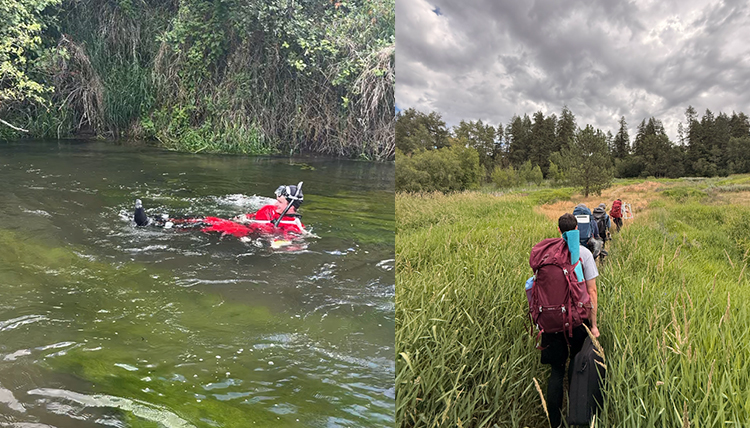
At camp we learned about mussel ecology and river restoration projects aiming to add habitats for native species like mussels and trout. Since mussels are filter feeders and help keep rivers clean, it was encouraging to find so many mussels at Mussel Camp. Although finding 6,000 mussels in a short section of river is an anomaly for today’s standards, restoration projects hope to make that abundance more common again since native mussels keep rivers healthy. I spent most of my time in the lab learning about how the hinge between each shell of a mussel grows throughout its lifespan. A mussels puts down dark lines every year of its life, and the space between each line can tell us how much the mussel grew that year.
Along with snorkeling for mussels, I worked on data visualization of MicroCT scans of Sawfish rostral teeth. Sawfish have a protruding rostrum on their face which has teeth that stick out sideways. Sawfish look like sharks but they are actually rays, and their rostral teeth and the teeth in their mouth look different and serve different functions. From the scans of the rostral teeth, we can see tubules that grow with the fish, and since they grow with the fish, we can use those tubules to learn about the life-history of sawfish! I used R, a programming language, to graph the number of tubules in each tooth. It was a nice full-circle moment, since I'd first learned to code in R just last semester in Biological Data Analysis, taught by my mentor, Dr. Hegg. Getting to apply that skill to real research data made the skills I learned in class really stick in my memory.
I came into this summer hoping to get better at working through a problem methodically, which I got to do as I wrote code to graph tubules and squinting at hinge lines under a microscope. I'll most remember floating face-down predicting if there would be mussels under a cool looking log.