
Powering the Future with a Master's in Transmission & Distribution
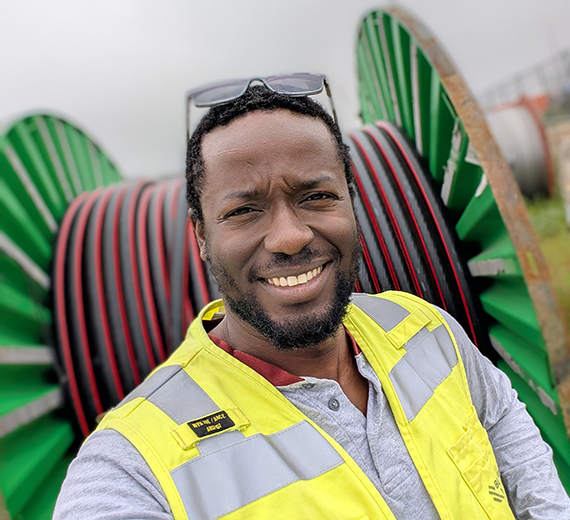
From rebuilding power grids after Category 5 hurricanes to balancing full-time consulting with rigorous coursework, Dexter Hypolite shares how Gonzaga’s flexible online Master's in Transmission & Distribution (T&D) program provided the tools, research capabilities, and community needed to lead in a rapidly evolving power industry.
What do you currently do for work?
I am currently a Senior Project Engineer and consultant at Burns & McDonnell. With 15 years of experience in the power industry, I specialize in overhead and underground distribution design, grid resiliency, and project management. My recent work includes recent work focuses on leading high-capacity projects to design, procure and construct distribution connections to mission-critical facilities.
Why did you decide to return to school for a master's degree?
Returning for my Master’s was both a personal and professional mission. Personally, it was a goal I set for myself years ago. Professionally, I wanted to use the program as a platform to mentor others. Having navigated the reconstruction of the grid following two Category 5 hurricanes, I felt a responsibility to share those unique stories of rebuilding with resiliency and to help shape the next generation of engineers.
Why Gonzaga and why the Master's in Transmission & Distribution?
After facing rejections from graduate programs immediately following my undergraduate studies in 2011, I spent a decade gaining field experience. When I applied to Gonzaga ten years later, the M.Eng. in Transmission & Distribution was the perfect fit. It allowed me to maintain a healthy work-life balance while remaining deeply focused on the industry I am passionate about.
What skills did you develop in the program that you use in your career?
The program sharpened my ability to conduct high-level research and deepened my familiarity with complex industry standards like NESC, IEEE, and AEIC. One of the most valuable aspects was learning to perform rigorous hand calculations to verify software outputs—a skill that ensures accuracy in my daily design work. Additionally, networking has been invaluable; I remain in close contact with several professors and colleagues.
What are the challenges for the power industry and how did the program help you meet those challenges?
The industry is currently grappling with skyrocketing power demand, supply chain delays, and a significant loss of institutional knowledge as experts retire. Gonzaga’s program prepared me to address these by teaching me how to perform advanced engineering calculations to ensure the grid can meet future demands. It also provided a framework for strategic utility planning and risk management, which I use to guide young engineers through the project lifecycle.
What does the future of power look like to you?
The future is bright but will remain challenging as we modernize our infrastructure. For me, that future involves a heavy emphasis on mentorship. I plan to eventually transition into teaching because I believe it is vital to transfer knowledge and field experience back into the academic world.
What has your return on investment been?
The ROI has been significant across the board. Professionally, it has provided the credentials needed to eventually serve as an adjunct professor, potentially when I meet my career and personal goals. Financially, I was supported by both my employer and financial assistance from Gonzaga. However, the greatest return has been the long-term professional relationships I’ve built across the industry.
How was your experience with the faculty?
The faculty were exceptional. From my first year, professors were incredibly responsive to my questions. The fact that many of them still keep in touch with me today speaks volumes about their commitment to student success beyond the classroom.
How did the online program allow you to balance school with work and life?
Flexibility was essential. I was able to manage my coursework during my lunch breaks and in the evenings, using the weekends to catch up on more intensive tasks. This structure allowed me to continue my full-time responsibilities as a Project Engineer while successfully completing my degree.
What advice would you give to anyone considering Gonzaga's T&D program?
Pace yourself. Look at the curriculum ahead of time and plan your courses so you aren't overwhelmed during busy seasons at work. Most importantly, be active on the discussion boards and network. Always contribute to the discussion board early. These are your future colleagues. I’ve actually met six of my classmates for dinner in various cities outside of graduation; those connections are just as important as the coursework.