
How a Lunch Meeting Sparked a Leadership Movement at Gonzaga
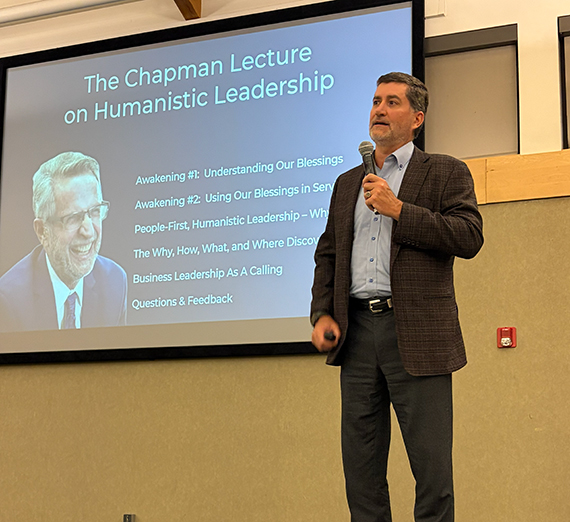
When Gonzaga professors Brian Steverson and Adriane Leithauser walk through Jepson Center, they oftentimes think back to a lunch conversation in 2022 that lasted little more than an hour.
With close to 50 years of experience teaching business ethics at Gonzaga, Steverson and Leithauser have spent most of their careers helping students understand why business should serve people and the common good. Yet they still describe that 2022 meeting with Brian Wellinghoff of Barry-Wehmiller as one of the defining moments of their professional lives.
"I've had three callings in my life," Steverson recalled during a recent podcast recorded at Gonzaga. "The first was to study philosophy. The second was to marry my lovely wife, Adriane. The third happened when I walked out of that room."
That conversation launched what has become a growing partnership between Gonzaga's School of Business Administration and leaders associated with the Truly Human Leadership movement, a philosophy that places human flourishing at the center of organizational success.
The latest chapter unfolded during Gonzaga's annual Truly Human Leadership Week October 12-16, which brought students, faculty, staff and business leaders together to explore what people-centered leadership looks like in practice.
The week included the annual Chapman Lecture, named for Bob Chapman, former CEO of Barry-Wehmiller and the leading voice behind the movement. More than 250 attendees gathered to hear this year's lecturer, Steve Gund, CEO of The Gund Company, discuss how leaders can make human-centered workplaces a reality through everyday actions.
For Steverson and Leithauser, the partnership feels like a natural extension of Gonzaga's Jesuit identity. As Leithauser remarked at the inaugural Chapman Lecture in October 2025, “We were so moved by our first encounter with Truly Human leadership, we knew we had to bring this message and this way of thinking about leadership to everybody at Gonzaga.”
That connection resonates deeply with a University Mission rooted in educating men and women for and with others. It also echoes key principles of Catholic social teaching, which emphasize the dignity of every person, the importance of meaningful work and the responsibility to advance the common good.
For students, those concepts often begin in the classroom. The challenge, Leithauser said, is helping them see what those concepts look like in real organizations.
"We're good at supplying the why," Steverson said. "The how comes from people like you."
That practical perspective was a major theme throughout Leadership Week.
During the podcast conversation, Gund shared how his own introduction to Chapman and Barry-Wehmiller reshaped the way he viewed business leadership. One message stood out.
"Business is the conduit that provides opportunity for people to become who they're meant to be," Gund recalled Chapman telling him years ago.
The idea challenged a generation of business thinking that often measured success primarily through profits and shareholder returns. For Gund, leadership begins with people.
At The Gund Company, he describes a culture focused on helping employees discover purpose, develop their talents and achieve personal growth. The company's organizational purpose is straightforward: "to recognize and serve others so that lives are transformed."
"Our product is our people," Gund said.
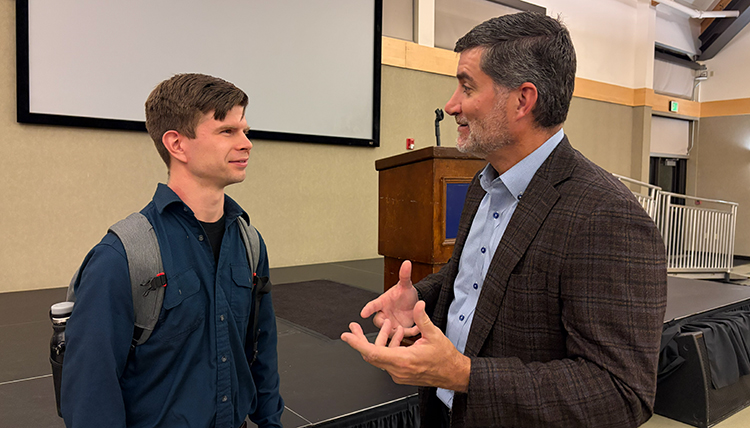 Steve Gund, CEO of The Gund Company, chats with a Gonzaga student after delivering the business school's annual Chapman Lecture.
That emphasis on personal transformation struck a chord with Gonzaga students, many of whom are searching for meaningful careers rather than simply lucrative ones.
Throughout the week, students packed classrooms, participated in discussions and filled the lecture hall beyond capacity for Gund's talk.
"We ran out of seats," Steverson joked during the podcast.
For Gund, the engagement provided a hopeful glimpse of the next generation of leaders.
He believes young professionals are increasingly interested in finding work that aligns with their values and contributes to the lives of others.
"I think this generation is seeking meaning," Gund said. "They're hungry for meaning."
That search for purpose is a topic Gonzaga faculty intentionally encourage students to consider.
In senior-level courses, business students are challenged to imagine their careers as a noble vocation. Faculty ask them to envision what leadership looks like when the ultimate goal is contributing to the common good.
"What would it look like for you to practice it as a noble vocation?" Both Leithauser and Steverson ask their students.
The conversation extends beyond students. Over the last four years, Gonzaga has incorporated aspects of Truly Human Leadership into faculty, administration, and staff development as well, inspired in large part by Steverson and Leithauser's passion for the philosophy behind Truly Human Leadership and their partnership with leaders from Barry-Wehmiller. What began as discussions with students has grown into development opportunities for faculty and staff and administration, creating spaces to explore leadership rooted in trust, dignity, empathy and accountability.
This fall, the School of Business Administration is building on that foundation through Truly Human Leadership Level 2, a new cohort experience designed for faculty and staff who completed the original program. The series will explore trust and psychological safety, dignity, and accountability with care through facilitated discussions and peer-coaching conversations. The program reflects the SBA's belief that human-centered leadership is not only something to teach students, but something to model and practice as a community.
"At the School of Business Administration, we are committed to preparing students not only for successful careers, but also for lives of purpose and service," said SBA Dean Ken Anderson.
As higher education navigates significant change, Steverson believes organizations need stronger relationships, deeper listening and greater trust.
"We need to be able to model it ourselves as a community," he said.
That commitment has helped deepen collaboration between Gonzaga and business leaders who share similar values.
The national visibility generated by the recent Barry-Wehmiller podcast adds another dimension to that work. Featuring Steverson, Gund and Wellinghoff, the conversation highlighted how Gonzaga has emerged as an important voice in integrating leadership, ethics and human dignity within business education.
The events showcase not only a successful lecture series but also a growing network of partnerships, student experiences and leadership development opportunities that continue to expand the reach of Truly Human Leadership on campus and beyond.
Back in Jepson, however, the story still traces back to a simple lunch meeting four years ago. Steverson and Leithauser walked out of that room convinced they had encountered something that aligned deeply with Gonzaga's mission and their own sense of vocation.
Years later, hundreds of students, faculty, staff and business leaders have become part of that conversation. And if Truly Human Leadership Week is any indication, the movement that began around a lunch table is still growing.