
When Serving Others Really Hits Home
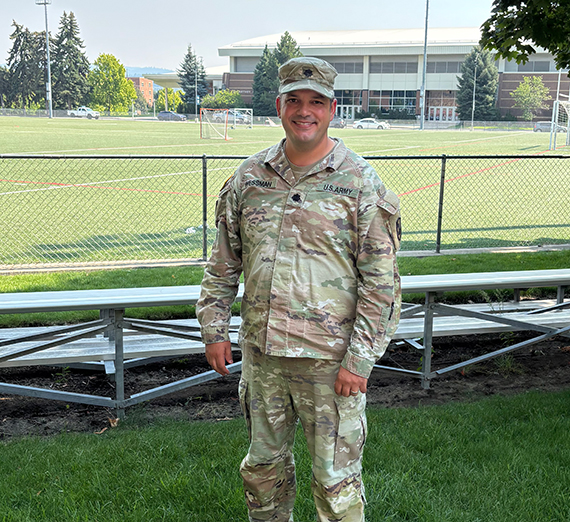
Responding to emergencies is nothing new for U.S. Army Lt. Col. Dan Wessman (’02, ’11 M.A.).
He worked in Baghdad during the Iraq War and continued his service as a leader in the National Guard in the decades since, including in his current role as Homeland Response Force Commander for Region 10 (Washington, Oregon, Idaho, Alaska). In that job, he’s led National Guard “citizen soldiers” into recovery efforts after the massive flooding in western Washington late last year, and worked on the chemical explosion of a Longview paper mill this spring.
When the Spokane wildfires ignited on August 1, Wessman and his team were activated to support the community through a day history will show to be one of the most tragic in the Lilac City’s history. And there’s no question that the job felt a little different for Wessman as he led 250 National Guard soldiers in their work, including nearly 100 housed at Gonzaga in the days after the fires started.
This disaster was affecting his own home, the city where he went to school at Gonzaga, where he worked in University Relations at Gonzaga for a spell, and where he moved back to in 2024 with his wife Missy (’02, previously Carstens) and two daughters.
“We’ve done responses to fires and other disasters throughout the state, but for me and several others, this is the first time that we’re responding here at home,” Wessman said in a conversation a little more than a week since he and his team were deployed to the Spokane fires. “It has a different feeling to it. I don’t know whether it’s pride at being able to help home or what you’d call it exactly. But it definitely has a different feeling.
Making Spokane Home
Wessman calls himself a “military brat” who “grew up all over the world” thanks to his U.S. Army pilot father and a mother who, although a civilian, worked for the Department of the Navy.
Military service was big in his family. His grandfather and his seven brothers all served, as did his dad, his uncle, a couple of aunts and cousins. His own brothers went into the military as well, and one older brother was in ROTC at Gonzaga during Wessman’s senior year of high school. Wessman visited to see his brother graduate and his military commissioning, and after checking in at the financial aid office, he decided ROTC might be a good way to go as he pursued his English degree with minors in history and theatre arts.
His four years as an undergraduate made Spokane “home” for Wessman in every sense of the word. The community he found and sensed growing on campus as the Zags made their epic run to the Elite Eight his freshman year (1998-99) solidified his feeling that he’d found his place.
“Campus had gone crazy,” Wessman recalls. “The community was all over the place. David’s Pizza’s trailer was out there handing out free slices. An ESPN camera filmed through the window of a dorm room over my shoulder of all of us watching the game against UConn. That kind of community – wow.”
Even though he planned to be a teacher, Wessman’s unit was called to Iraq during his four years of active duty following graduation from Gonzaga, and his experience helped him decide that what he actually wanted to do was serve his country in the military. And it was in Iraq that he realized how deeply the lessons learned at Gonzaga were entrenched in his everyday life.
The Home Fires
Wessman’s been working on creating a special unit within the Washington National Guard to address chemical, biological and radiological disasters, realizing whether the soldiers are dealing with a nuclear leak, a wildfire or a flood, the skills they put to work are similar: working with the affected community, engaging the populace, working with local police and fire departments and first responders.
Wessman and his charges have had a busy summer before the Spokane fires; he notes there are Guard members fighting fires in Wenatchee, and Guard aviators in Deer Park flying helicopters and delivering water shots on fires throughout the state.
“The Guard is mobilized, and this is something we’re used to doing just about every summer,” Wessman says. “This summer just happens to be a lot worse than most.”
After the evacuations across Spokane went into effect Aug. 1, Wessman and his team primarily worked at traffic control points, first to help guide people to safety from burning neighborhoods, and then to protect them from entering still-burning areas before the evacuation levels allowed. Then, as many Spokanites were allowed to return to their homes, many Guard members shifted to supporting the Red Cross in building kits of protective equipment, blankets, water and food, and then delivering the kits to neighborhoods.
Wessman’s home is located between where the Old Trails and Fairview fires erupted, but he was able to make sure his wife and children were safely out of their paths before he reported for duty.
“We’ve been working long days. The first day was incredibly long, and there was no thought that, ‘Oh, I should go home, I miss home,’” Wessman says. “I was in the fight and focused on that once I knew my family was safe.”
Working alongside his fellow Guard members, Wessman has seen the incredible outpouring of support across Spokane in the aftermath of the fires. “I have never witnessed so much community support and an outpouring of love and generosity as I’ve seen here,” Wessman says.
Throughout this experience and his career, Wessman finds himself constantly reflecting on the lessons learned at Gonzaga. He says his command philosophy is taken pretty much “straight from the principles of the Jesuits,” with a focus on loving oneself and loving one’s neighbors.
“I talk about that routinely with my guys,” Wessman says. “You have to know who you are, and you have to know who they are, to be able to truly love and support the folks in your command.
“I draw on the skills I learned at Gonzaga all the time, every day. It’s such a part of who I am now that it’s hard to single out moments where I say, ‘Yup, that’s from GU.’ It’s just who I am.”