
Handling with CARE: Practicing Discernment Alongside AI

Discussions around higher education and artificial intelligence continue apace across the country and on campus. Gonzaga is fortunate to have thoughtful faculty members, administrators, information technology experts and others leaning into those philosophical and practical debates about how to ensure students use AI purposefully and with care for humanity—if they choose to use it at all.
One of Gonzaga's leaders in AI research is Jay Yang, founding director of the Institute for Informatics and Applied Technology. As part of his work, Yang is currently leading an xAI faculty fellows cohort in exploring how AI affects human formation, student career preparation and Gonzaga's Jesuit Mission. He's also developed a personal practice, C.A.R.E., to help him discern if he's using AI for the right reasons and in the right way.
C.A.R.E. stands for clarity, authorship, reciprocity and effects, with each area including questions to consider, a positive practice, and the potential risks of using AI for a particular project. Yang developed the C.A.R.E. framework through years of studying AI's rapid development and an eye on cura personalis.
"There are many messages out there that equate AI with cheating, that it's all 'fake' or bad, and I think that is fundamentally wrong," Yang says. "There are many kinds of AI technologies, and we as educators have a responsibility to guide and co-learn with students, to be aware of what AI is about and how AI platforms are affecting everything from journalism to accounting, to law, to nursing and so on."
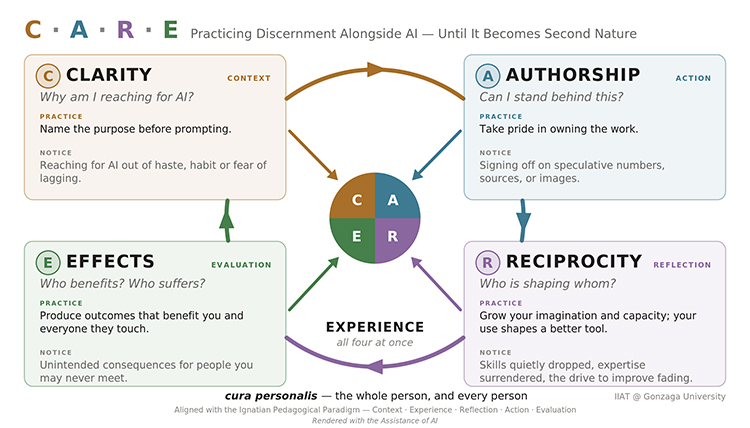
We talked to Yang about his C.A.R.E. framework and how he uses it in his work. This interview has been edited for length and clarity.
Can you briefly describe the CARE Framework and how it guides your own work using AI?
"C.A.R.E." is a practice that I developed for myself when working alongside AI. I want to ensure that I have "C"larity for myself in the purpose of using AI; I am proud of what I "A"uthored with the assistance of or rendered using AI as a technological tool; I can increase my imagination and creativity and positively influence how AI helps me and others in "R"eciprocity; and I proactively looked into the "E"ffect and impact to myself and those I may not be aware of when I use AI.
I created this "practice" because I want to get into a mode where I can unconsciously act in these ways when working alongside AI, and I hope that my children and others can develop a practice like this for themselves. I strongly believe that with such a practice of discernment, rooted in Ignatian pedagogy, we will direct the AI technologies to help us and the humanity be better, achieving a new high on what human can do while taking good "C.A.R.E." of everyone and everything around us.
What are the most concerning issues related to AI and AI policies in higher education right now, in your opinion?
I actually think "banning AI" is a wrong approach, and so is blindly pushing for AI adoption without a carefully thought-out strategy and guidance. The challenge is that higher-ed leaders do not know well enough what the right approach is and there is too much noise around the issue.
In my opinion, it's our educators' responsibility to be brave and learn about the proper uses, advances, limitations and risks of AI (and data-driven technologies in general) alongside students and professionals in our disciplines. Equating AI as a short cut or cheating tool has been a mistake. It tells society how to misuse or abuse the technology instead of promoting the proper use for human flourishing while preserving the environment we care about.
Imagine higher-ed institutions broadly embracing a practice like C.A.R.E. (or something similar) two to three years ago and adopting AI as a Socratic learning assistant where students can practice and brainstorm complex concepts from a variety of viewpoints and connect these concepts across subjects. Imagine a world where professors design learning activities where students are assessed by the process to solve the problem, not the answer or product that is being produced. We can still do it now, but we need to be purposeful and responsibly use AI and other technologies for education and learning, instead of categorically banning or pushing AI for everyone.
What is best way for an institution to reach some sort of consensus on AI's proper use in classes, or in university communications, etc.?
In almost every single higher education institution, there are excellent "best practices" of proper AI uses by faculty and staff. Bring those out into the light. More importantly, the faculty should be charged with their mission to educate students by educating themselves. As a faculty member, we have expertise in our subject area, but more importantly we are supposed to be experts to guide students to learn and thrive. Being adaptive and curious should be in every faculty member's DNA; Let's be brave and eager to learn the good, bad, and ugly aspects of AI and guide our students to be positive contributors to society. This work requires leadership and expertise. I would suggest some kind of interdisciplinary AI council to support a university's leadership, faculty, and staff with recommendations while having the space to do the work and discern what best practices could apply across all areas of the University.
What should the expectations be for students using AI for classes? For faculty and administrators using it in their work?
Purpose, Agency, Learning (PAL) is an education and learning framework one of our own faculty members, Anny Case [professor of teacher education], has developed. It was a key reference for how C.A.R.E. was developed. Essentially, faculty needs to lead the way for purposeful and intentional uses (and non-uses) of AI. Faculty and students can work together to decide what are the proper ways of using AI to enhance learning. Productive struggle is almost a necessary means to learn, not just to know. If we can articulate our purpose, claim ownership and agency, and focus on challenging ourselves to learn and produce work through experiences and processes, we will be fine and we should be able to stand firm on how we use AI to provide value to ourselves and to others. That is why I developed C.A.R.E. for myself, and I want to share it out.
Also, I believe a good use of generative AI is to use it to brainstorm and connecting material from a variety of viewpoints with examples and correct citations. (Independently functioning agentic AI is a whole other conversation). Generative AI can help us connect contexts that we might not be aware of. From there, we learn more, we can produce higher quality work, and we can render with styles that we couldn't easily do or even be aware of before -- all of it done with purpose and agency.
How can the CARE Framework help the Gonzaga community as it, like institutions across the country and the world, wrestles with how to embrace or adapt to AI?
I think first we need to embrace that we are vulnerable and we could diminish our human capabilities if we are not careful. C.A.R.E. Is designed to remind us and force us to practice until it becomes second nature. We and others can create learning activities around C.A.R.E. or a similar practice. At IIAT, we are also developing AI instruction modules that could be downloaded and used to practice C.A.R.E. for our community and beyond. It should be available very soon.