Phage Genomics Course

/GUMainWebsite/Academics/Colleges-and-Schools/College-of-Arts-and-Sciences/Majors-Programs/Biology/pictures/450/450-phage.jpg450-phage.jpg

What is the Phage Genomics Course?

This is a two-semester lab course that will substitute for Cell Biology Lab (fall of sophomore year) and Genetics/Evolution Lab (spring of sophomore year). The lab course is built around a research project to discover and characterize new bacteriophage (viruses that infect bacteria). These phage will infect a Mycobacterium species that is closely related to the bacterium that causes tuberculosis. The students in the course will contribute their data to the National Genomics Research Initiative, a project aimed at discovering the diversity of mycobacteriophage genomes in the environment. The more that is learned about these viruses, the more tools we may have at fighting tuberculosis in the future. The course faculty and one student will present their research findings at a symposium in the late spring.

Gonzaga has been awarded a grant from the Howard Hughes Medical Institute to participate in this project through its Science Education Alliance (SEA). GU is one of about 60 instititutions nationwide participating in the SEA.

Students in this course will acquire hands-on research experience as they:

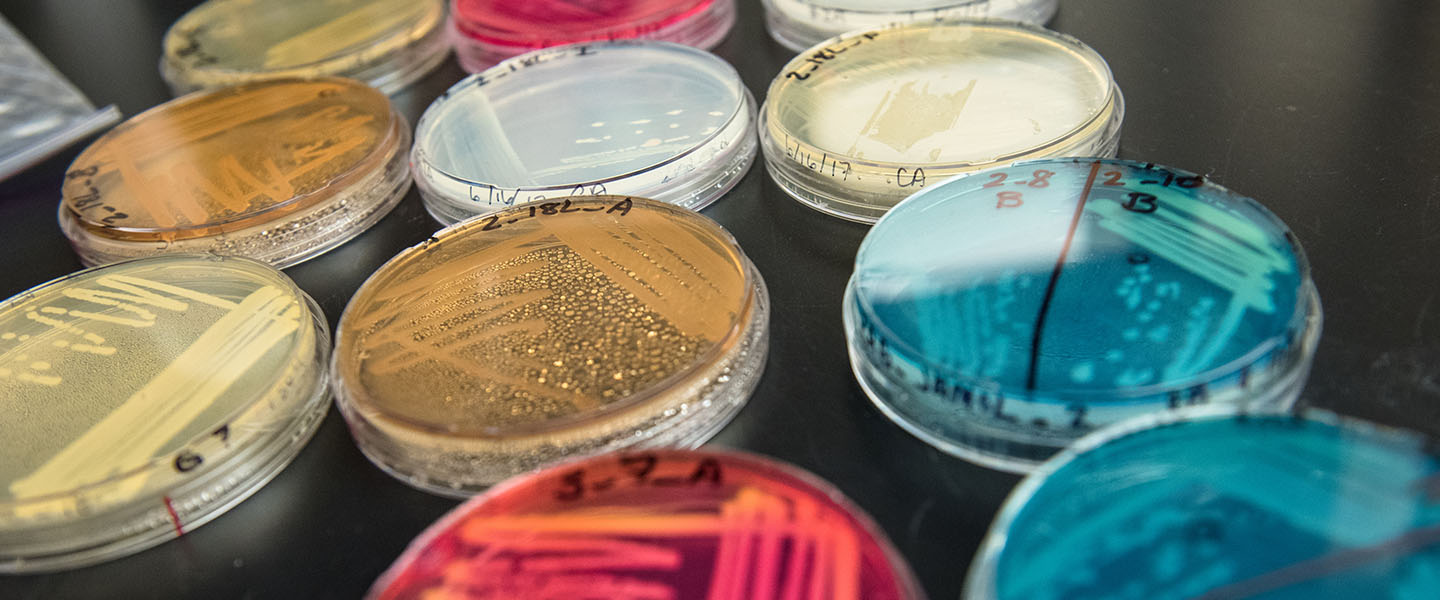
  • isolate bacteriophage from local soilplaques on petri plate
  • obtain electron microscope images of their bacteriophage
  • prepare bacteriophage DNA for sequencing
  • identify and annotate the genes and other elements in the new bacteriophage genome
  • collaborate with other institutions in the Science Education Alliance
  • learn fundamental lab skills in cell biology, genetics, and evolution

phage MannyPSee a student research poster from October 2010, posted in Hughes 1st floor hallway. 

See the genome of the phage GUmbie, annotated by the class of 2010/11, and deposited in GenBank at the NCBI. Our analysis of GUmbie was presented by Samantha Blake at the SEA 3rd Annual Symposium at Janelia Farm Research Institute, June 2011.

See what current students are saying about their experiences.

Does it satisfy requirements for the Biology major?

The course is a 2-credit lab course that meets twice each week for 3 hours. All of the course credits apply to the Biology major. The lab will be taken in place of the normal Cell Biology and Genetics labs. In addition to regular lab credits, students will earn credits for BIOL 498 Directed Research. These credits will count as upper-division biology elective credits. All Biology majors (B.S.) require 18 upper-divsion elective credits to graduate.

Participating students will register for these courses:

Fall
BIOL 201L Cellular Biology Laboratory (Phage Genomics section number). 1 credit. 3 hr/week.
BIOL 498 Phage Genomics Research. 1 credit. 3 hr/week.
Spring
BIOL 202L Genetics and Evolution Laboratory (Phage Genomics section number). 1 credit. 3 hr/week.
BIOL 498 Phage Genomics Research. 1 credit. 3 hr/week.


Why does it substitute for Cell Biology and Genetics/Evolution labs?

Biology students learn a lot of lab techniques, analyses, and scientific writing in the lab courses for Cell Bio and Genetics/Evolution (201L and 202L). These courses help prepare students for upper-division lab courses and for participating in experimental research in faculty labs and summer internships.

Students will also learn a lot of lab techniques, analyses, and scientific writing in the Phage Genomics course. Most of these lab techniques will be the same as those in 201L/202L, learned in the context of the research project. These experiences will also prepare students for upper-division lab courses and for participating in experimental research in faculty labs and summer internships.

Here's a sampling of techniques from both courses:

Cell Biology and Genetics/Evolution             
Phage Genomics
micropipetting micropipetting
sterile technique sterile technique
spectroscopy spectroscopy
bacterial growth bacterial growth
microscopy microscopy
centrifugation fractionation centrifugation fractionation
gel electrophoresis gel electrophoresis
DNA isolation
DNA isolation
scientific writing scientific writing
enzyme kinetics phage microbiology
immunofluorescent staining bioinformatic sequence analysis
assorted team projects evolutionary genomic analysis


Who should apply?

The course is open to all first-year Biology majors who are planning to take Cell Biology next fall and Genetics/Evolution next spring.

You should apply if any of the following apply to you...

  • If you are interested in learning science in a new way.
  • If you are serious about preparing a solid resume for med school or other graduate programs.
  • If you are the type who likes to discover new things.
  • If you like working toward something that will make a difference in the world someday.
  • If you would like to do something that will get you excited about science.
  • If you would like to get research experience, but haven't been hired in a lab yet.


A cohort of 16 students will be selected.

Download the application here.

Application for 2012-2013

Please return by Friday, March 30 to poxleitner@gonzaga.edu

Read more about it.

News about Gonzaga joining the Phage Genomics project

Student experiences in Phage Courses at other colleges

Info from the Howard Hughes Medical Institute, who is sponsoring this project

A description of why biomedical scientists are so interested in bacteriophages these days

Do you have questions?

Please contact Dr. Anders (anders@gonzaga.edu) or Dr. Poxleitner (poxleitner@gonzaga.edu) to talk more about this opportunity.


Phage Genomics Course

Download 2011-12 Application Apps. are due Thursday Mar. 24, 2011.


Phage Genomics Course

Phage Genomics Flyer Download flyer to share with students.


Biology Website

Biology Website Visit Gonzology, the Biology Dept. website.


Click to visit CAS Homepage/GUMainWebsite/Academics/Colleges-and-Schools/College-of-Arts-and-Sciences/inc/logologocopyright/GUMainWebsite/Academics/Colleges-and-Schools/College-of-Arts-and-Sciences/inc/quicklinksquicklinkscopyright /GUMainWebsite/Academics/Colleges-and-Schools/College-of-Arts-and-Sciences/inc/quicklinks-biologyquicklinks-biologycopyright
BIOLOGY DEPARTMENT
502 E. Boone Avenue AD 5
Spokane, WA 99258

PHAGE CONTACTS
Dr. Kirk Anders
Phone: (509) 313-5933
anders@gonzaga.edu

Dr. Marianne Poxleitner
Phone: (509) 313-5547
poxleitner@gonzaga.edu

/GUMainWebsite/Academics/Colleges-and-Schools/College-of-Arts-and-Sciences/inc/contactbox-phagecontactbox-phagecopyright
/GUMainWebsite/Academics/Colleges-and-Schools/College-of-Arts-and-Sciences/inc/menubarmenubarcopyright/