
Arts and Sciences: Laying the Foundation

Arts & Sciences Laying the Foundation

By Robert Prusch
Dean, College of Arts & Sciences

William W. Wang is a test engineer for Micron Technology, Inc. He received his bachelor's degree in computer engineering in 2003. The laboratory experiments and design projects he experienced at Gonzaga helped strengthen his problem‑solving and analytical skills. But it was the core curriculum he received in the College of Arts and Sciences that provided him with the foundation upon which he now lives.

"The education I received during my four years at Gonzaga not only prepared me for the engineering workforce, but it also prepared me to better understand my own life," Wang said. "The professors taught me to make ethical and moral decisions, as I indeed did receive an education of the mind, body and spirit."

Every undergraduate student at Gonzaga gets the same core foundation in the arts and sciences. This includes the crucial thought and expression block of critical thinking, speech and composition. This block is critical because it develops skills necessary for success in their undergraduate tenure and for their eventual role in society. Students also are required to take three courses in both philosophy and religious studies. In the College, students take a wide range of core classes that make up almost one‑half of their total credits toward graduation - ranging from art to science.

Chuck Murphy, Gonzaga's vice president for finance, graduated from GU in 1972 with a business major. He recalls the impact his arts and sciences professors had on him. For example, he had Father Pat Carroll, S.J., for speech, Jerry Kohls for metaphysics and Franz Schneider for poetry.

"I had no interest in poetry, but Franz Schneider made the course," Murphy said. After graduation, Chuck worked in the business world for awhile before coming back to Gonzaga to work. He felt that Gonzaga would be a great place to work, and it has proven to be, said Murphy, now in his 29th year at the University.
"It feels good to participate in a place that can change your life," he added.

In recent years the College of Arts and Sciences has been hit hard by the increases in undergraduate enrollment. As the University's core curriculum is centered in the College, the credit load has increased from 29,509 in fall 1999 to 40,093 in fall 2003. This fall, the University is adding five new full‑time, tenure track faculty in the College, in addition to fixed‑ten‑n and adjunct faculty who have been added over the past five years.

"I often think about what my life would be like if I didn't go to Gonzaga, and that may sound a little dramatic," said Jeff Brown ('94), who works in software for NextIT in Spokane. "But those threads of what this place stands for, and what it teaches people, are the exact same whether you went here 10 years ago, 20 years ago or you go to Gonzaga today."

"Gonzaga has allowed me to grow," added Katie Best, a junior psychology major.

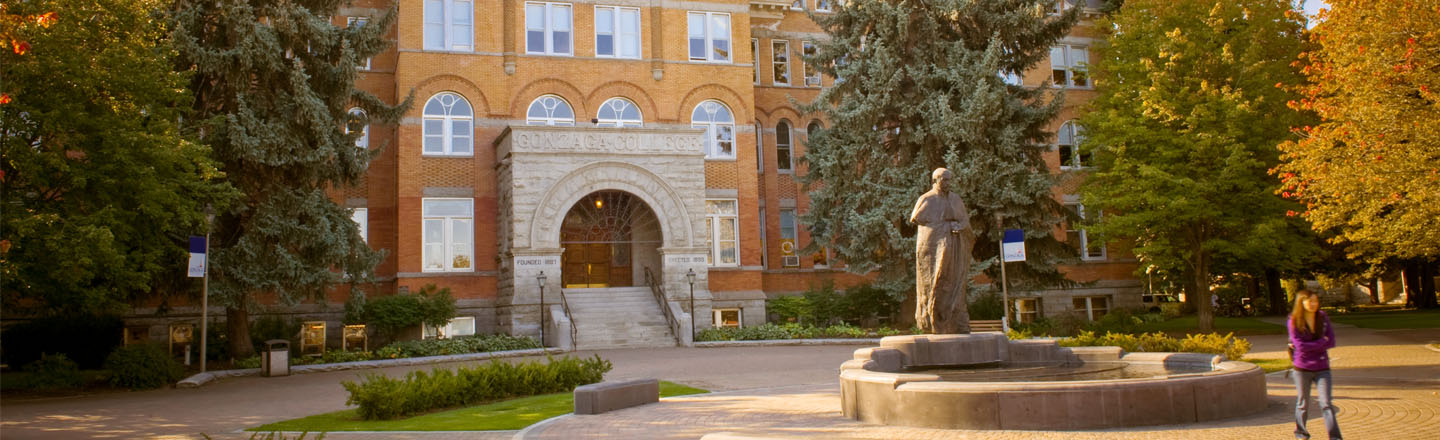
Gonzaga College, founded by Father Joseph Cataldo, S.J., opened Sept. 17, 1887, with seven students and 17 in the Jesuit community. Gonzaga became the College of Arts & Sciences in 1912 with the addition of the Law School.

Today, the College consists of 21 academic units (departments and programs) and has more than 30 degree programs. We have more than 2,800 majors in the College, with 160 full‑time faculty serving our students.

Interactions between College faculty and students are not restricted to the classroom and teaching labs. Students and faculty are engaged in interactive professional activities, as well. Students work with science faculty on summer research projects. Ceramics students work with Professor Terry Gieber to produce works of art, and broadcasting students work with Assistant Professor Dan Garrity to produce on‑campus TV programming.

The College and core curriculum are central to the academic component of our mission at Gonzaga, but there is so much more. Father Hans Peter Kolvenbach, S.J., Superior General of the Society of Jesus, speaks of formation of our students, going back to Ignatius of Loyola addressing the "Common Good" that he reinterprets in the context of "not what our students become, but who they become." In other words, what will our graduates contribute to their communities?

Community service and outreach is another example of our students living the University's mission. Coordinated through the Center for Community Action & Service Learning (CCASL), the College has developed the Gonzaga Indian Education Outreach Program (GIEOP). This program exposes our students to a different culture, and allows them to serve as mentors to Native American students in Wellpinit and Nespelem, north of Spokane. Over 30 Arts & Sciences students engaged in the program last year, with Gonzaga students visiting the reservation schools and Native American middle and high school students visiting Gonzaga.

The scholarly accomplishments of the College faculty are impressive. These include but are not limited to publications, presentations, performances, art shows, etc. Publications range from books, such as Beth Cooley's (associate professor, English) "Ostrich Eye," (for which she won the 20th Annual Delacorte Press First Young Adult Novel Contest), to Sister Mary Garvin's (associate professor, religious studies) "Women and the Spiritual Exercises" (of St. Ignatius). Robert Carriker (Arnold Professor, history) continues with his presentations on Lewis and Clark in the Northwest. Kevin Hekmatpanah (associate professor, music) has performed regionally as a soloist in a number of cello pieces. Mary Farrell (associate professor, art) recently displayed a number of her works in the University of Montana art print collection show.

Students in the College have been equally successful. We have nationally ranked debate and mock trial programs. Students from the College have attended conferences nationwide where they have participated in resenting papers and posters. Our students have gone on from Gonzaga into all areas of endeavor, including but not limited to teaching, business, government, medicine, law and social work as examples. In addition, our students have been quite successful in going onto highly competitive graduate and professional schools after graduating from Gonzaga.