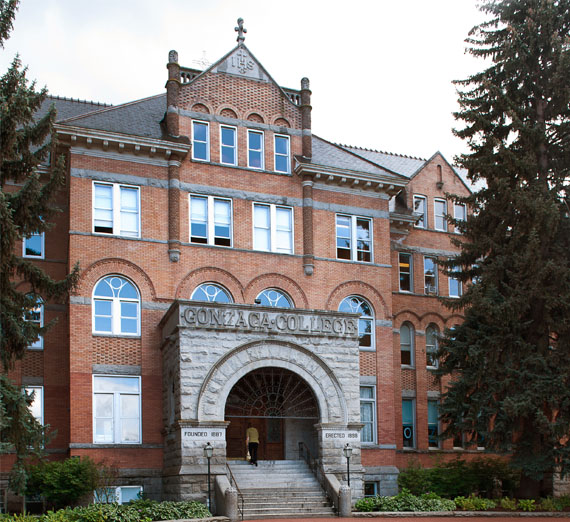
The Passion
Jesuit educated economists are able to analyze economic problems and determine solutions that will have a positive impact on their communities. Knowing the principles underlying supply and demand, competition, and market structures is essential to resolving the socio-economic inequalities that exist today. The study of economics at Gonzaga University provides the student a means of specializing in a social science while at the same time acquiring knowledge and skills useful for any career. Organizations of all types increasingly recognize the importance of having personnel who possess a broad background in economics.
The Program
The College of Arts and Sciences in cooperation with the School of Business Administration offers two majors in economics. The faculty of the School of Business Administration teach the courses in the major field, but students are enrolled in the College of Arts and Sciences and must fulfill its degree requirements. The Bachelor of Arts degree offers students an extensive background in economics for careers in business or government, as well as for advanced study in law or business. The Bachelor of Science degree includes extensive coursework in mathematics as well as economics in preparation for graduate study in economics.
Courses apply economic principles to the analysis of monetary and fiscal policy,environmental problems, taxation and government spending, antitrust policy and government regulation, economic globalization, and labor markets and income inequality.
One of the distinguishing aspects of the program is the involvement of students in economic experiments for both classroom instruction and faculty research.Third and fourth year students with a minimum 3.0 grade point average may do an internship as part of their major and may be eligible for membership in Omicron Delta Epsilon, the national honor society in economics.
The Potential
A variety of career opportunities await Gonzaga economics graduates. Positions exist in profit and non-profit enterprises as well as in government. Gonzaga graduates work as analysts, business news reporters, consultants, and educators.
Employers of Recent Economics Graduates Include:
• Avista Advantage
• Close Up Foundation
• Government of Belize
• Russell-Mellon
• Safeco Insurance
• Spokane Teachers Credit Union
• U. S. Army
• U. S. Dept. of Justice
Gonzaga economics graduates choose to pursue their graduate studies in economics at fine institutions such as Syracuse University, University of Oregon, and the University of California-Los Angeles. Graduates have also entered masters degree programs in business and accounting at Washington State University and Gonzaga University. Many graduates go on to study law at schools such as Georgetown University, Willamette University, and Gonzaga University.
Some students pursue graduate studies in other disciplines, such as international finance at Brandeis University, international relations at Georgetown University, government at the University of Maryland, and architecture at the University of Washington.
The People
John H. Beck, Ph.D., Michigan State University; Professor of Economics, specializes in state and local tax policy, and teaches public finance and history of economic thought. As a member of Washington State's Tax Structure Study Committee in 2001-2002, he becameinfamous as an advocate for a state income tax.
Randall W. Bennett, Ph.D., Michigan State University; Professor of Economics, specializes in sports economics and teaches industrial organization and macroeconomics. With Professor Beck, he co-authored "Taxation, License Fees, and New Car Registrations," Public Finance Review, 31 (September 2003), in which they found that value-based vehicle registration fees discourage people from buying new cars. (Behaving according to their own model of economic behavior, after the repeal of Washington's motor vehicle excise tax, Professor Bennett replaced his 1974 Volkswagen and Professor Beck replaced his 1989 Oldsmobile).
Dan Friesner, Ph.D., Washington State University, Assistant Professor of Economics, specializes in applied econometrics and health economics. Professor Friesner teaches economics and statistics. His research focuses on developing new empirical methods for measuring the quality of health care, and also determining how different factors impact health care quality. He has recently published articles in Health Economics, Applied Economics, and Health Care Management Science.
Kevin Henrickson, Ph.D., University of Oregon, Assistant Professor of Economics, specializes in applied microeconomics and labor economics. Professor Henrickson teaches labor economics and environmental economics. His current research interests include examining the decisions of workers prior to entering the labor market and the effect of those decisions on labor market outcomes.
Matthew McPherson, Ph.D., West Virginia University, Assistant Professor of Economics, specializes in international economics. Professor McPherson teaches international economics, global economic issues, and managerial economics. His research interests include empirical trade estimation and international stock market correlations and predictability.
For more information, please contact:
John Beck, Ph.D.
Director, Economics Program
Gonzaga University
Spokane, WA 99258
(509) 313-3429
(800) 986-9585, ext. 3429
beck@gem.gonzaga.edu