
Graduation and Dissertation Guidelines
Official Graduation
Graduation marks the completion of the course of study leading to a Ph.D. in Leadership Studies. Strictly speaking a student is not a graduate of the program until the student’s transcript indicates she or he has graduated. Official graduation, and not the graduation ceremony, is the graduation that counts!
For the purposes of the Doctoral Program, official graduation occurs when the student :
- gives the Program Coordinator the completed and signed dissertation,
- satisfies all of the requirements of the Student Dissertation Checklist including removal of all incompletes,
- and the Program Coordinator (not the student) has gotten the signature of the Dean of the School of Professional Studies.
Up To 19 Students Graduate Each Academic Year
A student can officially graduate at six specified times during the year. During an academic year, June 1 through May 31, Gonzaga University can only officially graduate 19 students. Once the 19 graduates have been reached, students will move to the list for the next academic year. Students needing to graduate during a specific year are responsible for the timely completion of their dissertation and working with their advisor to satisfy the requirements of the Program. The list of students who have officially graduated during the year is public information and is posted. The faculty of the Doctoral Program are committed to our students, recognizes that some students have special timelines, and will work with them on meeting their needs.
Graduation Ceremony
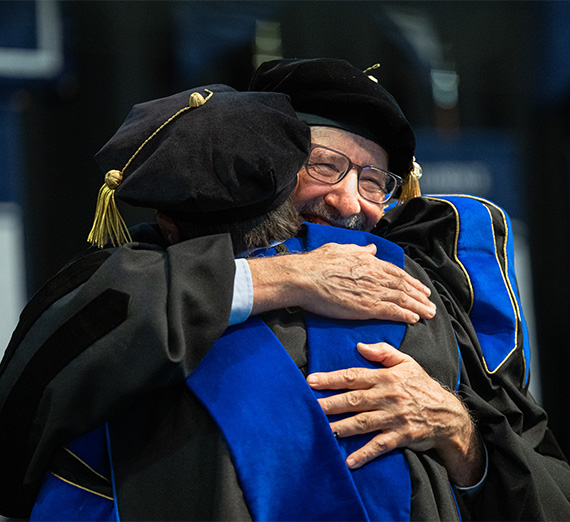
In May of each year Gonzaga University has a Graduation Ceremony. Participation in the Graduation Ceremony is NOT the same as official graduation and the number of students participating in the Ceremony can differ from the number who officially graduate. To participate in the Graduation Ceremony, a student must have:
- a completed and edited draft of their dissertation ready for distribution to their committee by February 1,
- and must have the dissertation signed by their committee by April 15.
Dissertation
The doctorate symbolizes the ability of an individual to plan and conduct research and scholarly work at the highest level. The dissertation should demonstrate a comprehensive knowledge and exceptional attainment of scholarship pertinent to a specialized field of study (Blue book). The dissertation will be published and accessible to professionals and other doctoral students world-wide. The quality of the dissertation represents both the student and Gonzaga University. Given the high standards for the dissertation, it takes much, much longer to write and edit than most students anticipate. It is not uncommon to go through as many as seven rounds of rewriting and editing before the student, the advisor, the other members of the committee, and the Dean of the School of Professional Studies are satisfied.
Dissertation Timeline and Checklist
Detail on these items can be found in the Details on the Dissertation Process Section
Date
Planning
_________ 1. Consider possible dissertation topics
_________ 2. Identify committee chair and submit the Dissertation Committee Selection form (Green Form-sent via email with the Candidacy Status Achieved letter) with signature of the Committee Chair to the Program Coordinator
_________ 3. Sign and submit to the Program Coordinator the Faculty/Candidate Agreement Statement Regarding Dissertation Advising (will become part of Green Form, until then signed statement)
_________ 4. Work with committee chair to focus topic
_________ 5. Work with committee chair to identify other committee members
_________ 6. Network with other DPLS students planning for or working on their proposals.
_________ 7. Identify model dissertations relevant to topic
_________ 8. Begin focused reading on topic (individually directed study)
_________ 9. Use a reference data base such as RefWorks.
_________ 10. Work with committee chair to develop Dissertation Synopsis
_________ 11. Post Dissertation Synopsis
_________ 12 Strongly recommended, take DPLS 728, Dissertation Scholarship and Conceptual Framework Development
_________ 13. Prepare Petition for Proposal Seminar and get Chair’s approval
_________ 14. Take DPLS 730 Proposal Seminar (limited to 7 students)
Proposal
_________ 15. Develop draft of proposal based on Proposal Seminar
_________ 16. Edit by DPLS approved Editor (or student becomes an approved Editor)
_________ 17. Distribute edited proposal to Committee after approval by Chair
_________ 18. Required time prior to Proposal Defense, o working days
_________ 19. Chair receives feedback from Committee and works with candidate on changes needed prior to defense
_________ 20. Candidate and chair set date for Defense
_________ 21. Distribute proposal to Committee
_________ 22. Proposal Defense
_________ 23. Ensure clean copy of Proposal and signed Dissertation Proposal Approval form in student file
_________ 24. Obtain IRB approval-link recommended
Research and Writing
_________ 25. Enroll in dissertation units
_________ 26. Network with other DPLS students doing research or writing their dissertation
_________ 27. Conduct research, begin writing while doing research, stay in close contact with Advisor
_________ 28. Write abstract
_________ 29. Arrange public presentation either before or after signing but prior to submission to the Dean(GU-Seattle Conference)
_________ 30. Edit by DPLS approved Editor
_________ 31. Distribute to Committee after approval by Chair
_________ 32. Required time prior to signing 25 working days
_________ 33. Feedback from committee prior to signing ceremony
_________ 34. Arrange signing ceremony
_________ 35. Revise Draft distribute to committee after approval by Chair
_________ 36. After signing ceremony, Make last minute edits prior to prior to printing on approved paper
_________ 37. Enroll in additional dissertation units of more than five terms
_________ 38. Check with Advisor and Program Coordinator to ensure transcript in order and all bills paid
_________ 39. Submit clean copy and Student Dissertation Checklist to Program Coordinator
_________ 40. After graduation, stay in touch with the Program.
University Application to Graduate
_________ 1. Application to Graduate obtained from Degree Evaluation or online. For March, April, May apply by Nov 15, for June-August and October-December apply by January 23. There is a significant lat fee for missing these dates.
Graduation Ceremony
_________ 1. February 1 deadline for distribution to Committee of edited copy of dissertation.
_________ 2. March 15 First date for signoff if dissertation is distributed to committee on February 1
_________ 3. April 15 Last date for signoff
_________ 4. April 23 Last date for submitting signed copy of dissertation on approved paper to Program Coordinator
_________ 5. Apply to participate in the Graduation Ceremony and order Cap and Gown.
_________ 6. Graduate School Graduation, The day before Mother’s day in early May
Faculty Availability
When classes are in session, all faculty members are available and meet with students by appointment. During certain other times that coincide with breaks in the schedule for students, faculty members are not available to meet with students or to read Candidacy Papers, Proposals, and Dissertations. During these breaks, faculty members engage in professional development and personal renewal.
- May 1 to the beginning of the 6-week Summer Session.
- The end of the Summer session to September 1.
- December 1 to the beginning of the Spring semester.
- Regular Gonzaga holidays.
Students need to keep these times in mind as they plan their schedules. If a student submits a Candidacy Paper or Proposal at the end of the Summer Session, he or she should not expect feedback until early in the Fall Semester.
Responsibilities of the Faculty and the Candidate
This agreement spells out the responsibilities of the Faculty, especially the Dissertation Chair (also referred to as the Advisor) and the Candidate (also referred to as the Student) regarding the important work of developing the dissertation proposal, defending the proposal, and writing the dissertation.
Faculty Responsibilities
As dissertation advisor, the faculty member serves as a mentor to candidates, providing them encouragement and support along the dissertation journey. More specifically, the faculty advisor will:
Converse. Engage candidates in conversations about their dissertation topics that help them formulate meaning and purpose for their research, and help them think about the direction their research might take.
Challenge. Review candidates' thoughts and expressions of those thoughts verbally and in writing, providing feedback that challenges them to think about their dissertation topics and research methods in new ways, encouraging candidates to move beyond their current thinking.
Facilitate Deep Thinking. Assure the dissertation exemplifies "deep" thought concerning the topic in the following areas:
- a. Purpose. There is a clear explanation of the purpose of the study and its social significance.
- b. Knowledge. The questions being asked will expand existing knowledge concerning the topic.
- c. Framework. There is a sound conceptual or theoretical framework explicated that guides the candidate's thinking about the topic.
- d. Method. The research methods chosen allow candidates to answer the research questions and gain new insights about the topic.
- e. Results. The results are presented clearly and represent the data collected.
- f. Findings. The findings or conclusions are based on the data collected and discussed in a way that clearly expands understanding about the topic.
- g. Writing. The writing style and tone throughout the dissertation is scholarly and represents high-quality work.
Review and Provide Feedback. Provide candidates feedback on their written drafts within about 15 working days (see when faculty members are available), unless other arrangements have been made with the candidate. When the due date for comments from the advisor has passed, it is the responsibility of the student to contact the advisor and to follow-up weekly thereafter.
Redirect as Needed. Slow down the dissertation process and revise the candidate's timeline for graduation if this timeline compromises the quality of the candidate's work.
Candidate Responsibilities
The dissertation is to represent the candidate's best work. This means that candidates must take it upon themselves to provide careful thought to each dissertation draft submitted to their faculty advisor. Although each draft submitted will not be "perfect" and there is likely to be more work needed to strengthen the document, doing one's best work at any particular time is important. Not only does this save time for the review process, candidates gain an appreciation for and a sense of personal mastery over their own work.
In working with your dissertation advisor, the candidate is responsible for maintaining a reasonable timeline for completing the research and must be willing to adjust the planned graduation date if more time is needed to complete the dissertation in a quality manner. Either the candidate or the advisor can initiate discussion about the need to change the timeline.
Listen. Listen carefully to the advisor's feedback and be willing to engage in conversation concerning this feedback. If the candidate does not make changes suggested by the advisor, the candidate should explain the reasons why. Pay Attention. The candidate needs to be attentive to thinking and writing and always put forth their best work. All work should represent a logical flow of thought, be clearly written, and carefully edited.
Write. The candidates ensures that the writing meets the requirements of academic writing. If needed, the candidate should be willing to consider hiring a writing coach, one who can help formulate and organize thoughts and put them on paper. In addition to the edits by an approved editor required before the distribution of the proposal to the committee and before the distribution of the completed dissertation before the dissertation signing, some candidates will need to hire an editor or even a writing coach as they work through the dissertation process.
Relate. Dissertation writing and advising is about the relationship formed between the candidate and the advisor. The candidate is encouraged to deepen collegial relationships with committee members throughout the dissertation process. At a minimum, the candidate is responsible for developing, maintaining, and coordinating committee relationships, meetings, and deadlines.
Working with the advisor in a manner that is healthy and positive can reduce stress associated with dissertation writing. If the candidate has a complaint about the advisor, talk to him or her about how to improve the partnership. If this does not resolve the concerns, schedule a meeting with the dissertation advisor and the Chair of the Department or someone identified by the Chair of the Department. It is unprofessional to discuss problems with other faculty members, the Program Coordinator, or others who are not directly involved in the process.
Create. Remember, this is the candidate’s dissertation and not the advisor’s. This means the candidate is responsible for doing the work. The advisor will provide you feedback for improving the work, but it is the candidate who is responsible for making it something both the candidate and Gonzaga University will be proud of. Network. The candidate is encouraged to network with DPLS student colleagues during the process.
Faculty Advising Loads
The doctoral faculty are committed to high-quality, scholarly dissertation and will not sacrifice this quality for a desired graduation timeline.
Insuring Faculty Availability to Work with Candidates by Limiting the Number of Dissertations Per Chair
Because the relationship between the faculty advisor and the candidate is the most important factor in determining the quality and timely completion of the dissertation, faculty members (including adjunct faculty) are limited to chairing no more than four dissertation of students who will graduate in an academic year (June 1 through May 31). Exceeding the limit of four graduates means that the other students working on their dissertations suffer by not having the level of access to the advisor that they deserve. Students need to respect themselves, their classmates, and their advisor by not asking a faculty advisors to exceed the limit of four graduates during an academic year. Advisors work with other students on the planning and proposal stages.
Tracking Projected Timelines
The Program maintains a website with:
- (a) information about where students are in the dissertation process broken down by advisors and
- (b) detailed projected completion timelines of students who have successfully defended their proposal and are in the research and writing stage.
Timeline Planning
When a candidate asks a faculty member to serve as the chair or advisor of the dissertation committee, the candidate needs to provide a desired graduation timeline and to update this information on the dissertation synopsis. The faculty member will talk with the candidate about whether the timeline is realistic in light of the normal time it takes to complete the dissertation in a quality fashion. This timeline is important to faculty members to assure they will not have more than four candidates they are advising who will be graduating in any given academic year. If a faculty member's dissertation load is already "full" for that academic year:
- (a) either the faculty member may agree to be a member of the committee but may not be able to serve as the chair of the committee or
- (b) the candidate may agree to change his or her timeline for graduation to accommodate the faculty member's dissertation load.
The faculty realizes there is some flux in the timelines candidates set for themselves, in that candidates may come to realize that the data collection, analysis, and writing takes longer than anticipated to create high-quality work; or life brings unanticipated events that require shifts in plans. These situations can create a backlog for the faculty advisor, such that the subsequent academic year he or she may be serving as dissertation advisor for more than four candidates who intend to graduate that year. Any exception to the limit of four graduates during an academic year requires the approval of the entire core faculty of the program.
Timeline Changes
If candidates need to change their dissertation advisor because of the advising load of their advisor, efforts will be made to have the new chair be a faculty member who is already on the dissertation committee and is familiar with the candidate's work. In most instances this would mean the candidate would keep the same committee membership, but there would be a switch in who would serve as the committee chair. Candidates will be involved in making decisions about such shifts.
Students who plan the completion of the dissertation and the sign-off in a semester other than the Spring semester will have an easier time. They will avoid the stress of competing for the attention of their advisor when many other candidates are trying to complete their dissertations in order to participate in the May Graduation Ceremony.
Estimated Time for Each Stage
It is the expectation that a student should be able to complete:
- the planning stages of the dissertation in six months,
- the proposal stage in six months,
- and the writing and completion stage in one year.
Students who take more than six months in the planning or the proposal stage or more than one year in the dissertation stage will be asked to remove themselves from the “active” category to make room for another student who is ready. As noted above, students who are ready to advance to the writing and completion stage when the advisor already is working with four students can chose another chair or continue to work on their own and wait for the advisor to have an opening.
Details on the Dissertation Process
Planning
Numbers correspond to items on the Dissertation Timeline.
The Planning stage normally begins with submission of clean final copy of the Candidacy paper and receipt of a letter from the Program that Candidacy has been granted.
- 1. Planning actually begins with a consideration of possible dissertation topic that should have started in DPLS 720.
- 2. Student then requests a faculty member to chair their dissertation committee, gets signature, and returns Dissertation Committee Selection form to the Program Coordinator.
- 3. Within 30 days the student signs and returns to the Program Coordinator the Faculty/Candidate Agreement Form and discusses responsibilities for the dissertation with the Advisor. Eventually this will be added to the Dissertation Committee Selection form. Until then the student signs and dates a statement that they have read, discussed the form with their chair, and agree with the division of responsibilities.
- 4. The candidate works closely with the chair to define and focus the topic, a process that will continue until the dissertation is completed.
- 5. Other committee members are generally chosen in consultation with the Chair. All committee members do not have to chosen at once. The chair and one committee member are usually from the Program. The third committee member can be from the department or form the outside. Outside committee members must have Ph.D. (or equivalent terminal degree.) For outside committee members the student submits a CV to the Advisor who then requests approval of the Doctoral Faculty.
- 6. Completion of a dissertation is made a lot easier with a little help from friends. The Program will look for ways to facilitate social networking among the students at the Planning/Proposal and the Research and Writing stage. Initially this will be involved monthly meetings and opportunities to use the internet to stay in touch. It will be the responsibility of the students to find the support what works for them and to support their classmates.
- 7. As part of the effort to build relationships with the research librarians at Foley and as part of the exploration of topics and ways of approaching them, students should identify dissertations from Gonzaga and other universities that might serve as a model for their work. Begin the habit of recording successful combinations of search words. Remember that students can get electronic copies for free of Gonzaga dissertations completed since 1997.
- 8. Continue focused reading on the topic, while ensuring that full citations, page numbers where material is found, and URL and date access for web pages are recorded. Often students enroll in individually directed study or work independently to produce annotated bibliographies.
- 9. Use RefWorks or a program of your choice for building a database of all references.
- 10. Work closely with the chair to develop a draft Dissertation Synopsis. The Dissertation Synopsis should include:
- (a) tentative title,
- (b) student name,
- (c) date information in synopsis was last revised,
- (d) name of committee chair and other committee members,
- (e) tentative purpose for the study (less than 350 words),
- (f) tentative methodology (less than 350 words),
- (g) relevance to the leadership scholarship (less than 350 words),
- (h) rational for doing the study and answer to the “so what?” question (less than 350 words),
- (i) projected semester for taking DPLS 728 (optional),
- (j) projected semester for taking DPLS 730,
- (k) projected proposal defense date,
- (l) projected date for distribution of edited dissertation to committee, and
- (m) projected committee sign-off date.
-
- By the time of the proposal defense the tentative statements should become more definite. Projected dates become dates completed. Sections e, f, g, and h should not exceed about 350 words each.
- 11. Post the Dissertation Synopsis not later than the beginning of DPLS 728 and keep this information up to date.
- 12. It is strongly recommended that students enroll in the optional course DPLS 728 Dissertation Scholarship and Development of the Conceptual Framework.
- 13. DPLS 728 can be used to develop the petition to enroll in DPLS 730 Proposal Seminar. Additional details on the petition for DPLS 730 are provided below.
- Petition to enroll in DPLS 730 Proposal Seminar
- 13.1 At a minimum the petition includes the following steps:
- (a) 3 to 5 pages of Chapter I,
- (b) 20 to 30 pages of Chapter II, and
- (c) 3 to 5 pages of Chapter III.
- 13.2 The petition should cover:
- (a) a statement of the problem to be investigated and
- (b) the proposed purpose of the study, buttressed with a rationale for its significance.
- 13.3 For most studies the petition should include:
- (a) reference to major issues related to the topic, and
- (b) an indication of unanswered questions.
- 13.4 For most studies the literature review should:
- (a) cover a combination of empirical studies, and
- (b) more theoretical/conceptual studies.
- 13.5 The petition should describe the conceptual framework proposed for the study while realizing that this is likely to change.
- 13.6 The petition should include:
- (a) a brief description of the methodology to be used
- (b) a rationale for this choice, and
- (c) why other methodological approaches have been rejected.
- 13.7 The petition should be prepared using the dissertation template. RefWorks or another reference database system should be utilized when creating the reference list.
- 13.8 The candidate's advisor then reviews the petition and then forwards it, with her or his recommendation to the instructor scheduled to teach to DPLS 730-Proposal Seminar during the term the student wishes to enroll. The instructor for DPLS 730 selects up to seven students to enroll.
- 13.9 The petition should be submitted to the advisor and forwarded onto the instructor at least 60 days before the beginning of the class. Upon acceptance of the petition, the instructor will notify the student who has been accepted and arrange for them to be enrolled. (Note: students cannot enroll themselves in DPLS 730).
Proposal
The Proposal stage begins with acceptance into DPLS 730 (Proposal Seminar) and ends with the successful defense of the proposal. Prior to enrolling in DPLS 730 the student must:
- (a) have been advanced to candidacy,
- (b) have completed or be enrolled in DPLS 722 (Quantitative Data Analysis) and DPLS 723 (Qualitative Research Theory and Design), and,
- (c) have completed the (NIH) training regarding the protection of human subjects,
- (d) and provide a copy of their certificate of completion to the Program Coordinator for placement in the student's file.
- (e) student receives letter from the department chair stating student has achieved candidacy status and is now a doctoral candidate.
14. DPLS 730 (Proposal Seminar) is a required course designed to help the candidate develop and complete Chapter I, II, and III of the dissertation proposal. Prior to commencement of DPLS 730 the student should strive to:
- (a) have a completed literature review, and
- (b) have a comprehensive understanding of what the literature says about the proposed dissertation topic.
15. Upon completion of the DPLS 730 (Proposal Seminar) the desired outcomes include:
- (a) a completed first full draft of the dissertation proposal (Chapters I, II, and III). Prior to Proposal Defense, Chapters I, II, III, will be further refined with ongoing support of the candidate's dissertation chair. The candidate's Defense can be scheduled as early as 30 days after completion of DPLS 730 (Proposal Seminar).
16. Once the dissertation chair is satisfied that the draft is ready to distribute to the other committee members, the student arranges and pays for the document to be edited by a Program approved editor (or the candidate, if the candidate is a Program approved editor).
17. The chair approves the distribution of the Proposal to the other committee members. The candidate contacts committee members to identify which format is desired for review of the draft (electronic, hard copy, or both) and then distributes the draft to the committee.
18. From the date the Proposal is distributed to the committee there must be a minimum of 20 working days before the actual defense. This allows time for the committee members to review the Proposal and to submit comments to the chair. Any committee member may indicate that the Proposal is not ready for defense and recommends more time is needed.
19. The chair considers feedback from the committee and reviews recommendations with the candidate for revisions that need to be completed before the defense.
20. The chair in consultation with the candidate determines the date for the defense. If the candidate is asked to make revisions to the Proposal the committee members must be given an additional 10 working days before the scheduled defense date.
21. The candidate makes the following arrangements to schedule the defense:
- (a) contact Program Coordinator and committee members
- (b) determine room location with guidance from Program Chair
- (c) distribute any additional documents
- (d) ensure that all committee members are available to participate in the proposal defense
- (e) if necessary arrange audio visual equipment for remote contact with appropriate committee member such as speaker phone, web cab, etc.
- (f) secure necessary contact information from committee members if remote set up is appropriate.
Guests are usually not allowed at the defense.
22. The proposal defense process involves:
- (a) a discussion to clarify the study's purpose, conceptual framework, and corresponding research methods
- (b) at the conclusion of the defense, the student may be required to submit an addendum or a substantial rewrite and complete other work either prior to collecting data or at the time the completed dissertation is submitted
- (c) the Chair takes notes on the decisions of the committee and provides the candidate with a follow letter detailing the decisions of the committee members
- (d) the Chair obtains the signatures of the other committee members on the Dissertation Proposal Approval form and gives it to the Program Coordinator for the candidate's file.
- (e) the candidate enrolls in the one credit DPLS 735 (Proposal Defense) course. When a satisfactory grade is achieved the proposal has been successfully defended.
If the candidate has completed all the required credits except for the dissertation credits, the candidate is officially considered to be ABD (All But Dissertation).
23. The candidate may be asked to submit a clean copy for the file. A letter will be prepared by the advisor to serve as a contact between the Program and the candidate concerning what is needed to complete the dissertation and the degree. The candidate is responsibility to work with the Program Coordinator to ensure that these documents are placed into their academic file.
24. At the time of the defense the candidate should provide a draft of their IRB application.
Research and Writing
The Research and Writing Stage begins with successful Defense of the Proposal and ends with submission of the clean copies of the dissertation along the signed Candidate Dissertation Checklist provided to the Program Coordinator.
25. Enroll in 5 credits of DPLS 736, either during one term or spread over several terms.
26. Networking with other DPLS students is even more critical at the Research and Writing stage than it was at the Proposal stage. Since there is no formal class for DPLS 736 interaction with other students is not scheduled and students are on their own.
27. Using the approved Proposal as a guide conduct the research and write up the results. Maintain close contact with the Advisor. Begin writing up the results and conclusions simultaneous to conducting the research. Make sure the final chapter is well developed.
28. Draft the abstract and discuss with the Advisor.
29. Arrange a public presentation on the research. The public presentation must occur before the dissertation is submitted to the Dean. It is the candidate's responsibility to make the necessary arrangements for this required presentation, including announcements. Most public presentations follow the format of a presentation at an academic conference. Participation in the Seattle University-Gonzaga University conference, satisfies this requirement.
30. Have the dissertation edited by a Program approved editor.
31. The chair approves the distribution of the Dissertation to the other committee members. The candidate contacts committee members to identify which format is desired for review of the draft (electronic, hard copy, or both) and then distributes the draft to the committee.
32. There is a minimum of 25 working days between the distribution of the dissertation to the committee and sign-off ceremony. This time allotment provides the committee members time to review the Dissertation and to get back to the chair their comments. Any committee member can indicate that the Dissertation is not ready for sign-off and that more time is needed. Committee members should be informed how much time they have to review the Proposal.
33. The chair identifies how to receive feedback from the committee, what to do with the feedback, and when sign-off can be scheduled.
34. If the candidate is asked to make revisions to the Dissertation the committee members must be given copies of the revisions and have at least 10 working days before the sign-off.
35. The chair in consultation with the candidate, determines the date for the sign-off ceremony. It is the responsibility of the candidate to arrange the room and ensure the committee can attend. If necessary the candidate will arrange audio visual equipment for remote contact with appropriate committee member such as speaker phone, web cab, etc. The candidate will obtain the contact information such as the phone number of anyone who has to be contacted remotely.
There should not be a need for any substantive revisions after the sign-off ceremony.
- (a) The candidate prepares and brings to the sign-off ceremony multiple copies of the signature page and the abstract page to be signed by the committee.
- (b) The candidate should ensure the names of the committee members and their degrees are correct.
Some candidates bring a camera. Guests are welcome to attend the sign-off ceremony.
36. After the signing ceremony, the student makes any last minute edits prior to printing. At least 2 copies of the dissertation are printed on 25% cotton, white paper (SouthWorth fine business Paper or equivalent).
37. If more than 5 terms have passed since the Proposal Defense, the candidate must enroll in DPLS 737 (1 credit) for each term, starting with the 6th, until completion.
38. It is the student's responsibility to:
- (a) request a transcript
- (b) make sure all grades have been turned in
- (a) and to work with the Advisor and the Program Coordinator to ensure that all the course degree requirements have been satisfied.
The student will also want to ensure that there are no outstanding financial obligations.
39. The student submits to the Program Coordinator the clean copies of the dissertation printed on approved paper along with the signed Student Dissertation Checklist. The student needs to double-check the specific requirements for printing and make sure all pages are in order before printing the final copies of your dissertation.
The Research and Writing stage ends when:
- (a) the Program Coordinator has submitted the dissertation to the Dean,
- (b) the Dean has signed it, and
- (c) the graduation is posted to the official transcript.
After dissertations have been sent for binding, it can take as long as four months for them to be returned.
40. After graduation:
- (a) the student is encouraged to stay in touch with the program,
- (b) ensure that the program and Gonzaga University have their current address, and
- (c) be involved in alumni activities of the Program.
University Application to Graduate
1. Application to Graduate obtained from Degree Evaluation Office or online. For March, April, May apply by Nov 15, for June-August and October-December apply by January 23. There is a significant late fee for missing these dates. http://www.gonzaga.edu/Campus-Resources/Offices-and-Services-A-Z/Registrar/Degree-Office/Graduate/appgraduatedegree.asp
Graduation Ceremony Timeline
1. February 1 deadline for distribution to Committee of edited copy of dissertation.
2. March 10 First Day for signoff if edited dissertation was distributed to the committee on February 1. (Minimum of 25 working days from distribution of edited copy of dissertation.)
3. April 15 Last date for signoff
4. April 23 Last date for submitting signed copy of dissertation on approved paper to Program Coordinator. The Program Coordinator will send to Dean for review and signature. The student should never directly contact the Dean’s office concerning the dissertation signature.
5. Apply to participate in the Graduation Ceremony and order Cap and Gown. All students who participate in the Ceremony are expected to wear the Cap and Gown that is ordered for graduation and not the fancier Cap and Gown they will order if they go into academia.
6. Graduate School Graduation, The day before Mother’s day in early May
Editors
At least twice in the process, (a) before the distribution of the proposal to the committee and (b) before the distribution of the entire dissertation to the committee the document needs to be edited by an editor. This will be at the student’s expense. Students are expected to use editors approved by the Program. The program maintains a list of approved editors that can be requested from the Program Coordinator. Students can of course become certified editors.
Support for Students Working on the Dissertation
The Program recognizes the importance of social networking. The Program also recognizes that once the proposal has been approved there is a significant difference in the type of interaction with other students that will be useful.
Students are encouraged to explore social networking programs, figure out what works and then ensure that everyone who is at the stage has opportunity. The program will set up monthly meetings and develop a Google group as a beginning step.
Once students have been accepted into DPLS 730 and until they have successfully defended the Proposal, every month before the first Friday of the month, they need to check in on their status on the DPLS Dissertation Proposal Student Support Google group. The first Friday of each month there will be a pot luck coffee/breakfast at.
Once students have successfully defended their proposal, they graduate to the DPLS Dissertation Student Support Google group. Every month before the first Monday of the month they need to check on their status. They can then join others who are in the area for conversation at a place to be selected.
Institutional Review Board (IRB)
The Doctoral Program in Leadership Studies requires completion of Human Participant Protection Education as a prerequisite for admission to DPLS 730 (effective Spring 2008) and prior to submission of an IRB application for students who have already completed DPLS 730.
The free, web-based course presents information about the rights and welfare of human participants in research. The two-hour tutorial is designed for those involved in conducting research involving human participants. It satisfies the National Institute of Health (NIH) human subjects training requirement for obtaining Federal Funds.
- Select this link to enter the course. Upon successful completion of the course print a certificate of completion from your computer and provide one copy to Marnie Broughton for you file and another copy to Deborah Booth, AD Box 25, Gonzaga University.
- Gonzaga University Institutional Review Board IRB information and forms.
- Official Gonzaga University IRB Consent Form.
- Sample IRB Consent Form on Doctoral letterhead and ready to be completed.
Writing Resources
This section discusses APA, introduces academic writing and provides links to rubrics, templates and guides designed to improve student effectiveness.
Use of APA
- APA Style Guide. The Doctoral Program in Leadership Studies uses the format of the American Psychological Association (APA) as included in the Publication Manual, Fifth Edition. The APA Home Page provides additional information. A Sixth Edition is scheduled for release July 1, 2009.
- DPLS Style Variations. The Program has adopted several changes in APA that are documented in The Guide to Style and Mechanics, also referred to as the Red Book. A spiral-bound hard copy can be purchased by contacting the program coordinator at 509-313-3485.
- DPLS Checklist for Academic Papers. The Checklist for Academic Paper, Candidacy Paper, Dissertation Proposal, and Dissertation identifies some of the most common mistakes make by Doctoral students. Students are strongly encourage to use the checklist to review all papers before they are submitted.
Academic Writing
Doctoral students are expected to demonstrate excellence in academic writing. Gocsik and Becker provide practical guidelines.
- What is a Scholarly Paper? Based on the work of Karen Gocsik, Darmouth and adopted for the Doctoral Program in Leadership Studies.
- Becker, H. (1986) Writing for Social Scientists: How to Start and Finish Your Thesis, Book, or Article. Chicago, IL: University of Chicago Press (available GU Bookstore or BookFinder.com)
Rubrics
Papers are evaluated using three standard rubrics. Students must understand and master the competencies described in the rubrics to excel at scholarly writing.
Templates
Templates are MS Word files with about 25 predefined styles for headers, lists, references, block quotes, etc. Use of styles for headers makes it possible to automatically generate a Table of Contents.
- Template for Academic Course Papers.
- Template for Academic Course Papers and the Candidacy Paper With Table of Contents and Abstract. last updated on 2-12-07
- The Dissertation Template DPLSdiss62.doc
- DPLSdiss62.doc replaces DPLSdiss61.dot and includes corrections on the Title page to make Faculty lower case, adds space after block quotes, and the addition of new styles for the last item in block quote lists: "Block 1.5 List, Last in List" and "Block List, Last in List."
- These new styles add space after the last item in a block quote list.
- The instructions that had been on the first page of the template are now part of the White Book.
- Both the dissertation and the paper template use the same formatting styles.
- The White Book provides DRAFT instructions for use of templates, based on MS Word 2003.
Guides for Academic Papers and Dissertation
- The Paper Format is a guide to the format of an academic paper and is an example of what an Academic Paper or Candidacy Paper should look like.
- But I've Never Written A Dissertation Before: A User-friendly Guide for the Preparation of the Dissertation Proposal and Dissertation (November, 2008). Referred to as the The Blue Book.
- MS Word Version of The Blue Book
- PDF Version of The Blue Book
- Spiral-bound hard copy can be purchased by contacting the program coordinator at 509-313-3485.
Other Resources
- University of Iowa, Introduction to MS Word 2007 Help for moving from MS Word 2003 to MS Word 2007
- Gonzaga University Writing Center The Writing Center strives to serve all writers in the academic community at Gonzaga University. The website of the Writing Center has excellent additional resources.