
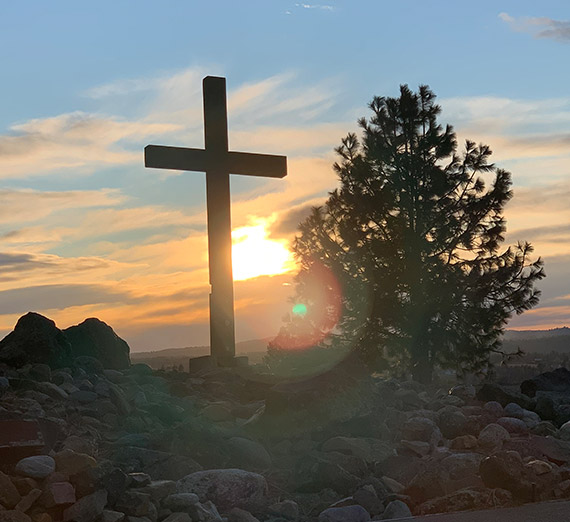
Gonzaga University owes its founding and early formation to Sicilian-born Fr. Joseph Cataldo, S..J. (1837-1928). Chronically frail in health and seemingly unfit for the rigors of missionary life, Cataldo is a figure that continues to amaze and inspire researchers. He first joined his Italian Jesuit confreres in the Turin Province's "Montium Saxorum" Mission in 1865, established himself at St. Michael's Mission among the Upper Spokane's, and quickly became a dominant force in the area. Cataldo was appointed General Superior of the Rocky Mountain Mission in 1877, then comprising eight Residences and thirty-eight active members scattered throughout Washington, Idaho, Montana and Oregon.
The impetus to build a college was born of competition with Protestants for access to various tribes through Congressionally allocated and subsidized mission schools. Cataldo recognized the need for local formation of Jesuits to staff those schools and the central location of Spokane Falls for that purpose. A half-section of railroad land was purchased for a campus in 1881, and by 1886 the venture had both a building and a capable first superior, Fr. James Rebmann. Gonzaga College began its first academic year September 17, 1887 with a Mass of the Holy Spirit, a tradition that continues today. Its Jesuit community totaled seventeen members, nearly a 1:1 ratio with its first student body. For admission, applicants "must know how to read and write, and not be under ten years of age;" in addition to preparatory subjects, an upper level course of studies was also offered. An early decision to enroll only white students indicated that though rooted in the missionary cause, Gonzaga's role was to be at least one step removed from it.
Enrollment rose quickly, helped by the Jesuits' sponsorship of a surrounding Catholic lay community through their legal arm, the Pioneer Educational Society. Day students were first allowed in 1889, and a new frame church and boarding facilities, complete with electricity, were constructed three years later. After weathering the Depression of 1893, Gonzaga's cautious, steady leaders, Frs. Leopold Van Gorp and Paul Arthuis, turned to the task of building a more permanent residence and school. First, Gonzaga was incorporated and legally empowered to grant degrees. Next, requiring two years to complete, a four-story brick structure was ready for use in 1899. Meanwhile they had relocated the church to centralize the new campus; the old school was also moved closer, and the Northwest Jesuit Scholasticate was transferred there from St. Ignatius Mission, Montana.
In their new building at the century-turn, Gonzaga's faculty and staff of 24 stood ready to greet 244 registered students. Both a Classical and a Commercial Course of Studies were offered. The former was subdivided into a Collegiate Department, with Classes in Philosophy, Rhetoric, Poetry and Humanities, and an Academic Department, with First, Second and Third Academic Classes. The Commercial Course, divided into three levels, stressed essential business management skills; it also included a Preparatory Department, with two levels, whose purpose was the instruction of grammar to younger pupils. Extracurricular time could be devoted to a variety of sodalities, a military cadet corps, the band, choir or symphony, debate or dramatic societies, baseball, and though unsanctioned, football. By its fourteenth commencement in 1901, Gonzaga had conferred a total of two Masters and thirty-one Baccalaureate degrees.
The next two decades witnessed steady growth and development. In 1903-4 the main building was doubled in size, adding a swimming pool and gymnasium to students' extracurricular repertoire; in response to a fatal typhoid outbreak, two years later Goller Hall was built, a combined infirmary and Jesuit residence. The original frame church was converted to a theater and relocated again to make clear space for a towering twin-spired St. Aloysius Church, dedicated in 1911. Fr. Arthuis' next great building project was a new Jesuit Scholasticate, Mt. St. Michael's, completed in 1916 and located atop a prominence twelve miles northeast of the campus. New construction ceased during the WWI years, though modest improvements were made to the physics, chemistry and biology facilities. Less visible changes had been happening too, which indicate an increasingly serious academic climate and consolidated student body. In 1910 the quarterly Gonzaga Magazine first appeared, offering students a new outlet for creative expression. The state legislature awarded Gonzaga legal status as University in 1912, the same year its School of Law opened under the capable direction of Dean Ed Cannon. And not only were the scholastics removed to Mt. St. Michael's, but two nearby parochial elementary schools were now absorbing the younger grades.
In retrospect the 1920s seem a boisterous decade at Gonzaga. Football, reinstated in 1907, was now a community passion, and though neither dominant nor ever fully integrated into regional collegiate conference participation, its teams at least became legendary. The spectacles required a stadium, capable of seating twelve thousand boosters; the much loved and abused DeSmet Hall men's residence was also added in 1925. Reflecting the spirit of the times, a School of Economics and Business Education was opened in 1921. A campus weekly, The Bulletin was added two years later, temporarily displacing the more reflective Magazine, which when revived in 1926 was renamed Gonzaga Quarterly. Also reflecting a national trend toward more standardized educational criteria, education classes appeared in the curriculum as early as 1920. Summer intensive courses for teachers began in 1924, and the Board of Trustees established a School of Education in 1928, the special care of Dean Maurice Flaherty, S.J., for its first twenty-five years.
Like the rest of the country, the 1930s and early 1940s were lean years for Gonzaga, and but for the determined leadership of President Leo Robinson, S.J., and a key contribution in 1939, the University might not have survived. Virtually no new buildings were added, though a Graduate School was organized in 1931, the Library modernized in 1933, and a School of Engineering established in 1934, in response to demand created by New Deal-sponsored projects. In 1940 the student body numbered 1200, of whom 500 were either scholastics, nursing or law students. But campus life changed dramatically during the WWII years. A disastrous fire swept through the Law Library and science labs three days after Pearl Harbor. Many Jesuit faculty members departed to become chaplains, and women assumed a more prominent presence. From 1941 to 1945, Dean James McGivern saw his Engineering enrollment drop from 175 to 31 students. The ever popular but expensive football program was finally dropped in 1942. Meanwhile during the same years, nearly 3250 men passed through Gonzaga as part of the U.S. Navy's V5 and V12 training programs.
Due to the G.I. Bill, Gonzaga rebounded during the postwar years, especially the School of Engineering, which was presented with a handsome new building in 1949. Other developments included adding Journalism to the School of Business, a ROTC program, and a radio station. For the first time in its history, Gonzaga's 1948 freshman class included coeds, who would read and soon revise the school's "Credo of the Gonzaga Man." In five years their numbers required the construction of a women's dormitory, soon followed by the "COG," a new Student Union Building. Gonzaga Prep High School was also completed in 1954, which meant that these students were no longer a part of campus life. An Accelerated Teacher Training program was added to the School of Education in 1956, and the following year, a new men's dormitory. The Crosby Library was also dedicated in 1957, an effort initiated nine years earlier by Gonzaga's most famous alumnus, Bing Crosby, then at the height of his career. Finally, another more subtle change was happening throughout the 1950s. At the opening of the decade, Jesuits comprised 45% of the 110 faculty members, excluding the Schools of Law and Nursing; fifteen years later that total had nearly doubled while the relative presence of Jesuits had dropped to 31%.
The energy animating the Second Vatican Council seems to have touched Gonzaga too, for the 1960s opened with a burst of activity. The spirit of the old Gonzaga Quarterly, discontinued since 1937, found new expression in Reflection, which has continued to the present. Two new programs were added, a Masters in Business in 1962 and the Florence (Italy) Study Abroad the next year, and the first issue of the Gonzaga Law Review appeared in 1966, all of which have remained as prominent, popular features of the University. By 1966 there had been a spree of new construction too, no less than seven dormitories, a building for Chemistry and Biology, and the Kennedy Athletic Center, as well as the acquisition of a nearby structure for the Law School. Gonzaga's Jesuit Residence also was replaced in 1964. The following year marked the beginning of a fifteen-year odyssey for historian Fr. Wilfred Schoenberg, S.J., as director of the Museum of Native American Culture (MONAC). Eventually located on the campus periphery, the original museum building now serves as a multi-purpose Conference Center.
In 1974 the Trustees inaugurated Gonzaga's twenty-third president, Fr. Bernard Coughlin, S.J., thus ushering in a critical era of steady growth matched with fiscal stability. He began with an endowment of $6 million and an annual budget of $9.6 million; at his retirement twenty one years later in 1995, the former stood at $50 million and the latter at $71 million, balanced for all but the first two years of his tenure. Meanwhile the student body had increased from about 3000 to 5000 enrollees. Two new programs were formed in 1975, a School of Professional Studies and CREDO, a popular sabbatical curriculum in Religious Studies. In 1978 a baccalaureate in Nursing was added, and a doctorate in Educational Leadership the following year. Existing programs acquired professional accreditation: the Law School in 1977, Nursing in 1983, Engineering in 1985, and Business in 1990. In the process a new School of Business was constructed, and Engineering, as well as the Athletic Center, were expanded. More recently Gonzaga has added a $20 million state-of-the-art library, a building for the School of Education, and a Fine Art Center and Museum. A final event of note, nearly hidden in the heart of the Coughlin era, was the centennial-year formation of the Council for Partnership in Mission. Charged with creating a new statement of institutional mission, the Council is now actively encouraging its integration into all aspects of university life, thus crafting a vision for Gonzaga's second century, in which cooperation between its Jesuit and lay members will need to be redefined anew.
On September 17, 1998, Fr. Robert. J. Spitzer became the 25th President of Gonzaga University, following the interim presidency of a Gonzaga legend, Harry Sladich, and the short tenure of Fr. Edward Glynn. Fr. Spitzer's appointment came at a time when the school needed a leader to continue its reputation for excellence. President Spitzer, a 1974 graduate of Gonzaga, said his primary purpose would be to help Gonzaga enhance its profound mission toward its students and the Inland Northwest.
Just prior to the fall semester of 2000, the Gonzaga University School of Law building was opened on time and under budget. The 110,000 square foot building costing $17.5 million was a vast improvement over the former elementary school, where the law school had resided for almost 40 years.
As Gonzaga entered the new millennium, student enrollment continued to accelerate. In the fall of 2001, there were 5,300 students. Consequently, the University needed additional space for student housing. The following fall semester identical residence halls, Dillon and Goller Halls, were opened to house about 2,050 students. Previously, Gonzaga had constructed the Dussault Apartments (1995), Burch Apartments (1996) and Corkery (2001) to help with the housing crunch. At one point at the turn of the century, Gonzaga leased an addition from a local hotel, which was a popular choice for 82 students.
Major campus improvements were under way in the fall of 2003. No other single year in Gonzaga's history had seen as much campus construction. Some of the construction included: a new 18-foot-wide, red-brick walkway form Astor Street to the Crosby Center; a 37,000-square-foot addition and greenhouse to Hughes Hall; a 30,000 square foot addition to the Jepson Center for the School of Business Administration to be completed in the following fall; a new west wing of Cataldo Hall; remodeling of the Administration Building; and improvements to the COG.
Due to the success of the men's and women's basketball teams, an arena was built and opened for the 2004-2005 season. It was named for the main donors, the McCarthey family. The McCarthey Athletic Center cost about $23 million. In addition to hosting Gonzaga sporting events, the 6,000 seat arena would provide a location for entertainment opportunities, educational events, and meetings. Bill Cosby would be the first, non-sporting event, to perform.
The Kennedy Apartments at Sharp and Pearl streets opened in April 2007. A year previously, the apartment complex was completely destroyed by arson. The 75 unit structure, which housed 220 students, also included a Gonzaga apparel store and coffee shop. The second section to mirror the first complex is currently under construction.
For 36 years, Pecarovich Field, later August/ART Stadium, was home to Zag baseball. This facility was torn down to make room for the McCarthey Athletic Center. While a new baseball stadium was being built at a new location just to the south of the old field, Gonzaga baseball was played at Avista Stadium, home to the Spokane Indians. Named for the major contributor to the project, the Patterson Baseball Complex opened in spring 2007 with the field known as the Washington Trust Field, after another major supporter, Washington Trust Bank. The $7 million facility provided home and visitors' locker rooms, baseball offices, laundry, training equipment, batting cages, and a natural grass field.
In summer 2007, the first group of 42 students went to Africa to serve and learn. Three groups traveled to locations in western and central Zambia and Benin, West Africa. Each group had different priorities, including teaching English, researching chimpanzee behavior, helping to build a school, and teaching villagers how to filter polluted water using locally available materials.
Fall 2007 marked the celebration of the 120th anniversary of the College of Arts and Sciences at Gonzaga University. During Fall Family Weekend in October, the Administration Building was renamed as College Hall. Always having been the home of the College of Arts and Sciences, the building will carry the College's name. The new name now affords a recognized home for Gonzaga's largest and oldest College.
Dedicated on October 6, 2007, the bronze bulldog titled "This is Our House" was a gift of the Senior Class of 2006 . Created by Vincent DeFelice, this 5-foot tall statue guards the McCarthey Athletic Center. Today, numerous Gonzaga students and alumni pose with this iconic statue.
In April 2008, the St. Ignatius Statue was dedicated. Sculpted by George Carlson, the nine foot bronze statue graces the main entrance of College Hall with a reflecting pool and redesigned landscape. This "Meditation" statue represents St. Ignatius' contemplative moment of transformation.
Robert Spitzer, S.J. stepped down as President in July 2009 after serving 11 years. During his tenure, he saw the enrollment increase from 4, 507 in 1998 to 7,319 in fall 2008. He completed a $119 million capital campaign for buildings, student financial aid, faculty enrichment, technology, and mission programs.
Coughlin Hall, a residence hall, opened in Fall 2009 honoring long time Gonzaga President, Bernard Coughlin, S.J. Housing freshmen and sophomores, it has an onsite café, a reception desk staffed for late night hours, parking beneath the first floor, a classroom, a seminar room, and a faculty member lives in the residence hall and coordinates the living and learning activities. Several floors are themed communities, such as Service and Leadership, Global Engagement, and Mind, Body, and Spirit.
Also opening in 2009 the PACCAR Center for Applied Science, was made possible through the lead gift of $2 million from PACCAR Inc. This 25,000 square foot high-tech building houses sophisticated technological laboratories dedicated to robotics, artificial vision, and transmission and distribution engineering, classrooms and offices. In 2010 the building received the LEED (Leadership in Energy and Environmental Design) Gold certification for incorporating sustainability principles into engineering design. The building was recognized for its natural lighting, energy efficiency, and open public spaces.
In January 2010, the Gonzaga Alumni Association moved out of the Crosby House into the Huetter Mansion formerly the Bishop White Seminary. Huetter Mansion, the former home of Bishop White Seminary, was physically moved across Addison Street over multiple days in July of 2008. Academic offices would be housed upstairs in Bing Crosby's former home, while the Huetter Mansion would be restored to its former elegance to host alumni functions and staff.
The new Engineering-in-Florence program started in the spring 2010 with 22 sophomores, most of them GU students. Engineering students would no longer have to choose between studying abroad and completing their degrees on time.
Thayne McCulloh, D.Phil., '89 was inaugurated as Gonzaga's 26th President on October 22, 2010. This marked the first time that a lay person held the position of President at Gonzaga University, which had previously been filled only by Jesuits. Prior to obtaining this position, McCulloh had been with the University since 1990, serving in many roles, including that of interim Academic Vice President and interim President.
Jane Korn became the first female dean of the Law School in July 2011. She replaced Earl F. Martin, who became dean in July 2005 and stepped down to become Gonzaga's executive vice president. Law Professor George Critchlow served as acting dean from 2009 - 2011.
Today, Gonzaga University looks much different than its humble beginnings in 1887. Fr. Cataldo could never have imagined that his school would become such a big business in Spokane. Gonzaga's operating budget for the fiscal year 2011-2012 is almost $235 million with an endowment of over $150 million. Instead of the initial 20 boys attending, Gonzaga now has a coed enrollment over 7,000. Fr. Cataldo's original purchase of 320 acres has diminished. Over time, Jesuit officials sold most of the property to individuals for neighborhood homes. Gonzaga continues to purchase some of that property back to house today's expanding facilities. The campus now includes 105 buildings on 131 acres and a physical plant value of $333.7 million as well as a personal property value of $18.6 million. Instead of 17 Jesuits educating the young boys, today Gonzaga employs over 1,200 people. Consequently, Gonzaga University is one of the major employers in Spokane.
Although physically and financially Gonzaga does not resemble the institution of 1887, Gonzaga has never lost its primary goal. As written in the 1887 catalog, Gonzaga's object is to offer students "the facilities for securing a solid and complete education, based on the principles of religion and calculated to fit them for a successful career in life." For 120 years, Gonzaga University continues to offer a quality Jesuit education to its students.
Compilation of the histories of David Kingma and Stephanie Plowman, Foley Center